
Highlights
- TVT and TOT are mid-urethral sling surgeries that treat stress urinary incontinence by providing support to the urethra using different anatomical routes.
- While both procedures show similar short-term success, long-term evidence and clinical guidelines generally favor the retropubic TVT approach for superior outcomes.
- The two methods carry different complication risks, with TVT having a higher risk of bladder injury and TOT being more associated with groin or thigh pain.
Stress urinary incontinence can make everyday actions such as coughing, laughing, exercising or lifting unexpectedly lead to urine leakage. When conservative treatments do not provide sufficient relief, TOT vs TVT is one comparison patients may encounter when discussing mid-urethral sling surgery. Both procedures are designed to support the urethra, but the route used to place the tape, their complication profiles and the evidence supporting their long-term outcomes are different.
Table of Contents
What Are TOT and TVT Procedures?
TOT and TVT are types of mid-urethral sling surgery used primarily to treat female stress urinary incontinence (SUI).
Stress urinary incontinence occurs when pressure inside the abdomen rises and the urethra cannot remain adequately closed. This commonly becomes noticeable during activities such as:
- Coughing or sneezing
- Laughing
- Running or jumping
- Exercising
- Lifting heavy objects
A mid-urethral sling provides additional support underneath the urethra. Synthetic polypropylene tape is commonly used and remains in the body as a permanent implant.
Although TOT and TVT aim to solve the same problem, they take different anatomical routes through the pelvis.
What Is TVT?
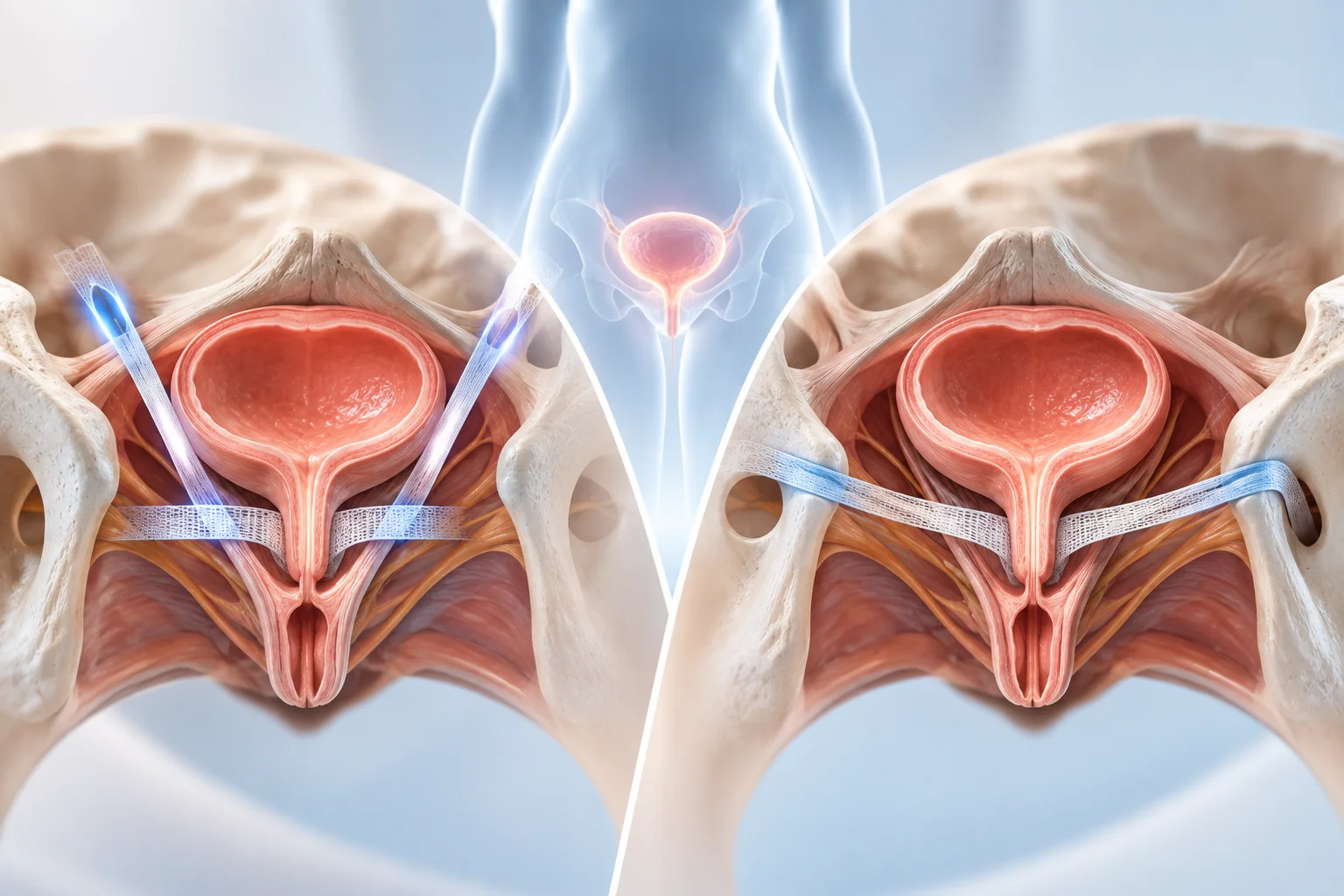
TVT stands for tension-free vaginal tape. In the conventional TVT procedure, the sling passes from underneath the urethra upward through the retropubic space, which is the area behind the pubic bone.
A small vaginal incision is made beneath the urethra, and the tape exits through small incisions above the pubic area. For this reason, TVT is generally classified as a retropubic mid-urethral sling.
The tape is positioned without applying significant tension. Instead of tightly compressing the urethra, it provides support when abdominal pressure rises.
What Is TOT?
TOT stands for transobturator tape. It also supports the mid-urethra, but the sling travels laterally through the obturator region rather than passing behind the pubic bone.
Small incisions are generally made in the groin or inner-thigh region in addition to the vaginal incision. The tape can be inserted using slightly different inside-out or outside-in techniques.
The transobturator approach was developed partly to avoid some of the structures encountered during retropubic sling placement and thereby reduce particular complications such as bladder injury.
TOT vs TVT: What Is the Main Difference?
The most important difference in TOT vs TVT is the anatomical pathway of the sling.
| Feature | TVT | TOT |
|---|---|---|
| Full name | Tension-Free Vaginal Tape | Transobturator Tape |
| Sling route | Retropubic, behind the pubic bone | Through the obturator region |
| Main incision | Vaginal plus small suprapubic incisions | Vaginal plus small groin incisions |
| Bladder injury risk | Relatively higher | Relatively lower |
| Groin/thigh pain | Less characteristic | Relatively more common |
| Long-term evidence | Extensive | Available, but some guidelines favour retropubic outcomes |
| Main purpose | Stress urinary incontinence | Stress urinary incontinence |
These differences matter because the route of the sling changes which anatomical structures are encountered during surgery.
Neither procedure should therefore be selected simply because one appears technically easier. The patient’s anatomy, previous pelvic surgery, severity of stress incontinence, previous continence procedures and individual risk factors can all influence treatment planning.
Which Is More Effective: TOT or TVT?
Both procedures can significantly improve stress urinary incontinence, and several clinical trials have reported broadly similar short-term outcomes.
A major multicentre randomised trial involving 597 women compared retropubic and transobturator mid-urethral slings. At 12 months, objectively assessed treatment success was 80.8% with the retropubic sling and 77.7% with the transobturator approach. The study found that objective success met its predefined criteria for equivalence, although the two techniques differed in their complication profiles.
However, longer-term evidence has created a more nuanced picture.
A large network meta-analysis of 175 randomised trials involving more than 21,000 women found strong evidence supporting mid-urethral slings for stress urinary incontinence and reported better cure outcomes for retropubic mid-urethral slings than transobturator slings in its comparison. The authors also noted that long-term evidence on adverse events remains more limited.
The current European Association of Urology guidance reflects this distinction. It recommends informing women that long-term outcomes from retropubic mid-urethral slings are superior to those inserted through the transobturator route.
This does not mean that every patient should automatically undergo TVT. Clinical circumstances and individual risk factors remain important.
Differences in Risks and Complications
Because TOT and TVT travel through different areas of the pelvis, the risks are not identical.
TVT Risks
The retropubic route passes close to the bladder and structures within the pelvis. Potential complications include:
- Bladder or urethral perforation
- Bleeding or haematoma
- Difficulty emptying the bladder
- Urinary tract infection
- New or persistent urgency symptoms
- Mesh exposure or erosion
- Pelvic pain
- Rare injury to surrounding structures
Research comparing the two techniques consistently identifies bladder perforation as more common with the retropubic route.
A systematic review involving 16 randomised trials and 2,646 women found that the transobturator approach was associated with lower risks of bladder perforation, retropubic or vaginal haematoma and long-term voiding dysfunction than the retropubic approach.
TOT Risks
TOT avoids much of the retropubic space but introduces its own characteristic risks.
These can include:
- Groin or inner-thigh pain
- Vaginal injury
- Difficulty urinating
- Urinary tract infection
- Urgency symptoms
- Mesh exposure or erosion
- Pain during intercourse
- Persistent pelvic or neurological symptoms
The same meta-analysis found that thigh or groin pain occurred more frequently following transobturator sling placement.
This illustrates an important point: TOT does not simply represent a lower-risk version of TVT. Instead, the type and location of potential complications differ.
What Do Current Guidelines Say About TOT vs TVT?
Recommendations vary between healthcare systems, and this is particularly important when reading older articles about sling surgery.
The UK National Institute for Health and Care Excellence (NICE) recommends that women considering surgery for stress urinary incontinence receive detailed counselling about surgical alternatives, risks and the uncertainties surrounding long-term mesh complications.
NICE currently includes the retropubic mid-urethral mesh sling among surgical options after non-surgical treatment has failed. Its guidance says that a transobturator approach should not routinely be offered unless specific clinical circumstances make the retropubic route unsuitable, such as certain previous pelvic procedures.
European Association of Urology guidance similarly supports mid-urethral sling surgery as an option following appropriate counselling while stating that longer-term outcomes favour the retropubic route.
This makes specialist assessment particularly important. The decision is no longer simply a matter of choosing between two apparently equivalent versions of the same operation.
Who May Be Suitable for Sling Surgery?
Mid-urethral sling surgery is primarily intended for stress urinary incontinence.
Typical symptoms include leakage when:
- Coughing
- Sneezing
- Laughing
- Running
- Jumping
- Exercising
- Lifting
It is important to distinguish this from urgency urinary incontinence, where a person experiences a sudden compelling need to urinate followed by leakage.
Some women have mixed urinary incontinence involving both stress and urgency symptoms. In these cases, treatment should be based on which symptoms are predominant and on a full clinical assessment.
NICE recommends supervised pelvic floor muscle training for at least three months as first-line treatment for women with stress or mixed urinary incontinence before moving to surgical options.
When Might TVT Be Preferred?
A retropubic sling may be considered when long-term effectiveness is an important factor and there are no specific reasons to avoid the retropubic route.
There is also evidence that retropubic slings may perform particularly well in some women at greater risk of recurrent stress incontinence.
A systematic review examining women with factors such as intrinsic sphincter deficiency, obesity, pelvic organ prolapse or recurrent stress urinary incontinence reported higher objective and subjective cure rates with retropubic slings than with transobturator slings within the populations studied.
Intrinsic sphincter deficiency is a form of stress incontinence in which the urethral closing mechanism itself is particularly weak. Another meta-analysis focusing on this group found higher subjective cure rates with retropubic slings than transobturator slings.
These findings do not determine treatment for every individual, but they can form part of the discussion between the patient and specialist.
When Might TOT Be Considered?
A transobturator approach may still be considered in selected cases, particularly when the surgeon wants to avoid the retropubic space because of individual anatomy or previous pelvic procedures.
The transobturator route has demonstrated a lower risk of certain complications, particularly bladder perforation and some forms of postoperative voiding dysfunction, in comparative research.
However, this must be balanced against its greater association with groin or thigh pain and evidence suggesting an advantage for retropubic slings in some longer-term outcomes.
The appropriate choice therefore depends on the patient’s clinical history rather than one procedure being universally suitable.
Recovery After TOT and TVT
Both TOT and TVT are relatively minimally invasive compared with traditional open continence surgery.
Many patients can leave hospital on the same day after an uncomplicated mid-urethral sling procedure, provided they are comfortable and able to empty their bladder adequately.
Immediately following surgery, the clinical team will usually assess whether the bladder is emptying normally. Temporary difficulty urinating can occur, and some patients may need short-term catheterisation.
Light daily activity can usually be resumed progressively. More strenuous exercise, heavy lifting and sexual activity generally need to be avoided until healing has progressed sufficiently and the surgeon has confirmed that recovery is satisfactory.
Cambridge University Hospitals advises that many patients can resume normal activities within approximately one month, although more strenuous activities may require longer.
Recovery instructions should always be personalised because additional pelvic procedures or individual complications can substantially alter the timeline.
Is the Mesh Permanent?
Yes. Conventional TOT and TVT procedures use a synthetic tape that remains permanently implanted beneath the urethra.
This point should be clearly understood before surgery.
Mesh complications are uncommon in many patients but can sometimes include exposure through vaginal tissue, infection, pain, urinary problems or erosion into nearby structures. Complete removal of an implanted sling may not always be possible, and removal surgery itself can carry risks.
For these reasons, NICE specifically recommends informing women considering retropubic sling surgery that the mesh is permanent and that complete removal may not be possible.
Patients should also understand the available non-mesh alternatives, including autologous fascial sling surgery, where the patient’s own tissue is used, and colposuspension. Urethral bulking injections may also be considered in selected circumstances.
Questions to Ask Before Choosing TOT or TVT
A consultation for stress urinary incontinence should involve more than asking which procedure has the highest success rate.
Useful questions include:
- Is my leakage definitely caused by stress urinary incontinence?
- Do I have mixed or urgency incontinence as well?
- Have conservative treatments been adequately attempted?
- Is there a reason the retropubic route would be unsuitable for me?
- How could my previous pelvic surgery affect the choice?
- What are the surgeon’s results and experience with the recommended procedure?
- What are the risks of bladder injury, urinary retention, groin pain and mesh complications?
- What alternatives are available without synthetic mesh?
- What happens if the sling does not work or causes complications?
Shared decision-making is particularly important because different patients may value the potential benefits and risks differently.
TOT vs TVT Treatment with CK Health Turkey
Patients considering treatment for stress urinary incontinence can contact CK Health Turkey in Antalya for an individual assessment and treatment planning. CK Health Turkey works with contracted healthcare institutions holding health tourism authorisation and supports international patients throughout their treatment journey.
The first step is determining the type and cause of urinary leakage. Treatment may range from conservative pelvic floor management to surgical options depending on the patient’s symptoms, previous treatments, examination findings and clinical history.
For patients considering TOT, TVT or another treatment for stress urinary incontinence in Turkey, contact CK Health Turkey or visit the CK Health Turkey website to discuss your symptoms and arrange a personalised medical assessment.
Both TOT and TVT can provide effective support for women with stress urinary incontinence, but they are not identical procedures. TVT follows the retropubic route and has stronger long-term evidence in current European guidance, while TOT avoids the retropubic space and may reduce certain complications but carries a greater risk of groin or thigh pain. The right answer to TOT vs TVT should therefore come from an individual clinical assessment that weighs effectiveness, anatomy, previous surgery, mesh-related risks and the alternatives available.