
Highlights
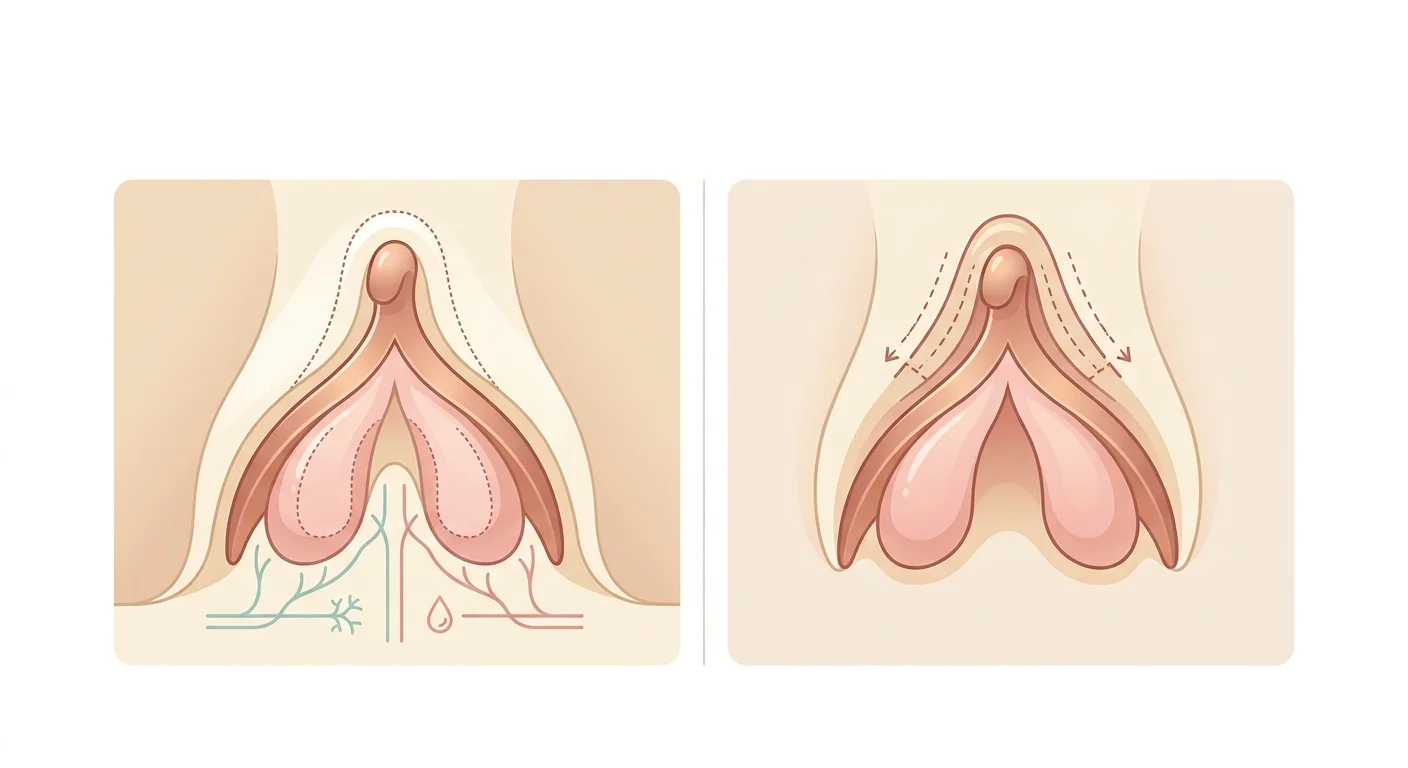
- The primary difference between clitoroplasty and clitoral hood reduction is anatomical, with the former involving the clitoris itself and the latter focusing on the surrounding skin folds.
- Clitoroplasty is a complex reconstructive or reductive procedure used for conditions like clitoromegaly, while clitoral hood reduction is a more targeted surgery often performed alongside labiaplasty to remove excess tissue.
- Both procedures require precise surgical planning to preserve the dense neurovascular structures of the clitoris and avoid complications such as loss of sensitivity or chronic pain.
Although their names sound similar, clitoroplasty vs clitoral hood reduction describes two different types of genital surgery. The main distinction is anatomical: clitoroplasty involves the clitoris itself, while clitoral hood reduction primarily removes or reshapes excess skin surrounding and covering the clitoris.
Table of Contents
Understanding this difference is particularly important because the clitoris has a complex nerve and blood supply, and procedures involving the clitoral structure require careful surgical planning.
Clitoroplasty vs Clitoral Hood Reduction: What Is the Main Difference?
The simplest way to understand the difference is to look at which tissue is being treated.
Clitoroplasty is an umbrella term for surgical procedures that change, reconstruct, reposition or reduce the clitoris itself. Depending on the indication, surgery may involve clitoral tissue rather than only the surrounding skin. Cleveland Clinic describes clitoroplasty as surgery that may reduce the size of the clitoris, reposition it, create a clitoris or otherwise alter its appearance.
Clitoral hood reduction, meanwhile, focuses on the clitoral hood, also called the prepuce. This is the fold of skin that covers and protects the clitoral glans. During clitoral hood reduction, carefully selected excess skin is removed while the underlying clitoral structures should remain undisturbed.
| Feature | Clitoroplasty | Clitoral Hood Reduction |
|---|---|---|
| Main treatment area | Clitoris itself | Skin covering the clitoris |
| Primary aim | Reconstruct, resize or reposition the clitoris | Reduce excess hood tissue |
| Common reasons | Clitoromegaly, congenital differences, reconstruction or selected cosmetic concerns | Hood redundancy, irritation or aesthetic concerns |
| Does it directly alter clitoral tissue? | It may | Normally no |
| Often combined with labiaplasty? | Less commonly | Frequently |
| Surgical complexity | Depends strongly on indication and technique | Usually more limited in anatomical scope |
The names can be confusing because clitoral hood reduction is sometimes referred to as clitoral hoodoplasty, which sounds very similar to clitoroplasty. However, the terms should not automatically be treated as interchangeable.
What Is Clitoroplasty?
Clitoroplasty refers to surgery performed directly on the clitoral structure. The exact procedure can vary considerably because the term covers both reconstructive and reduction techniques.
Historically, clitoroplasty has been particularly associated with management of clitoromegaly, including enlargement related to congenital adrenal hyperplasia and other differences in sexual development. Modern approaches generally place strong emphasis on preserving the neurovascular structures responsible for sensation and blood supply.
In adults, clitoroplasty may also be discussed for acquired clitoral enlargement, previous trauma or surgery, reconstructive requirements, or selected cosmetic concerns.
What Can Clitoroplasty Involve?
Depending on the patient’s anatomy and reason for surgery, clitoroplasty may involve:
- reducing enlarged clitoral tissue;
- repositioning the clitoris;
- reshaping the clitoral structure;
- reconstructing a clitoris after trauma or previous surgery;
- creating a clitoral structure as part of reconstructive surgery.
There is therefore no single universal “clitoroplasty technique.” The procedure can range from relatively limited reshaping to complex reconstructive surgery.
Because surgery may involve tissue close to the clitoral neurovascular bundle, detailed anatomical knowledge is particularly important. A 2026 narrative review of clitoral anatomy highlighted the dorsal neurovascular bundle as a critical structure during aesthetic and reconstructive clitoral surgery and stressed the importance of preserving blood supply and sensory fibres.
What Is Clitoral Hood Reduction?
Clitoral hood reduction is more specifically defined. It removes selected excess tissue from the folds of skin covering the clitoral glans.
The aim is generally to modify the size or contour of the hood without surgically reducing the clitoris itself. Cleveland Clinic describes the procedure as trimming excess hood tissue while taking care not to disturb the tissue and nerves of the clitoral glans.
People may consider the procedure because of:
- excess or prominent hood tissue;
- irritation during exercise or while wearing certain clothing;
- asymmetry;
- aesthetic concerns;
- disproportion between the clitoral hood and labia after labiaplasty.
Clitoral hood reduction is frequently performed alongside labiaplasty. ACOG notes that the procedure may accompany labiaplasty, partly because reducing the labia without addressing significant hood redundancy can leave an imbalance in the appearance of surrounding tissues.
Does Clitoral Hood Reduction Expose the Clitoris?
The goal is generally not to leave the clitoral glans permanently or excessively exposed.
The clitoral hood has a protective anatomical role. Removing too much tissue can create unwanted exposure and may potentially contribute to irritation, hypersensitivity or pain. Cleveland Clinic specifically warns that excessive removal intended to expose the glans may produce unpredictable results, including persistent clitoral pain.
For this reason, appropriate reduction is usually conservative and tailored to individual anatomy.
Is Clitoroplasty the Same as Clitoral Hood Reduction?
No.
This distinction is particularly important for patients comparing procedures online.
A person with excess skin around the clitoris does not necessarily need surgery on the clitoris itself. If the concern is limited to redundant hood tissue, a surgeon may instead consider clitoral hood reduction.
Conversely, someone with true clitoral enlargement may require investigation into the cause of that enlargement before any surgical treatment is considered. Clitoromegaly can have congenital, hormonal or acquired causes, meaning assessment may sometimes involve more than an aesthetic examination.
A consultation should therefore determine whether the concern involves:
- the clitoral hood;
- the clitoris itself;
- the labia minora;
- or a combination of these structures.
That anatomical diagnosis determines which procedure, if any, is appropriate.
Which Procedure Is More Suitable for Cosmetic Concerns?
For a patient whose concern is predominantly excess or prominent skin around the clitoris, clitoral hood reduction is generally the more anatomically targeted procedure.
Clitoroplasty is a broader operation involving the clitoral structure itself and is not simply another name for removing excess hood skin.
This distinction matters because genital anatomy varies significantly between individuals. There is no single normal size, shape or degree of clitoral hood coverage. Cleveland Clinic similarly notes that there is no ideal or universally “normal” clitoral hood appearance.
A surgeon should therefore assess the patient’s anatomy and symptoms rather than selecting a procedure based purely on photographs or terminology encountered online.
Can Clitoral Hood Reduction Affect Sensitivity?
Any surgery near the clitoris needs to be approached carefully because of its dense sensory innervation.
However, clitoral hood reduction is designed to remove superficial excess tissue while preserving the clitoris and its nerves.
One prospective study followed 37 patients undergoing labia minora reduction with clitoral hood reduction and measured genital sensitivity before and after surgery. The researchers did not identify an overall postoperative loss of sensitivity during follow-up, although the study was relatively small and should not be interpreted as proof that sensory complications cannot occur.
More recent evidence remains cautious. A 2026 systematic review and meta-analysis examining female genital cosmetic surgery — predominantly labiaplasty with or without clitoral hood reduction — found improvements in measured sexual-function outcomes across available studies. However, the authors rated the certainty of the evidence as low because much of the literature consisted of uncontrolled observational studies rather than randomized comparisons.
This is an important distinction: encouraging patient-reported results do not mean sensitivity improvement can be guaranteed.
What Are the Risks?
Both procedures involve a highly sensitive anatomical region, although the operations are different in scope.
Clitoral Hood Reduction Risks
Potential complications can include:
- bleeding or hematoma;
- infection;
- swelling;
- scarring;
- asymmetry;
- nerve injury;
- excessive tissue removal;
- insufficient tissue removal;
- altered or uncomfortable sensation.
Cleveland Clinic notes that excessive reduction can be particularly problematic because tissue that has been removed cannot simply be replaced.
Clitoroplasty Risks
The risks of clitoroplasty depend greatly on why the operation is being performed and which technique is required. They may include bleeding, bruising, scarring, chronic pain, altered sensation and injury to the clitoral nerve or blood supply.
Because clitoroplasty may directly involve clitoral tissue, preservation of the neurovascular anatomy is a major surgical consideration. Modern techniques therefore generally emphasize nerve-sparing approaches where clinically appropriate.
There are no strong comparative trials showing that every clitoroplasty carries more risk than every clitoral hood reduction. The actual risk depends on anatomy, technique, extent of surgery, surgeon experience and the underlying reason for treatment.
What Is Recovery Like?
Recovery varies depending on the procedure and whether additional genital surgery is performed at the same time.
After clitoral hood reduction, swelling, tenderness and discomfort are expected during the early healing period. Cleveland Clinic advises that significant swelling commonly improves over approximately six weeks, although some residual swelling can persist considerably longer. Sexual contact around the surgical area is generally restricted for approximately four to six weeks, depending on healing.
Recovery after clitoroplasty can be more variable because the term includes procedures of very different complexity. Cleveland Clinic describes full recovery as potentially taking approximately six to twelve weeks, with sexual activity usually avoided for at least six weeks or until the surgeon confirms adequate healing.
Individual instructions from the treating surgeon always take priority over general timelines.
Can Clitoral Hood Reduction Be Combined With Labiaplasty?
Yes. This is a common combination when both the labia minora and clitoral hood contribute to the patient’s concern.
Research has described several combined techniques for labia minora and clitoral hood reduction. A 2026 study of 68 patients undergoing a combined two-part procedure reported improvement in genital appearance satisfaction, although it was an observational study rather than a randomized comparison.
Another larger observational study proposed a classification system for different patterns of clitoral hood redundancy and reported high satisfaction following anatomy-specific reduction techniques. Again, the evidence was Level IV, so these findings should be interpreted in the context of the limited quality of available research.
The important principle is that the clitoral hood and labia should be evaluated together rather than automatically performing the same combination of procedures on every patient.
Questions to Ask Before Surgery
Before considering either procedure, useful questions for your surgeon include:
- Is my concern related to the clitoris itself or only the clitoral hood?
- Why are you recommending this particular procedure?
- Will any clitoral tissue be removed or repositioned?
- How will the nerves and blood supply to the clitoris be protected?
- Do I actually need clitoral hood reduction if I am having labiaplasty?
- What degree of tissue reduction are you planning?
- What changes in sensation are possible?
- How often do you perform this specific procedure?
- What is the expected recovery period?
- What happens if too much or too little tissue is removed?
The terminology should also be clarified before surgery. If a clinic uses terms such as clitoroplasty, hoodoplasty, clitoral hoodectomy or clitoral unhooding, ask exactly which anatomical structures the surgeon plans to alter.
Choosing the Right Procedure for Your Anatomy
Patients considering female genital aesthetic surgery in Turkey should receive an individualized assessment rather than selecting a procedure solely by name.
At CK Health Turkey, the treatment-planning process can help international patients discuss their concerns, medical history and expectations with the clinical team before deciding whether clitoral hood reduction, another genital aesthetic procedure or no surgery is the appropriate approach.
This is especially important when differentiating excess clitoral hood tissue from true enlargement or another anatomical concern. The surgical plan should be based on individual anatomy, symptoms and realistic expectations.
Patients considering treatment can contact CK Health Turkey or visit the CK Health Turkey website to request further information and a personalized assessment.
Ultimately, the key distinction in clitoroplasty vs clitoral hood reduction is the structure being treated: clitoroplasty alters or reconstructs the clitoris itself, whereas clitoral hood reduction reshapes the skin covering it. Because these procedures involve different anatomy, indications and potential risks, an experienced clinical assessment is essential before deciding which approach is appropriate.