Highlights
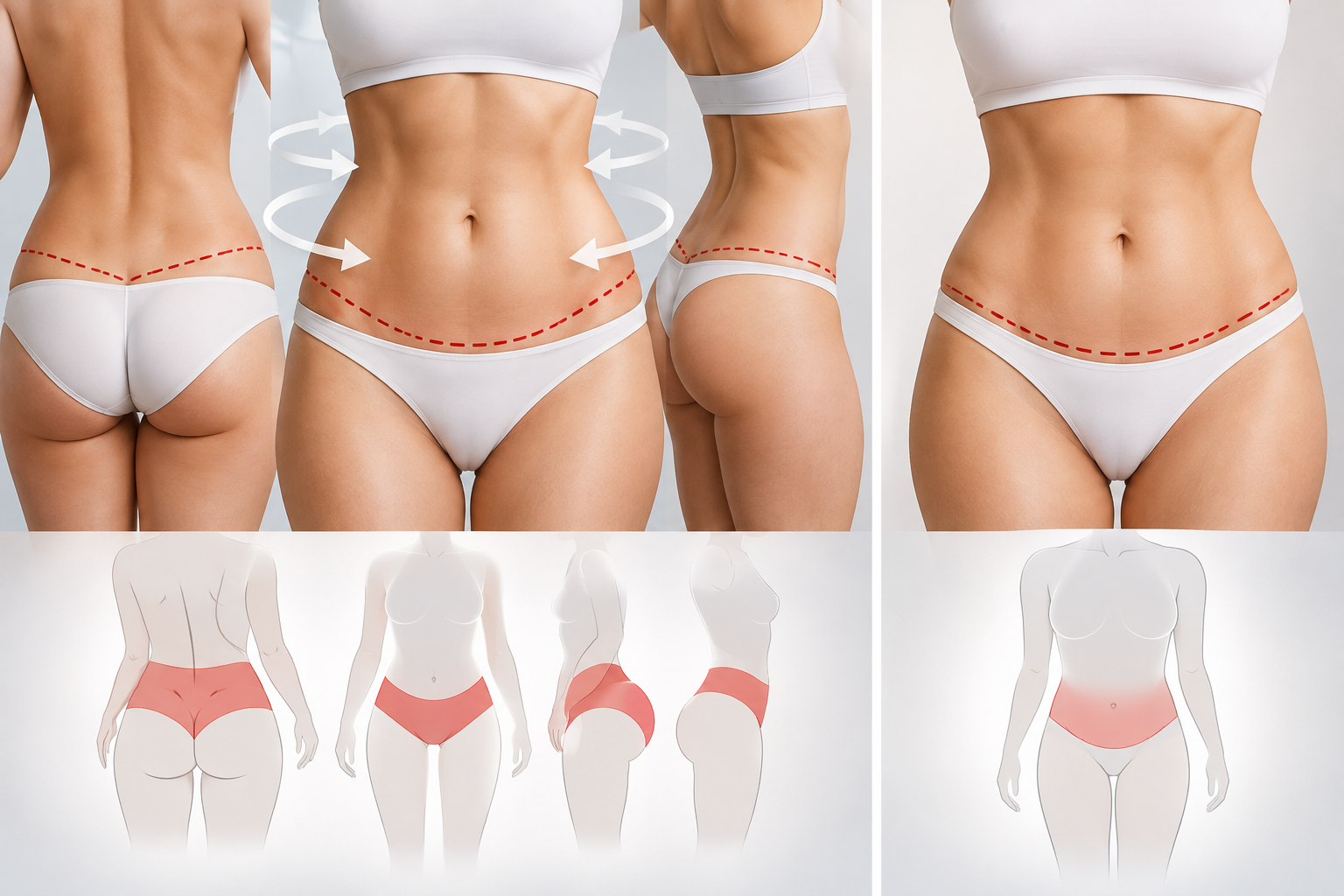
- The primary difference is the scope of the procedure, with a traditional tummy tuck focusing on the front abdomen while a 360 body lift extends around the entire waist to address the sides and back.
- A 360 body lift is typically recommended for patients with significant skin laxity following major weight loss, whereas a tummy tuck is often sufficient for localized abdominal concerns after pregnancy or aging.
- While both surgeries involve permanent scarring and significant recovery, the 360 body lift requires a longer circumferential incision and more extensive postoperative care compared to the traditional approach.
Wondering about the 360 body lift vs traditional tummy tuck difference? Both operations remove excess skin around the abdomen, but they do not treat the same areas of the body. The best option depends on where loose skin sits, your health, and how much correction you need.
Table of Contents
What is the 360 body lift vs traditional tummy tuck difference?
The most important difference is how far around the torso the operation extends. A traditional tummy tuck, medically called abdominoplasty, focuses primarily on the front of the abdomen. A 360 body lift, commonly called a circumferential lower body lift or belt lipectomy, extends around the waist to remove excess skin at the front, sides and back.
That wider approach can improve loose skin around the hips, lower back, buttocks and sometimes the outer thighs as well as the abdomen. However, it typically requires a longer incision and more extensive recovery planning. The exact areas treated vary with the technique and the patient’s anatomy. The Cleveland Clinic’s lower body lift guide describes the wrap-around incision as the central distinction.
What happens during a traditional tummy tuck?
A standard or full tummy tuck removes extra skin and, where appropriate, fat from the front of the abdomen. The surgeon usually makes a low horizontal incision, lifts and redrapes abdominal skin, and often repositions the belly button. When the abdominal wall is stretched or separated, the surgeon may tighten the underlying fascia to address rectus diastasis. Not every patient requires the same muscle repair.
For someone with skin laxity concentrated below and around the navel, a traditional tummy tuck may address the main concern without extending the scar all the way around the body. It does not usually correct a significant overhang of skin across the lower back or substantially lift the buttocks.
A mini tummy tuck, full tummy tuck and extended tummy tuck are different procedures. An extended tummy tuck generally reaches farther towards the hips than a standard one, but does not automatically include the full posterior component of a circumferential body lift. See our separate guide to extended versus standard tummy tuck surgery.
What happens during a 360 body lift?
A 360 body lift is designed for people with excess skin around much of the lower trunk, often after substantial weight loss. The surgeon removes a band of excess skin and tissue around the waist or lower torso. By lifting and closing the remaining tissue, the procedure can improve the abdomen, flanks, lower back and buttock contour. Some techniques also improve the appearance of the outer thighs.
The surgeon may need to reposition you during the operation to reach both the front and back safely. Abdominal muscle repair may be included when indicated, but it is not the defining feature of the body lift. Nor does every 360 body lift include liposuction or fat transfer; those are separate decisions based on safety, goals and tissue quality.
Different surgeons use terms such as lower body lift, belt lipectomy and circumferential abdominoplasty somewhat differently. Rather than relying on the name alone, ask exactly which areas your proposed operation treats and where the scar will run. The International Society of Aesthetic Plastic Surgery explains how these operations can combine an abdominal component with correction of the back, buttocks and lateral thighs.
360 body lift vs tummy tuck: side-by-side comparison
| Feature | Traditional tummy tuck | 360 body lift |
|---|---|---|
| Main treatment area | Front of the abdomen | Abdomen, sides and lower back; often buttocks and outer thighs |
| Typical incision | Low abdominal scar, often with a navel incision | Longer scar extending around the lower torso |
| Excess skin addressed | Primarily abdominal skin | More widespread circumferential skin excess |
| Abdominal muscle repair | Often included when needed | May be included when needed |
| Buttock or outer-thigh effect | Usually limited | May offer a lifting or contouring effect |
| Operation and recovery | Major surgery; scope varies | Typically more extensive, with wider wound care needs |
| Common candidate profile | Loose skin mainly at the front | Loose skin around the waist after significant weight loss |
This comparison describes common approaches, not a fixed surgical plan. Your surgeon may recommend a modified incision, a staged approach or another procedure depending on the examination.
Who may be better suited to each procedure?
When a traditional tummy tuck may make sense
A traditional tummy tuck may be sufficient when the main concerns are a loose abdominal apron, stretched skin around the navel or abdominal wall laxity, while the lower back and buttocks have relatively little excess skin. This may be the case after pregnancy, weight changes or ageing. The aim is not to remove the maximum possible skin; it is to treat the areas that genuinely need correction.
When a 360 body lift may be considered
A circumferential body lift may be more suitable when skin hangs not only over the stomach but also around the waistline, sides or lower back. People who have lost a substantial amount of weight may notice that a front-only operation would leave a noticeable contrast between the treated abdomen and untreated back. A body lift offers a way to address that circumferential distribution in one overall plan.
When neither procedure should be rushed
If weight is still changing significantly, nutritional deficiencies are unresolved, smoking or nicotine use has not been addressed, or medical conditions increase surgical risk, it may be safer to postpone surgery. A stable weight, adequate protein and micronutrient status, and an appropriate preoperative assessment matter particularly after bariatric surgery. Your treating team should assess whether the benefits justify the scale of the operation.
What about scars and the belly button?
All skin-removal surgery leaves permanent scars. A standard full tummy tuck typically produces a low scar across the lower abdomen and a scar around the repositioned belly button. The scar may be concealed by some underwear styles, but its length and visibility vary.
A 360 body lift usually creates a longer scar that continues from the abdomen around the sides and towards or across the back. The exact height and shape depend on the tissues being lifted. Because skin is removed from a larger circumference, the scar trade-off is greater. Surgeons aim to plan incision placement carefully, but no position can guarantee complete concealment or an invisible scar.
When the procedure includes full abdominoplasty, the belly button may also need repositioning. Scar colour, firmness and texture can change for many months after surgery, and final maturation differs from person to person. Discuss your personal risk of prominent or widened scarring if you have a relevant history.
Is abdominal muscle tightening included in both?
Patients sometimes assume that a 360 body lift always provides stronger abdominal muscle tightening. That is not necessarily true. Tightening of the abdominal fascia, sometimes called muscle repair, depends on whether the abdominal wall has separation or laxity that the surgeon intends to correct.
A traditional tummy tuck can include substantial abdominal wall repair. A 360 body lift may include a similar front-of-abdomen repair while additionally removing loose tissue from the back and sides. The difference is therefore not simply “more muscle tightening” but the distribution of skin and tissue being addressed.
Neither operation is a weight-loss treatment. Removing excess skin may change contour and remove some tissue weight, but surgery does not replace weight management or fitness. Likewise, a body lift is not a substitute for a dedicated inner-thigh lift when loose skin is concentrated on the inner thighs.
Recovery: is a 360 body lift harder than a tummy tuck?
Both are significant operations requiring postoperative supervision, wound care, movement precautions and a personalised activity plan. Because a 360 body lift creates a larger treated area, it often involves more complex positioning, dressings and scar care. The comparison is not absolute: a difficult tummy tuck with added procedures may be more demanding than a carefully selected body lift.
The first days after surgery
Swelling, bruising, soreness and restricted movement are common after either procedure. Your team may prescribe pain relief, compression garments and sometimes surgical drains, depending on the technique. Early, assisted walking is commonly encouraged when medically appropriate, but strenuous activity and pulling against the incisions must be avoided.
The first weeks at home
You may need help with meals, washing, household tasks and getting in or out of bed. Patients recovering from circumferential surgery must take particular care with positions that place pressure or tension on back and side incisions. Your surgeon should explain how to sleep, sit, bend, shower and care for any drains. Return-to-work timing depends on the operation, your job and your individual healing, not a universal calendar.
Longer-term healing
Swelling and scar changes can continue for months. Follow-up appointments allow the team to identify delayed healing, fluid collections or changes that need attention. Patients planning to travel abroad for surgery should receive an explicit plan for postoperative review and safe travel, including assessment of blood-clot risk. Do not book a return flight solely on the basis of a package’s advertised length of stay.
How do the risks compare?
Both operations can involve bleeding, infection, seroma (fluid collection), poor wound healing, wound separation, altered skin sensation, asymmetry, scarring, anaesthetic complications and blood clots. A larger incision may create additional wound-care challenges, but the actual risk for one patient depends on the procedure, health status, smoking exposure, body mass index, nutrition, previous operations and other factors.
A 2016 systematic review of circumferential lower-trunk contouring included 42 studies and 1,748 patients. Wound separation was the most frequently reported complication, while the authors noted that most included studies provided relatively low-quality evidence. Importantly, this research does not establish that one procedure is safer for every patient, and it does not replace an individualised risk assessment.
Seek urgent medical advice for concerning symptoms such as new shortness of breath, chest pain, one-sided leg swelling, heavy bleeding, fever with worsening wound redness, or sudden severe pain. Your surgical team should give you clear contact instructions for urgent concerns both before and after travel.
Does a 360 body lift make more sense after bariatric surgery?
It often becomes relevant after major weight loss because loose skin may extend around the entire lower torso rather than sitting at the front of the abdomen alone. However, not everyone who has had gastric sleeve or another bariatric procedure needs a circumferential body lift. The pattern and amount of remaining skin, current weight stability, nutritional status and overall fitness are more useful decision points than surgical history alone.
A 2021 systematic review and meta-analysis of post-bariatric body-contouring studies found that higher body mass index and larger amounts of removed tissue were associated with more complications in the studied populations. These findings support careful patient selection, but they cannot predict an individual outcome or prove which operation you personally require.
If loose skin is concentrated in several different areas, your surgeon may suggest staging operations rather than combining everything into one long procedure. That decision should balance surgical exposure, wound healing, recovery support and the overall treatment goal.
Is a 360 body lift the same as 360 liposuction or a 360 tummy tuck?
No. 360 liposuction describes fat removal around the torso and does not, by itself, remove a band of hanging skin. A body lift is an excisional skin-removal operation. Some clinics use “360 tummy tuck” as marketing shorthand for different combinations of extended abdominoplasty, back treatment or liposuction, so the term is not sufficiently precise to explain the surgical plan.
Ask for a written description of the exact procedure and incision pattern rather than relying on the number “360”. Our related article about 270 versus 360 tummy tuck terminology explores another commonly confused comparison. You can also read about buttock changes after a lower body lift.
Questions to ask before choosing a procedure
- Which areas of loose skin are being treated, and which will remain unchanged?
- Where will my incisions and scars be, including on the back and around the navel?
- Will abdominal fascia repair, liposuction or buttock contouring be part of the plan?
- What are my personal risks given my weight, medications, medical history and nutrition?
- Would staged procedures be safer or more appropriate than one combined operation?
- What support, follow-up and activity restrictions will I need after returning home?
Reviewing these details during a proper consultation helps set realistic expectations. Photographs and online experiences can be useful conversation starters, but cannot determine your individual surgical suitability.
CK Health Turkey: discussing your body-contouring options
At CK Health Turkey in Antalya, international patients can enquire about plastic-surgery treatment options and discuss the practical steps involved in planning care abroad. If you are considering a tummy tuck or a 360 body lift, a useful starting point is to explain where loose skin is causing concern, describe any previous weight-loss surgery and share your medical history for clinical review.
The appropriate procedure, hospital arrangements, recovery advice and travel schedule must be determined through individual assessment rather than assumed from a general article. Patient coordination can help you understand the consultation process and the information you need before making a decision.
Contact CK Health Turkey through ckhealthturkey.com to request guidance about a personalised assessment and discuss whether abdominal contouring or a circumferential lower body lift may be appropriate for your goals.
Ultimately, understanding the 360 body lift vs traditional tummy tuck difference means looking beyond the procedure name: a tummy tuck mainly addresses the front of the abdomen, while a body lift can treat excess tissue around the lower torso. The right choice is the one that matches your anatomy, health, expectations and the surgeon’s assessment—not necessarily the operation with the widest reach.