Highlights
- A panniculectomy is a functional procedure focused on removing a hanging apron of skin and fat to resolve hygiene and mobility issues, without tightening abdominal muscles.
- An extended tummy tuck is a cosmetic contouring surgery that reshapes the abdomen and flanks, typically involving muscle repair and belly button repositioning.
- The choice between the two depends on whether the patient's goal is medical relief from excess tissue or a broader aesthetic improvement of the waistline and body shape.
When comparing panniculectomy vs extended tummy tuck, the key question is what you need surgery to achieve. One procedure focuses on removing a hanging apron of lower-abdominal skin and fat, while the other aims to reshape a broader area of the abdomen and flanks. Both involve significant surgery, but they are not interchangeable.
Table of Contents
Understanding the differences can help you prepare for a consultation after major weight loss, pregnancy or other changes in body shape.
Panniculectomy vs extended tummy tuck: what is the difference?
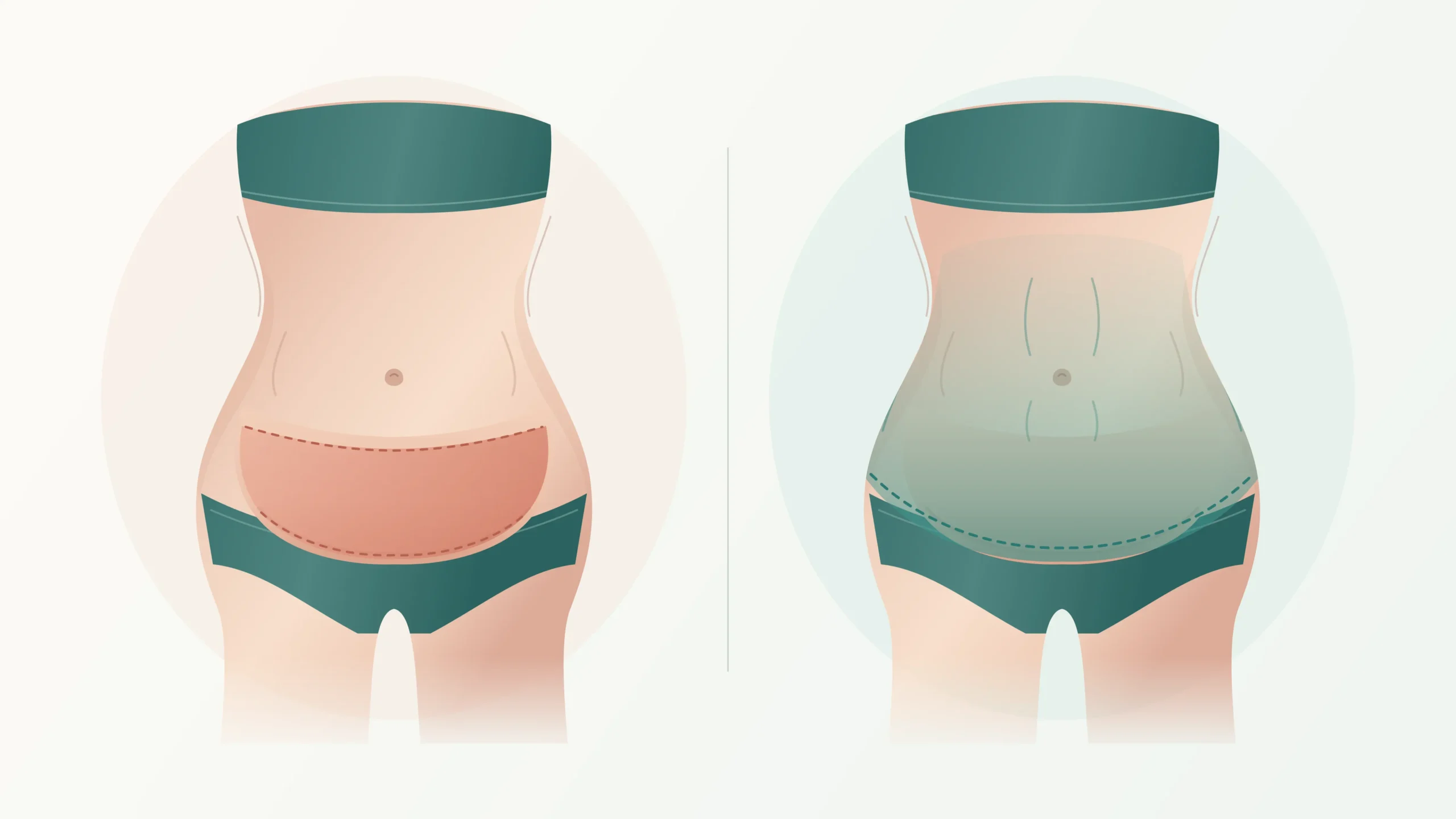
A panniculectomy removes the pannus—the apron of loose skin and underlying fat that hangs from the lower abdomen. Its main purpose is to address excess tissue, particularly when it causes rubbing, persistent skin problems, difficulty with hygiene or interference with movement. It does not ordinarily include tightening the abdominal wall or reshaping the entire waist.
An extended tummy tuck is a form of abdominoplasty that removes excess abdominal skin and reaches farther around the hips and flanks than a standard tummy tuck. It usually includes repositioning the belly button and can include repair of stretched abdominal fascia when indicated. Its focus is broader contouring, although it can also remove an abdominal overhang.
The American Society of Plastic Surgeons (ASPS) describes panniculectomy as removal of hanging skin and fat without the muscle tightening typically associated with abdominoplasty. The ASPS explanation of extended abdominoplasty highlights how its horizontal incision reaches around the hips to treat a larger area.
Terms and techniques can vary between surgeons. Ask for the proposed incision pattern and list of surgical steps rather than relying on the procedure name alone.
What is a panniculectomy?
A panniculectomy is designed to remove excess skin and subcutaneous fat hanging below the lower abdomen. The pannus can cover part of the pubic area or extend farther down, depending on the patient. The amount removed and the length of the incision depend on where the excess tissue sits.
This apron of skin can develop following significant weight loss, pregnancy, ageing or earlier surgery. In some patients, moisture and friction under the fold lead to recurring inflammation, rashes or skin breakdown. A bulky pannus may also make washing, dressing or walking difficult.
According to Cleveland Clinic’s patient guide, the operation can help address these practical difficulties but is not itself weight-loss surgery. It may improve the lower-abdominal profile without producing the waist definition or upper-abdominal tightening of a full abdominoplasty.
Does a panniculectomy repair separated abdominal muscles?
Not usually. A standard panniculectomy does not involve tightening the abdominal fascia or repairing rectus diastasis, the separation of the paired abdominal muscles. It generally aims to remove the overhanging apron rather than reshape the entire abdominal wall.
If you also have abdominal wall weakness or a hernia, a surgeon may recommend a different or combined operation. This requires separate planning and should never be assumed to be included in a basic panniculectomy.
What is an extended tummy tuck?
An extended tummy tuck builds on full abdominoplasty by treating not only the front of the abdomen but also excess skin extending towards the hips and sides of the waist. The longer horizontal incision reaches farther laterally than a standard tummy tuck. For some people who have lost considerable weight, this can address skin folds that would otherwise remain along the flanks.
During surgery, excess skin and some underlying fat are removed, the remaining abdominal skin is redraped, and the belly button is typically repositioned. Where needed, the surgeon may tighten stretched abdominal fascia. Liposuction may also be discussed, but it is a separate element of the plan rather than a guaranteed part of the operation.
The ASPS guide to different tummy tuck types describes the extended approach as appropriate for selected patients with pronounced skin laxity across the abdomen and flanks. The incision is longer, and the extent of treatment makes recovery planning important.
Is an extended tummy tuck the same as a 360 body lift?
No. An extended tummy tuck reaches around the sides of the torso, whereas a circumferential lower body lift typically continues around the back and may also lift the buttocks or outer thighs. A fleur-de-lis tummy tuck, which includes a vertical midline incision as well as a horizontal incision, is another distinct variation. Terminology can overlap in marketing, so request an illustration of the actual planned scars.
For related comparisons, see our articles on extended versus standard tummy tuck and 360 body lift versus traditional tummy tuck.
Panniculectomy vs extended tummy tuck comparison table
| Feature | Panniculectomy | Extended tummy tuck |
|---|---|---|
| Primary purpose | Remove the hanging lower-abdominal apron | Improve abdominal and flank contour |
| Areas treated | Primarily lower abdomen | Lower and upper abdomen, extending towards hips and flanks |
| Abdominal muscle/fascia repair | Not usually included | May be performed when indicated |
| Belly button | Usually not repositioned; may be affected by extensive tissue removal | Usually repositioned |
| Typical scar | Lower-abdominal incision; length depends on pannus | Longer lower-abdominal incision extending around the flanks, often with a navel scar |
| Expected emphasis | Relief from skin-fold problems and removal of excess tissue | Broader shape, waistline and skin tightening |
| Insurance considerations | May qualify as medically necessary in some healthcare systems | Usually regarded as cosmetic |
These are typical features, not promises about an individual operation. Medical need, surgical risk and treatment details should be assessed separately.
Which operation is better after major weight loss?
After bariatric surgery or substantial non-surgical weight loss, loose skin can affect several regions at once. Some people are mainly troubled by an apron that traps moisture, develops recurrent irritation or limits movement. Others also have extensive skin laxity across the upper abdomen, waist and flanks.
If the problem is primarily a heavy, hanging pannus, a panniculectomy may address the main concern without undertaking every contouring step associated with abdominoplasty. If the aim is to reshape the abdomen and flanks, with possible abdominal wall tightening, an extended tummy tuck may align more closely with those goals.
Neither is a substitute for losing weight. Surgeons generally prefer weight stability, adequate nutrition, and good control of health conditions before skin-removal surgery. Patients who have undergone bariatric procedures may need particular attention to protein intake, iron status and other nutritional deficiencies that can affect healing.
Our guide to which skin-removal surgery to consider first after weight loss explains why surgical sequencing matters when several areas need treatment.
How are the incisions and scars different?
Both procedures leave permanent scars. A panniculectomy usually involves a horizontal incision across the lower abdomen; for a large pannus, the incision may need to extend considerably farther across the body. Some techniques involve an additional vertical incision or altered management of the navel, depending on the amount and position of excess tissue.
An extended tummy tuck generally leaves a horizontal scar that runs across the lower abdomen and farther around the flanks. Because the belly button is typically repositioned, there is also usually a scar around it. The longer scar is a trade-off for addressing loose skin over a wider area.
Scar position is influenced by tissue distribution, previous scars and how much skin can be safely removed. Your surgeon should show where the proposed incisions will sit when standing and explain which portions may be concealed by underwear. No surgeon can guarantee invisible scars or identical healing between patients.
Will either procedure tighten the waist or fix a bulging stomach?
Removing a hanging pannus can make the lower abdomen appear flatter, and it may substantially improve comfort when skin folds are the primary problem. It does not normally tighten separated abdominal fascia, however, or treat fullness caused by internal abdominal fat.
Extended abdominoplasty may combine skin removal with abdominal wall tightening when muscle separation or fascial laxity is present. That can improve some types of abdominal projection, but it does not eliminate visceral fat within the abdominal cavity. Results depend on skin quality, fat distribution, abdominal wall anatomy and overall health.
If you have a bulge that might be a hernia, the surgical team needs to investigate it before planning a cosmetic procedure. A hernia repair and a skin-removal operation are different interventions, even if they are occasionally coordinated.
Recovery and aftercare: what should you expect?
Both operations are major surgeries. In the early recovery period, swelling, bruising, tenderness and limited mobility are common. The surgeon may use drains and recommend a compression garment depending on the technique. Wounds need regular observation and patients usually need help with lifting, shopping and other demanding activities.
There is no universally reliable rule that panniculectomy always has a faster recovery than an extended tummy tuck. Although standard panniculectomy usually avoids fascial tightening, people seeking it may have more extensive tissue removal or additional medical conditions. An extended tummy tuck treats a broader area and may involve muscle repair and greater discomfort from movement.
The NHS guidance on abdominoplasty describes weeks of restricted work and exercise after tummy tuck surgery, with recovery varying from person to person. Ask your surgeon for a procedure-specific plan rather than applying a generic timeline to both operations.
Gentle movement is usually encouraged as directed to reduce immobility, while strenuous activity, heavy lifting and positions that strain incisions may be restricted. If travelling home after surgery, discuss follow-up appointments, wound care and the timing of flights with the treating team. Long journeys and reduced movement make personal blood-clot risk assessment particularly important.
What are the risks of panniculectomy and extended tummy tuck?
Both procedures can cause bleeding, infection, delayed healing, wound separation, collections of fluid called seromas, haematomas, changes in sensation, asymmetry and prominent scarring. Anaesthesia and major surgery also carry risks, including blood clots. Complications can require additional procedures, hospital treatment or an extended recovery period.
Risk depends on more than the procedure name. Smoking and nicotine exposure, diabetes, weight and nutritional status, previous abdominal surgery, the quantity of tissue removed and other medical conditions influence the likelihood of wound problems. A well-planned operation and attentive aftercare reduce avoidable risks but cannot eliminate them.
A 2022 multicentre retrospective study analysed 11,137 patients who underwent functional panniculectomy or cosmetic abdominoplasty. Complications were more frequently recorded in the panniculectomy group, but those patients also had more pre-existing medical conditions. The findings do not show that panniculectomy is inherently more dangerous for every otherwise comparable patient; the groups differed in important ways.
Similarly, a 2024 study of 216 post-bariatric panniculectomy patients reported that wound-related problems were an important source of complications. Its results concern that specific patient population and should not be used to predict an individual’s risk without assessment.
Seek urgent medical attention for chest pain, breathlessness, new significant one-sided leg swelling, uncontrolled bleeding or other concerning symptoms. Contact the surgical team promptly for worsening wound redness, fever, discharge or separation.
Is panniculectomy medically necessary while an extended tummy tuck is cosmetic?
Often, that distinction is relevant, but the answer depends on the person’s symptoms and the healthcare system involved. A panniculectomy may be considered reconstructive or medically necessary where a significant abdominal apron causes persistent skin infections, ulceration, difficulty maintaining hygiene or functional impairment.
An extended tummy tuck generally targets appearance and overall body contour and is commonly treated as cosmetic surgery. Nevertheless, both procedures can have functional and aesthetic effects. Documentation of symptoms and the precise operation being proposed matters more than the name used in an advertisement.
For people considering treatment in another country, insurance or reimbursement should never be assumed. Requirements differ across insurers, countries, policies and individual cases. In particular, a policy that may recognise panniculectomy for medical reasons does not automatically cover travel or an elective operation in Turkey. Obtain written confirmation directly from the relevant provider before making financial plans.
How do you know which procedure is right for you?
The most useful starting point is an assessment of the amount and location of loose skin, whether the abdominal wall requires repair, and any skin-fold symptoms that affect daily life. Your surgeon will also review weight stability, medical conditions, medications, previous surgery and your expectations of scarring.
Consider discussing the following questions:
- Is my main problem a hanging skin apron, loose skin at the flanks, abdominal wall laxity, or a combination?
- Which areas will be treated, and which areas will remain unchanged?
- Will abdominal fascia or muscle separation be repaired, and is that medically appropriate?
- Where will the scars extend, and what happens to my belly button?
- Do recurring rashes or hygiene difficulties justify a separate functional assessment?
- What is my personal risk of wound complications, seroma and blood clots?
- What postoperative care, time away from work and travel restrictions should I plan for?
A surgeon may suggest a standard tummy tuck, circumferential body lift, staged procedure or no surgery rather than either of the two options discussed here. The right operation is one that matches the findings and the patient’s priorities, not simply the one that removes the most tissue.
CK Health Turkey: discussing abdominal skin-removal options
CK Health Turkey in Antalya provides an enquiry and care-coordination pathway for international patients considering plastic surgery in Turkey. If you are exploring procedures after weight loss, describing whether the loose skin mainly hangs over the lower abdomen or extends around your sides can help focus the initial discussion.
A qualified treating clinician needs to assess the abdomen, health history and surgical risks before recommending panniculectomy, extended abdominoplasty or another approach. A personalised consultation should also cover hospital and recovery planning, possible complications, follow-up care and the practical implications of travelling for treatment. Do not assume a particular operation, result or package inclusion before an individual assessment.
For more information about the consultation process and your body-contouring options, contact CK Health Turkey to discuss a personalised assessment.
Ultimately, the decision in panniculectomy vs extended tummy tuck depends on whether you primarily need removal of a troublesome lower-abdominal apron or more extensive contouring across the abdomen and flanks. Understanding the different goals, scars, recovery demands and risks will help you make an informed choice with your surgical team.