Highlights
- The number of crowns needed for a smile makeover is a clinical decision based on individual oral health and bite, rather than a standard marketing package.
- Extensive treatments like 24 crowns involve preparing many natural teeth, which should only be done if medically justified to protect damaged teeth or restore function.
- Conservative alternatives such as whitening, bonding, or veneers should be considered to preserve healthy tooth structure and avoid the risks of aggressive preparation.
How many teeth need crowns for a smile makeover is a common question for people comparing treatment plans, particularly when a quote mentions 20 or 24 crowns. If you are considering 24 crowns, you may wonder whether the back teeth need treatment too—or whether only the teeth seen when you smile should be restored. The answer depends on your actual teeth, bite and oral health, not a standard package number.
Table of Contents
A careful dental examination should establish which teeth need full crowns, which might benefit from less invasive care and which should simply be left alone.
How many teeth need crowns for a smile makeover?
There is no medically required number of crowns for a smile makeover. Some people need no crowns at all and can achieve their goals with whitening, orthodontics or composite bonding. Others need one or several crowns because particular teeth are broken, heavily restored, weakened or otherwise unsuitable for a simpler treatment.
A complex full-mouth rehabilitation may involve many crowns when there is widespread tooth wear, breakdown or a significant bite problem. That is different from placing a large number of crowns solely to produce a uniform colour or shape.
The NHS guide to dental treatments explains that a crown covers a natural tooth and that the tooth must be shaped so the restoration can fit. This tooth preparation is a clinical decision, not merely an aesthetic preference.
If a proposal includes 24 crowns, ask your dentist to identify each tooth, explain why a crown is recommended there and discuss what would happen if that tooth were left untreated. A clear answer should be based on examination and appropriate radiographs, not simply on how many teeth a marketing package contains.
Does a 24-crown smile makeover include the back teeth?
It may, but not always in the way patients expect. An adult usually has up to 28 permanent teeth excluding wisdom teeth, although the actual count differs if teeth are missing or previously extracted. A proposal for 24 crowns therefore represents extensive treatment across much of the mouth when applied to 24 natural teeth.
A frequently discussed arrangement is 12 crowns in the upper arch and 12 in the lower arch. In a full natural dentition, this can extend beyond the front teeth to include premolars and potentially some molars, depending on which teeth are selected. However, the words “12 upper and 12 lower” do not tell you exactly which teeth are being prepared.
Your dentist should provide a numbered tooth chart or annotated plan. Ask which premolars and molars are included, which teeth are excluded, whether all 24 units are individual crowns, and whether missing teeth require a bridge or implant-supported restoration instead.
Back teeth should be examined even if they are not going to receive crowns. Untreated decay, fractured fillings, gum disease or an unstable bite can affect the comfort and longevity of a new smile, even when the back teeth are not visible in photographs.
Front teeth, premolars and molars: what is the difference?
Each part of the mouth has a different job. Front teeth are important for appearance, speech and biting. Premolars contribute to chewing and may be visible during a broad smile. Molars are designed to withstand greater chewing forces and play an important role in keeping the bite functional.
One patient may show mainly the upper front six teeth when smiling, while another has a much wider smile that reveals premolars. This is why a photograph of another person’s smile cannot establish your required crown count.
Front teeth in the smile zone
The upper incisors and canines are commonly central to a smile makeover. If these teeth are structurally healthy but the concern is colour, spacing or a minor shape issue, options such as whitening, bonding or selected veneers might preserve more natural tooth material than full crowns.
Premolars at the sides of the smile
Premolars can be visible when smiling or laughing, especially in wide smiles. They may be considered for aesthetic treatment if their colour or appearance does not match the front teeth, but visibility alone does not establish that a full crown is necessary.
Molars at the back
Molars are often less visible, but they carry heavy chewing loads. A molar may require a crown because it has a significant fracture, a large failing restoration or other structural problems. A healthy molar does not need to be crowned merely to match a package count.
If your treatment plan changes the height or relationship of the teeth, your dentist must consider the entire bite—including back teeth—even when only some teeth are restored.
When do back teeth genuinely need crowns?
The American Dental Association’s patient guidance describes crowns as a way to protect a weakened tooth, restore a broken tooth, support a tooth with a very large filling or cover a dental implant, among other clinical uses.
For a back tooth, your dentist may recommend full coverage when:
- Extensive decay or a large failing filling has weakened the remaining tooth.
- A significant fracture or cracked cusp requires protection that a smaller filling cannot provide.
- A previously treated tooth needs protection following root canal therapy, depending on the remaining structure and clinical findings.
- Severe wear or structural damage is part of a carefully assessed reconstruction of the bite.
- A replacement crown is needed because an existing crown has failed or underlying decay is present.
Not every root-treated tooth automatically needs the same type of crown, and not every cracked or worn tooth requires full coverage. An onlay, overlay, direct restoration or another conservative treatment may sometimes be appropriate.
A crown should be placed because its expected benefits outweigh the loss of natural tooth structure and future maintenance burden. For more background, see our guide to crowns on teeth.
24 crowns vs fewer crowns: what should you compare?
The best comparison is not simply how many teeth look whiter in a preview. It is whether each proposed treatment is justified by the current health of the tooth and the desired result.
| Plan | Possible reason | Question to ask |
|---|---|---|
| No crowns | Healthy teeth with aesthetic concerns manageable conservatively | Could whitening, bonding or orthodontics achieve my goal? |
| A few selected crowns | One or several damaged or heavily restored teeth | Why does each selected tooth need full coverage? |
| Restorations mainly in the visible smile | Aesthetic concerns involving front teeth and visible premolars | Are veneers or bonding more suitable for some teeth? |
| 24 or another large number of crowns | Potentially extensive reconstruction, sometimes offered as an aesthetic package | What diagnoses justify preparing so many teeth, including back teeth? |
There is no universal evidence-based rule that a smile makeover should use 8, 16, 20, 24 or 28 crowns. Those numbers often describe the scope of a proposed cosmetic treatment rather than a clinical threshold.
Do healthy back teeth need treatment to match a Hollywood smile?
Not necessarily. If your back teeth are healthy, comfortable and functioning properly, cosmetic treatment may not be justified simply because you would like the visible teeth to be a different shade. Dental treatment should be based on a whole-mouth assessment, with preservation of healthy tissue wherever feasible.
A smile makeover can involve different treatments for different teeth. For example, one damaged tooth might require a crown, a neighbouring tooth might suit a veneer and other teeth might need only cleaning or whitening. Mixing treatments may be appropriate if the dentist can achieve a comfortable, consistent result.
The Oral Health Foundation’s 2026 patient advice warns that unnecessarily aggressive preparation for crowns or veneers removes tooth tissue permanently and may lead to sensitivity, infection, gum problems or later restorative treatment. This concern is relevant wherever treatment is performed, not only in Turkey.
Before committing to extensive crowns, ask for an explanation of tooth preparation, alternatives and the likely long-term maintenance needs of each option.
How does the bite affect the number of crowns?
The bite, or occlusion, refers to how upper and lower teeth contact during chewing and jaw movement. If restorations are designed without considering the bite, patients may experience uncomfortable contacts, difficulty chewing, broken restorations or jaw muscle symptoms.
Sometimes existing back-tooth problems require treatment before a front-tooth makeover can function well. Examples may include missing support, significant wear, failing restorations or a complicated bite relationship. That does not automatically mean all premolars and molars need crowns.
A comprehensive evaluation may include photographs, dental impressions or digital scans, a bite assessment and radiographs when appropriate. The clinician should discuss whether changes to the bite are actually required, because altering the vertical dimension of the bite is a substantial decision.
Our full-mouth dental reconstruction guide explains how treatment of multiple teeth differs from a simple cosmetic update.
How can a dentist decide exactly which 24 teeth would be treated?
Good treatment planning should identify each tooth and the clinical reason for the proposed restoration. The exact number cannot be determined safely from one photograph or a social media message.
- Review your medical and dental history. Discuss sensitivity, chewing difficulty, past root canals, gum problems, grinding and previous restorations.
- Examine all teeth and gums. The dentist checks for decay, wear, fractures, gum inflammation and the condition of existing crowns or fillings.
- Obtain clinically indicated images. X-rays, photographs or digital scans may be recommended to investigate dental structure and plan the bite.
- Assess the smile and function separately. Which teeth show when you smile, and which teeth actually need strengthening or repair?
- Compare treatment alternatives. Consider whitening, composite bonding, orthodontics, veneers, onlays and full crowns where appropriate.
- Agree on a tooth-by-tooth plan. Ask for a chart listing the restoration recommended for each tooth, with a reason and an estimated cost.
- Discuss long-term care. Review cleaning, night-guard needs where applicable, repairs and how follow-up will be arranged.
The NHS explanation of a dental examination emphasises checking oral health and discussing treatment options after assessing the teeth and gums.
What if you need crowns only on the top teeth?
Some patients chiefly want to improve the upper smile, while their lower teeth are healthy. Depending on the bite, colour matching and the condition of the teeth, a clinician may recommend treating fewer teeth rather than automatically crowning both arches.
On the other hand, lower teeth may be visible when speaking or may need restorative work for clinical reasons. The dentist should decide whether treating one arch alone will work comfortably against the opposing teeth.
The correct answer is individual. “Top teeth only” should not be used to justify ignoring a cracked back tooth, but “both arches” is not a reason to crown healthy teeth unnecessarily.
Are crowns, veneers and bonding interchangeable?
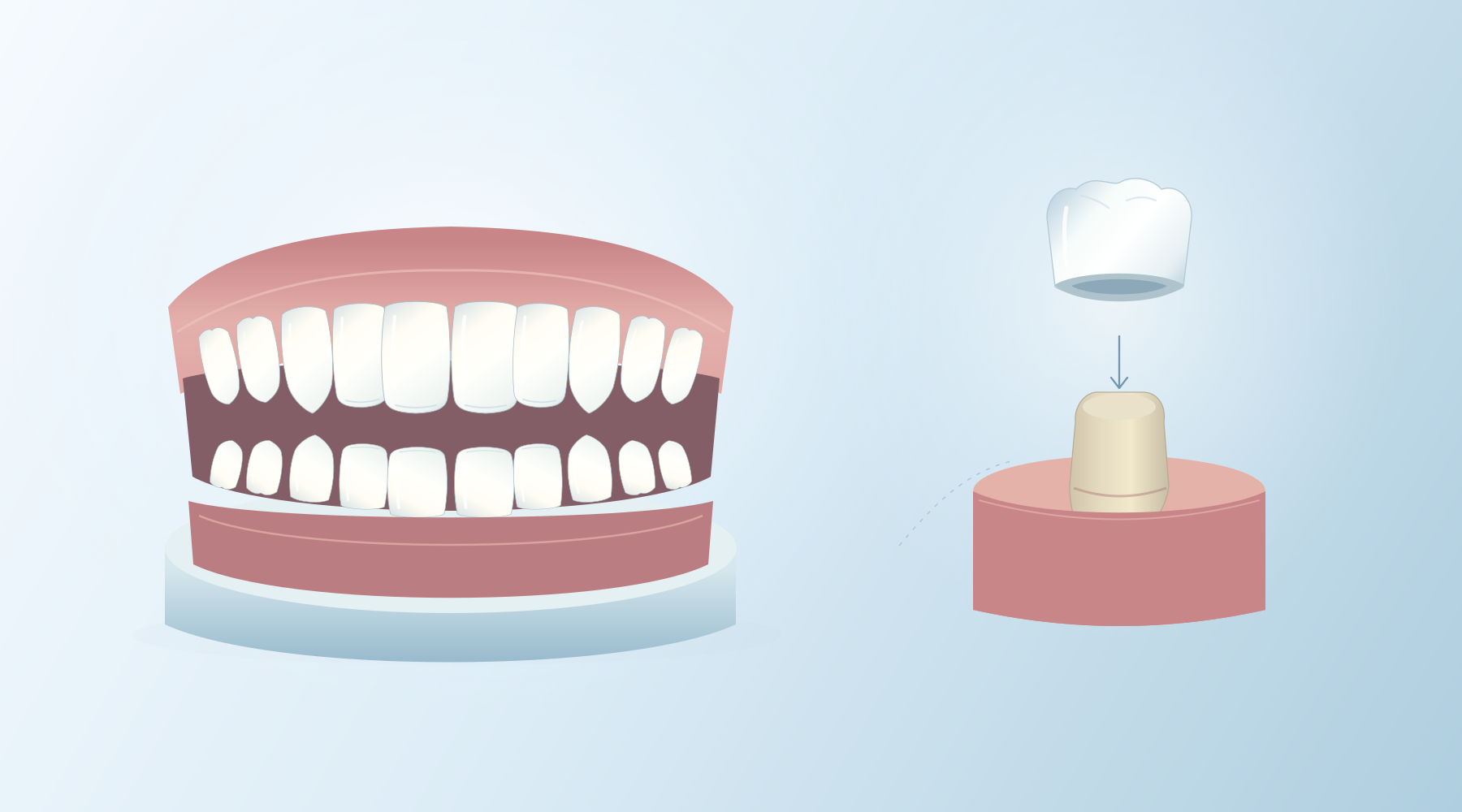
No. A crown covers most or all of the visible portion of a prepared tooth. A veneer normally covers the front-facing surface, while composite bonding may be added directly to selected areas to change shape or repair small defects.
The NHS notes that veneers may require preparation of the tooth’s front surface, although some designs require less preparation, and crowns require reshaping the tooth so the cap can fit. The amount of removal varies with the chosen treatment and clinical situation.
These differences become particularly important when a plan involves many otherwise healthy teeth. Less-invasive choices should be considered when clinically suitable, while a severely damaged tooth may still need a crown rather than a thin veneer.
Read our guides to tooth preparation for veneers and composite bonding for more detail.
What are the risks of crowning many teeth?
Every tooth prepared for a full crown loses some natural structure. Potential issues include temporary or persistent sensitivity, irritation of the dental pulp, a need for root canal treatment, gum inflammation, decay around margins, changes in the bite and chipping or failure of the restoration.
Because crowns may eventually need repair or replacement, treating a large number of teeth can also create a significant future maintenance commitment. A 2015 systematic review of single-tooth crowns found good average five-year survival across several crown materials, but also documented biological and technical complications. Its findings do not mean that a large cosmetic set will last forever or that extensive preparation is justified.
The British Dental Association has highlighted concerns about extensive crown placement on previously healthy teeth, particularly when patients return from treatment abroad requiring further care. These reports reinforce the importance of treatment planning and follow-up, rather than demonstrating that every overseas crown treatment is unsafe.
What should you ask before accepting a 24-crown quote in Turkey?
Request a written chart showing every tooth to be treated, the reason it needs treatment and the restoration proposed. Ask the dentist to distinguish cosmetic requests from structural problems and to explain any alternatives that preserve more tooth tissue.
Also clarify whether the quote includes examinations, imaging, temporary restorations, laboratory work, bite adjustments, follow-up appointments and treatment of any newly identified decay or gum disease.
The UK General Dental Council’s dental tourism guidance recommends finding out who will carry out the treatment, their qualifications, aftercare arrangements and who pays if complications require additional work.
Seek a second opinion if the proposed treatment is extensive and the explanation for each crown is unclear. There is no obligation to approve irreversible preparation because a travel booking has been made.
CK Health Turkey: a personalised smile makeover assessment
CK Health Turkey in Antalya supports international patients exploring dental treatment options in Turkey. If you are considering a smile makeover involving 24 crowns, you can begin by explaining your main concerns about appearance, chewing, existing dental work and whether your back teeth need treatment.
A qualified dentist needs to examine your teeth, gums and bite before deciding whether full crowns are appropriate and, if so, precisely which teeth should receive them. The consultation should also address less-invasive options, expected aftercare and any need for staged treatment rather than promising a fixed number of crowns in advance.
To discuss your individual needs and the consultation process, contact CK Health Turkey for further information.
Ultimately, the answer to how many teeth need crowns for a smile makeover is determined tooth by tooth. A proposal for 24 crowns may include back teeth, but healthy molars and premolars do not need crowns merely to complete a package; a properly assessed plan should protect your bite, preserve natural tooth structure and address the teeth that genuinely need treatment.