Highlights
- A 360 body lift can significantly alter existing lower back tattoos by partially removing, stretching, or repositioning the inked skin during the excision process.
- The final appearance of a tattoo depends on its proximity to the surgical incision line, which typically runs around the lower trunk, waist, and upper buttocks.
- Patients should discuss tattoo preservation with their surgeon before the procedure, as surgical goals like skin tightening may take priority over maintaining the tattoo's integrity.
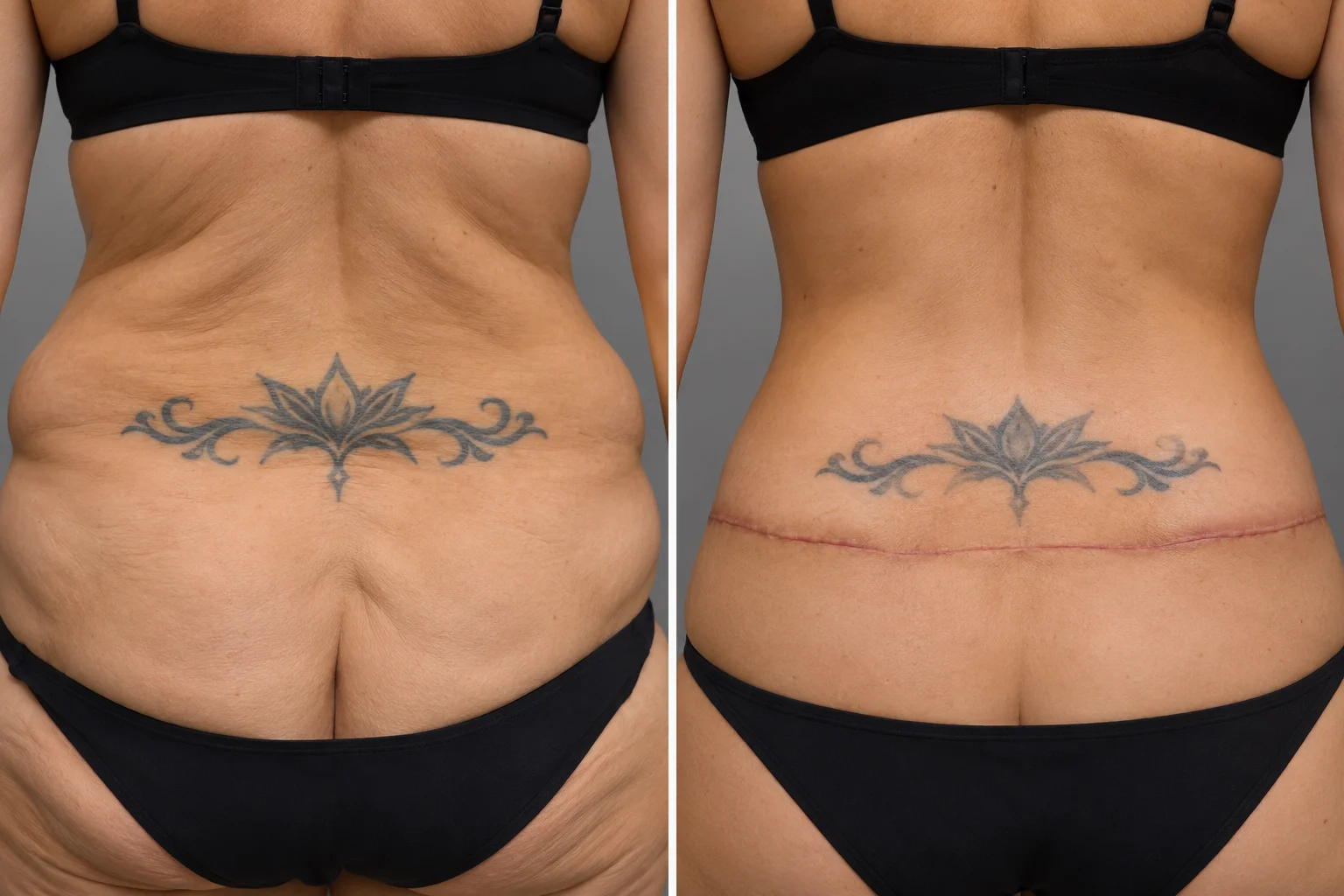
A lower back tattoo after 360 body lift surgery may look different from the way it did before, especially if the design sits close to the waistline or upper buttocks. A circumferential body lift removes excess skin and tightens surrounding tissues, which means an existing tattoo can be cut through, partly removed, stretched or repositioned. If you want a new tattoo after surgery, the timing also matters because healing skin and surgical scars need time to settle.
Table of Contents
This guide explains where the incisions usually run, how an existing tattoo may change and what to discuss with your plastic surgeon before planning a tattoo or a body lift.
Will a lower back tattoo after 360 body lift look the same?
Not necessarily. Whether your tattoo survives unchanged depends on its position, the amount of skin that needs removing, the proposed incision line and how the remaining skin is moved during surgery. A small tattoo located well above the planned incision may be largely unaffected, while a design crossing the lower back or upper buttock area may be altered substantially.
A 360 body lift, also called a circumferential lower body lift or belt lipectomy, is different from a standard tummy tuck. It addresses loose skin around the lower torso, potentially including the abdomen, flanks, waist, lower back, buttocks and outer thighs. The American Society of Plastic Surgeons (ASPS) explains that a circumferential incision allows excess skin and fat to be removed while tissues are repositioned.
The surgeon cannot know the final appearance of your tattoo from the name of the procedure alone. The key is to see exactly where the design lies in relation to the skin marked for removal.
Where is the scar after a 360 body lift?
A typical lower body lift leaves a long scar around the lower trunk. At the front, it generally runs low across the abdomen. It then extends around the sides of the waist and hips and towards the back, often near the upper buttocks. The exact position and shape vary depending on anatomy and the surgical technique.
The Aesthetic Society’s patient guidance describes a permanent scar that passes around the waist and above the buttock crease. It also explains that a surgeon may choose a higher or lower incision depending on the patient’s needs and preferences.
Because the scar crosses the general region where many people have lower back tattoos, the placement of the ink is especially relevant. A decorative design near the waistband, sacrum or upper buttock area might lie directly across the planned incision or within the section of skin to be removed.
For more about the operation itself, see our 360 body lift versus traditional tummy tuck guide.
How can a 360 body lift change an existing tattoo?
Several outcomes are possible, and more than one can affect a single design.
Part of the tattoo may be removed
If some of the tattoo is on skin that must be excised, that portion of the design may be removed along with the skin. For example, a lower-back design spanning the proposed excision area could lose part of a letter, outline or central motif. The remaining ink cannot be expected to join back together as the original image.
The tattoo may appear higher, lower or differently positioned
Skin is repositioned as surrounding tissues are lifted and the incision is closed. A tattoo that remains on the retained skin may therefore sit in a different position relative to your waist, buttocks or clothing line. Predicting its exact position is difficult until the surgeon has assessed how much tissue must be removed.
The design may stretch or change shape
Some remaining tattooed skin may be drawn tighter. An image with symmetrical lettering, straight lines or a geometric pattern can make even subtle distortion more noticeable. Swelling during the early recovery period can further alter its appearance temporarily.
A scar may divide the design
When the surgical incision crosses a tattoo, healing may leave a line through it. Pigmented skin at either side of the scar may not align exactly. Scar colour, width and texture can change during healing, so an early postoperative photograph may not show the final appearance.
A 2025 review about preserving tattoos during orthopaedic surgery discusses planning incisions around tattoos or incorporating them into an operative approach. Although it is not a study of lower body lifts, it reinforces a relevant principle: tattoos have personal significance, and their location should be considered during surgical planning rather than overlooked.
Which lower back tattoo placements are most likely to be affected?
There is no universal tattoo-safe zone, but location can help frame the conversation with your surgeon.
| Tattoo location | Possible effect of 360 body lift | What to clarify |
|---|---|---|
| Across the lower back at the waistline | May intersect the posterior incision or excised skin | Whether the central design will be cut or partly removed |
| Just above the buttock crease | May be near tissue removal and lifting | Whether its position or proportions may change |
| Higher on the back, above the planned surgical field | Less likely to be directly cut, but surrounding skin may shift | How far the proposed skin movement extends |
| Extending across the hips and flanks | May be affected by the circumferential incision on the sides | Which sections of the design lie in the excision area |
| On the upper buttocks | May be moved or partly removed depending on the technique | Whether buttock lifting changes the design’s location |
The table describes possible effects, not guaranteed results. Two patients with tattoos in approximately the same place can need different incisions because their skin excess and body proportions differ.
Can a surgeon preserve the tattoo by changing the incision?
Sometimes a surgeon can adjust markings within the limits of a safe, effective operation. However, preserving a tattoo should not compromise the blood supply, wound closure, scar position or intended contour correction. A lower body lift involves removing and moving enough skin to correct extensive laxity; simply drawing the incision around a tattoo may not be possible.
There are also different lower body lift techniques. A 2020 surgical case series involving 40 near-circumferential lower body lifts describes an approach that can preserve a bridge of skin across the lower back in selected patients. The authors explain that a complete posterior incision is not always required for their patients, but some patients with more extensive skin excess need a fully circumferential excision.
That study does not establish that a near-circumferential procedure will preserve every lower-back tattoo or that it is appropriate for everyone. The choice depends on body shape and the planned correction, not just personal preference about a design.
If a tattoo is especially important to you, bring this up before the surgeon finalises the operative markings. It is reasonable to discuss trade-offs, including whether some loss or distortion of the tattoo may be necessary to obtain the planned surgical result.
What should you do before surgery if you want to keep your tattoo?
Do not wait until the day of surgery to mention a tattoo that has personal or emotional value. During the consultation, explain which parts of the design are particularly important to preserve.
- Take clear photographs. Photograph the tattoo from the back and both sides while standing naturally, ideally showing the waist and upper buttocks.
- Show the full design. If the tattoo extends around your sides, let the surgeon see the complete artwork rather than one cropped image.
- Ask about the planned skin excision. Find out which skin is likely to be removed and where the final scar may sit.
- Discuss realistic outcomes. Ask whether the tattoo might be shortened, split, moved or distorted.
- Make your priorities clear. Explain whether preserving the tattoo matters more to you than a minor difference in scar placement or body contour, and listen to the surgeon’s safety assessment.
- Document the discussion. Confirm that you understand that the final result cannot be predicted with certainty before surgery.
A photograph or digital simulation can help communicate the likely changes, but it cannot guarantee how the ink and skin will settle after healing. Avoid choosing a surgical plan solely from a mock-up.
Should you get a new lower back tattoo before a body lift?
If you already know that you plan to have a 360 body lift, it may be sensible to postpone a new tattoo in the affected area until after surgery and recovery. A freshly placed design could end up on skin scheduled for removal or be distorted by the procedure.
New tattoos also create small wounds in the skin. They may cause irritation, allergic reactions or infection, all of which can complicate elective surgical planning. The US Food and Drug Administration (FDA) explains that tattoo inks and tattooing carry risks including infection and allergic reactions.
If you recently had a tattoo and are booked for surgery, tell your surgeon. Do not assume a newly tattooed area is ready for an incision simply because it looks dry on the surface. The team may need to examine it and decide whether the planned procedure should proceed as scheduled.
When can you get a new tattoo after a 360 body lift?
There is no reliable universal number of weeks for tattooing after a circumferential body lift. The answer depends on where the new design will sit, whether it overlaps the incision, how the tissues are healing and whether the surgeon expects further contour changes or revision surgery.
Tattooing directly over a surgical scar usually requires much more time than waiting for the skin to close. The Hull University Teaching Hospitals NHS Trust explains that scar maturation can take around 12–18 months. The NHS notes that some scars continue to fade and change for up to two years or longer.
That does not mean every scar becomes suitable for tattooing exactly at month 12 or 18. A mature-looking scar may still be raised, tender, numb, unstable or prone to abnormal scarring. Ask your operating surgeon to review the area and confirm whether tattooing is medically appropriate.
Breast Cancer Now’s guidance on decorative tattoos following surgery recommends waiting until scars are completely healed, which can take around a year, and ideally longer, and checking with the treatment team. Although that advice concerns breast surgery, it helps illustrate why fully healed surgical skin differs from a newly closed wound.
Can you tattoo over the body lift scar to hide it?
Some patients consider a decorative tattoo or medical tattooing to make a mature scar less noticeable. This may be an option in selected cases, but a tattoo does not remove scar tissue or guarantee that the scar will disappear.
Scarred skin can differ in thickness, colour, elasticity and sensation from surrounding skin. A design may not hold pigment evenly, and its appearance may change as the scar continues to remodel. A tattoo artist’s experience with mature surgical scars matters, but it does not replace medical clearance.
Do not tattoo over a wound that is open, inflamed, draining, unusually tender or still changing significantly. Patients with hypertrophic scars, keloids or a history of delayed wound healing should discuss the risks with a dermatologist or plastic surgeon before considering tattooing.
The FDA identifies infection, scarring and pigment reactions as recognised tattoo risks. A tattoo is therefore not a risk-free alternative to scar treatment. Our article on thigh lift scars and tattoo changes discusses similar considerations in a different body-contouring operation.
What about tattooing on skin away from the incision?
A new tattoo on an area of skin that has not been cut may sometimes be considered earlier than one that directly covers a body lift scar. However, body contouring can affect tissue tension, swelling, sensation and recovery beyond the visible incision, particularly near the lower back, hips and buttocks.
The timing should account for whether you still need compression garments, have residual swelling or experience numbness or tenderness in the planned tattoo area. Sitting, positioning and friction during a tattoo session may also be uncomfortable while the body lift is healing.
Rather than using a blanket rule such as “six weeks after surgery,” ask your surgeon whether the intended site is sufficiently healed and stable, even if it does not overlap the scar.
Does a tattoo feel different on numb or scarred skin?
Altered sensation can occur after a body lift because nerves in the skin and underlying tissues are affected by surgery. Some areas may feel numb, hypersensitive or tingly for a period of time. These changes can improve gradually, but some sensory changes may persist.
Numbness does not make tattooing automatically safe or painless. It may make it harder to recognise excessive irritation or skin injury during a tattoo session. Tattoo ink placed into scar tissue can also behave differently from ink placed into ordinary skin.
Discuss persistent sensory symptoms and any concerns about healing with your surgeon. A professional tattooist should be informed about the surgical history but should not be expected to diagnose nerve injury or scar stability.
What if your existing tattoo has already been distorted?
If your body lift has already taken place, allow swelling and scar changes to settle before making permanent decisions about correcting the tattoo. Early differences in shape may become less prominent as postoperative swelling resolves, but missing sections of a design will not regenerate.
Possible future options include working with an experienced tattoo artist to redesign the remaining artwork, placing a separate design in another location or considering medical advice about scar camouflage. Laser tattoo removal may be discussed in some circumstances, but it has its own potential adverse effects and may be more complicated on scarred skin.
According to the FDA, tattoo removal can require multiple sessions, may be incomplete and can cause additional scarring. Do not use unapproved creams or home removal techniques on a surgical scar.
If the tattoo crosses a painful, thickened or unstable scar, obtain clinical assessment before planning any cover-up, removal or correction.
Does scar position change when weight changes after surgery?
A 360 body lift can substantially change the shape of the waist and lower trunk. Subsequent weight changes can affect the surrounding tissues and may alter how existing tattoos look in relation to the body contours, even after the incision has healed.
The International Society of Aesthetic Plastic Surgery (ISAPS) recommends a stable weight before lower body lift surgery and explains that scars can continue maturing over many months. Maintaining a sustainable weight is relevant to preserving the general body-contouring result, although it cannot guarantee that every tattoo remains unchanged.
If you are still losing weight rapidly after bariatric surgery, discuss the timing of body contouring and any future tattoo with your clinical team. A more stable body shape can make both surgical planning and tattoo placement easier to evaluate.
What symptoms require medical attention after a body lift or tattoo?
During early body lift recovery, contact the surgical team if you develop increasing pain, spreading redness, heat, unusual discharge, fever, wound separation or a rapidly enlarging swelling. Do not assume a new tattoo-related irritation is harmless if the skin is inflamed or not healing.
The FDA advises medical review for a tattoo that is not healing or develops a rash, especially with fever. After major surgery, symptoms such as sudden shortness of breath or chest pain require emergency evaluation.
Do not apply tattoo products, perform scar massage or begin laser treatment near a healing incision without clearance from your surgical team.
Questions to ask before your 360 body lift
- Will the planned incision cross my lower back tattoo?
- Is any tattooed skin likely to be removed completely?
- Could the design stretch, split or appear in a different position afterward?
- Is there a medically appropriate way to adjust the incision without compromising the contouring result?
- How long might swelling and scar maturation affect the final appearance?
- When could I safely consider a new tattoo away from the scar?
- Would I be a suitable candidate for tattooing over the mature scar later?
- What follow-up should I arrange if the existing tattoo or scar becomes troublesome?
Ask to review the proposed incision markings while standing, if appropriate, so the relationship between the tattoo, waistline and intended scar is clear. Be prepared for the possibility that preserving every part of the tattoo may not be compatible with the operation your anatomy requires.
CK Health Turkey: discuss your tattoo before body contouring
CK Health Turkey in Antalya supports international patients exploring plastic surgery and body-contouring options. If you have an existing lower back tattoo, share clear photographs showing the complete design, including how it extends towards the hips or buttocks, before discussing a 360 body lift.
The operating plastic surgeon must assess your skin laxity, likely incision position and the trade-offs involved in preserving or removing tattooed skin. A patient coordinator can help organise the consultation and explain the treatment journey, but the final surgical plan and advice about future tattooing must come from the treating clinical team.
To ask about an individual body-contouring assessment, contact CK Health Turkey and explain your concerns about tattoo position, skin removal and scar placement.
Whether you already have a design or hope to create a new one, the key question about a lower back tattoo after 360 body lift is where the tattoo sits in relation to the tissue being removed and the scar that will remain. Discuss the existing artwork before surgery, expect possible changes to its position or shape and wait for appropriate healing and medical clearance before tattooing a new or scarred area.