Highlights
- Sleeping after a combined tummy tuck and BBL is complex because the tummy tuck requires a flexed abdominal position, while the BBL requires avoiding pressure on the buttocks.
- A modified side-lying position with flexed knees is often suggested as a compromise, but its suitability depends on the specific locations of fat grafts and incisions.
- Patients must follow a personalized recovery plan from their surgeon rather than using general guides, as improper positioning can damage grafts or strain abdominal repairs.
Finding comfortable tummy tuck and BBL sleeping positions can be one of the hardest parts of recovery when both operations are performed together. After a tummy tuck, patients are commonly asked to keep their hips slightly flexed to avoid pulling on the abdominal incision. After a Brazilian butt lift (BBL), prolonged pressure on newly grafted fat in the buttocks is usually restricted. Those instructions can conflict, which is why the position that works after either operation on its own may be unsuitable after the combination.
Table of Contents
This guide explains the possible positions, the limitations of pillows and recliners, and why a personalised recovery plan must be agreed with your surgeon before you go home.
Tummy tuck and BBL sleeping positions: why is it complicated?
The two operations involve different tissues that need protection during early healing. A tummy tuck, or abdominoplasty, removes excess abdominal skin and may tighten the abdominal wall. Tension across the lower abdominal incision can be uncomfortable and may affect healing, so patients are often advised to rest with their upper body and knees supported.
A Brazilian butt lift involves transferring fat to the buttocks, usually following liposuction in another area. Surgeons generally ask patients to limit direct, sustained pressure on the grafted areas during the initial recovery period. The American Society of Plastic Surgeons (ASPS) advises patients having buttock fat grafting to avoid prolonged sitting for approximately two weeks, sometimes longer, and describes side or stomach sleeping as common advice after BBL alone.
By contrast, the International Society of Aesthetic Plastic Surgery (ISAPS) describes an early flexed sleeping posture after abdominal surgery, with the upper body and knees supported to protect the abdominal incision.
Neither recommendation should simply be copied into a combined-surgery recovery plan. The treating surgeon must decide how to protect the abdominal closure and the areas where fat was placed while ensuring you can move safely, breathe comfortably and get out of bed.
How do sleeping instructions differ after each operation?
Understanding the individual instructions helps explain why the combination needs extra planning.
After tummy tuck surgery
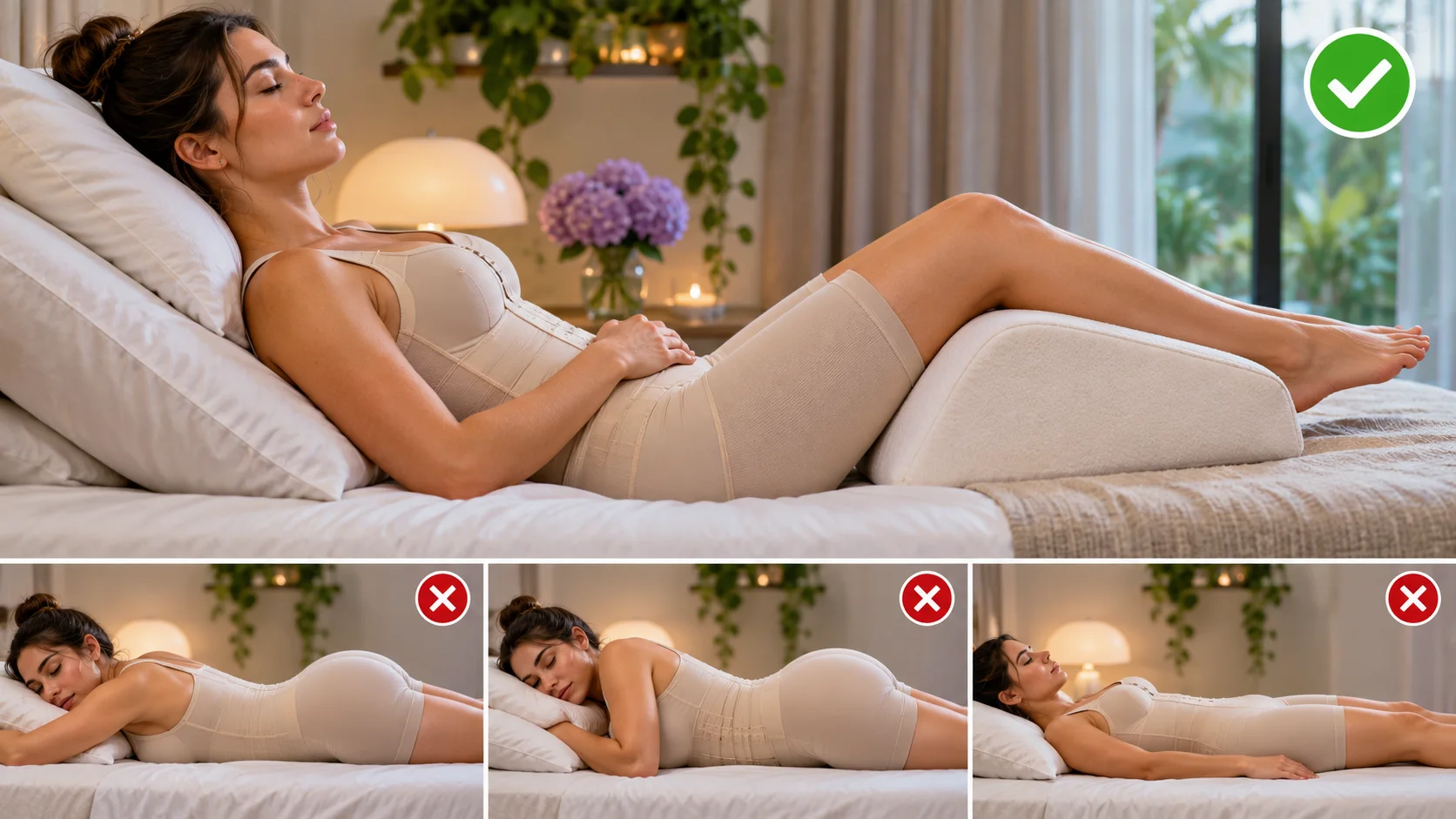
Many patients rest on their back in a slightly bent or “beach chair” position. Support beneath the knees and behind the upper back reduces the tendency to stretch the abdomen fully. Some patients use an adjustable bed or recliner. The ASPS notes that patients may need to remain flexed at the waist during the first week or so after a tummy tuck, although timing depends on the procedure and the surgeon’s instructions.
Sleeping face down soon after abdominal surgery can place pressure on the healing abdomen and may be painful or inappropriate, particularly if muscle repair was performed.
After BBL fat transfer
Surgeons typically try to minimise prolonged pressure on the grafted buttocks. The ASPS describes stomach or side sleeping as options after isolated buttock fat grafting. However, these positions are not automatically suitable if you also have a freshly tightened abdominal wall, incisions along the hips or fat placed in the lateral hip area.
Restrictions on direct sitting and sleeping pressure vary. An ASPS patient page describes avoiding prolonged sitting for around two weeks, while other surgeon protocols last longer. There is no single scientifically proven day when all grafts tolerate unrestricted pressure.
Which position may be considered after a tummy tuck and BBL together?
A surgeon may consider a carefully supported side-lying position with gentle hip and knee flexion for selected patients because it avoids placing full body weight on the abdomen or directly on the central buttocks. This is sometimes described as a modified fetal position.
However, a side position can still load the outer hip and lateral buttock. If fat was injected into those areas, or if the liposuction and incision sites make side-lying painful, this may not be acceptable. It is also possible that the abdominal repair or drains limit how much you can twist or curl up.
Some surgeons may instead prescribe a specifically supported reclined arrangement that attempts to offload the grafted buttocks while maintaining abdominal flexion. Others advise staging the operations because a practical, reliable position is too difficult to achieve safely in certain patients.
Do not select your sleeping position from a diagram alone. Your surgeon or nursing team should demonstrate exactly where supports go and confirm that the final position does not press on the areas that were grafted or place excessive tension on the tummy tuck incision.
Sleeping positions compared
| Position | Tummy tuck considerations | BBL considerations |
|---|---|---|
| Flat on the back | May stretch the abdominal incision if the hips and knees are fully extended | Can place prolonged pressure on the grafted buttocks |
| Reclined, hips and knees flexed | Often used after tummy tuck to reduce abdominal tension | Needs special assessment because buttock pressure may remain |
| Face down on the stomach | May press on the abdominal repair, wounds or drains | Commonly used after isolated BBL, but not necessarily with tummy tuck |
| Supported side-lying with gentle flexion | May allow some flexion without full abdominal pressure | May load the outer hip or lateral grafts; not suitable for everyone |
| Specialist pressure-relief surface | Must still support abdominal positioning and safe transfers | May offload selected areas, but requires surgeon approval and correct fitting |
None of these options is universally safest for someone with both procedures. The table highlights the decisions your surgical team must resolve, not instructions to improvise a position at home.
Can I sleep on my side after tummy tuck and BBL?
Possibly, if your surgeon explicitly approves it. Side-lying may provide a compromise between protecting the abdominal incision and avoiding direct central buttock pressure. A slightly flexed posture can reduce the pull on the lower abdomen compared with lying completely flat and straight.
The difficulty is knowing where your grafted fat was placed. If your BBL included hip-dip correction or lateral buttock fat transfer, one side of the body may rest directly on tissue the surgeon wants protected. A side position may also be uncomfortable where liposuction was performed around the waist or flanks.
A surgeon who discusses combining these procedures specifically recommends a side-lying, flexed position for selected patients, but that is a practice-specific recommendation, not a universal protocol established by clinical trials. Other plastic surgeons advise against combining the operations partly because comfortable recovery positioning is difficult.
Ask whether it is acceptable to lie on either side, whether the outer hips must be protected and how you should change positions during the night. Do not assume the same rule applies to every BBL design.
Why is stomach sleeping difficult after abdominoplasty?
After BBL alone, lying on the stomach may help reduce pressure on the buttocks. After a tummy tuck, however, the abdomen has a new incision and tightened tissue. Turning face down can put weight on the surgical area and may force the body into a less flexed position than the surgeon intends.
Muscle repair, swelling and drains can add to the difficulty. A patient who is drowsy from pain medication may also have trouble repositioning safely without assistance.
Even a special mattress or cushion designed for BBL recovery should not be assumed to make prone sleeping safe after tummy tuck surgery. Your team needs to examine how the surface supports the abdomen and whether it interferes with the incision or breathing.
Is a recliner safe after tummy tuck and BBL?
A recliner is often useful after a tummy tuck because it can keep the upper body raised and the knees bent. But a normal recliner also supports body weight through the buttocks, potentially creating the pressure a BBL recovery plan aims to avoid.
That means a standard recliner may solve one problem while creating another. Placing an ordinary cushion beneath the buttocks does not necessarily remove pressure from grafted fat. The ASPS advises that when sitting is permitted after isolated BBL, appropriate padding may be placed under the backs of the thighs to help reduce direct buttock pressure.
For combined procedures, ask your surgeon whether any supported reclined setup can be used for sleeping, not only for short transfers or sitting. A safe arrangement must avoid unstable positioning and must not obstruct circulation, breathing, incision care or access to your drains.
If you cannot comfortably maintain the prescribed position, contact the medical team. Do not compensate by stacking so many pillows that you might slide, roll or become trapped in an awkward posture.
Do BBL pillows, wedges and specialised beds help?
Recovery aids may make positioning easier, but no pillow is a substitute for a clinically approved plan. A BBL cushion is usually designed to shift some sitting pressure towards the thighs. It is not necessarily intended for all-night sleeping or for someone who has also had abdominal wall repair.
A wedge pillow may support the upper body or knees after tummy tuck surgery, whereas a positioning pillow around the hips may change how weight is distributed over grafted areas. Incorrect placement can transfer pressure to a different area of the graft.
Before buying equipment, show your surgeon the exact product and ask whether it is suitable for your operation and graft placement. If possible, have the hospital team help you try the actual supported position before discharge.
Do not rely on online marketing claims such as “protects 100% of BBL fat” or “guarantees graft survival.” The amount of fat retained depends on multiple surgical and biological factors, and postoperative pressure reduction cannot guarantee a specific cosmetic result.
How long must you avoid sleeping on your back or buttocks?
The restrictions are individual. ASPS guidance for isolated buttock fat grafting describes avoiding prolonged sitting for about two weeks, with some surgeons preferring longer. Other clinical protocols extend pressure precautions for several weeks. The precise point at which sleeping on the back becomes acceptable after a combined tummy tuck and BBL has not been established by a single high-quality trial.
Meanwhile, tummy tuck patients may gradually reduce the degree of flexion as abdominal tightness and wound healing improve. The need to protect the incision can persist even when discomfort begins to settle.
The two time frames do not necessarily end together. For example, a surgeon might clear changes in abdominal posture while continuing some graft-pressure restrictions—or the opposite, depending on healing and the operation performed.
The safest approach is to obtain instructions for your first night, the first follow-up visit and each later change in position. Avoid treating “two weeks” or “six weeks” as automatic permission to sleep normally.
What happens during the first night after combined surgery?
Your team should help you into an approved resting position while monitoring pain, circulation, breathing, bleeding and other early recovery concerns. You may have abdominal dressings, a compression garment and one or more drains, depending on the operation.
Getting up from bed may be more difficult because you are protecting both a fresh abdominal incision and grafted areas. Nurses can teach you how to move without abrupt twisting or straining and explain when assistance is needed.
Before leaving the hospital, make sure you know how to reposition, use the toilet, manage drains and get help if your prescribed posture becomes intolerable. A clear written plan is more useful than being told simply to “avoid your stomach and bottom.”
How can you get out of bed without pulling the incision?
After abdominal surgery, staff may teach a log-roll or supported side-turn method: move your shoulders and hips together, use your arms to help push up and avoid a forceful sit-up that strains the abdominal muscles.
However, a standard side-turn technique may load a recently grafted outer hip. If you have had BBL at the same time, ask a nurse or physiotherapist to demonstrate a transfer technique suited to your actual graft locations. Assistance may be needed during the first days.
Set essential items within reach and keep the route to the bathroom clear. Do not attempt a sudden movement because you are worried about spending a few seconds in the wrong position; controlled, assisted movement is often safer than rushing.
Our guide on sleeping after a 360 body lift covers another major body-contouring procedure, but a circumferential body lift is not the same as gluteal fat transfer and has its own incision pattern.
Why is walking important even when sleeping is difficult?
Rest is necessary, but staying completely immobile for long periods can increase the risk of postoperative blood clots. The NHS explains that early movement, leg exercises and sometimes compression stockings or prescribed medication are used to reduce clot risk after surgery.
How soon to walk and how far to go depend on your procedure and medical status. Your team may encourage short, assisted walks soon after surgery while also limiting strenuous activity, heavy lifting and pressure on the grafted areas.
Follow your surgeon’s advice on prescribed compression, anticoagulants and movement. Do not stop walking altogether simply to avoid changing sleep positions, and do not take extra blood-thinning medicines without clinical advice.
Seek emergency medical care for sudden breathlessness, chest pain, fainting or a concerning swollen, painful leg. These symptoms are not normal postoperative sleep difficulties.
Are tummy tuck and BBL safe to combine in one operation?
This is an important question to resolve before making a sleeping plan. Combining the operations can lengthen time under anaesthesia and adds potential challenges related to liposuction, abdominal skin blood supply, positioning and postoperative mobility.
Some surgeons perform both procedures together in carefully selected patients, while others prefer staging them because the recovery requirements conflict. An experienced plastic surgeon should explain whether a combined operation is appropriate for your health, body composition, intended liposuction areas and surgical goals.
A 2026 retrospective cohort study published in Aesthetic Plastic Surgery reviewed 1,120 patients, including 550 who had BBL, liposuction and abdominoplasty together. The combined group underwent longer operations and showed greater intraoperative physiological demands. The study did not demonstrate a statistically significant difference in recorded complications between groups, but it involved selected patients at one centre and does not establish that combining the procedures is safe for every patient.
A published critical appraisal of that study raised concerns about patient selection, limited complication events and outcome reporting. These limitations are important when evaluating claims that a combined procedure is automatically as safe as staged surgery.
Also, gluteal fat grafting has specific safety concerns, including life-threatening fat embolism. A multisociety safety statement supports placing fat only in the subcutaneous plane and using real-time ultrasound to help confirm safe injection placement. Choosing between combined and staged surgery must include these technical safety considerations—not only travel convenience or one recovery period.
Would staging the tummy tuck and BBL make recovery easier?
For some patients, staging the two operations allows each recovery to follow a more straightforward position plan: the tummy tuck can heal without pressure concerns from newly transferred buttock fat, and the BBL can be followed by its own graft-protection instructions.
Staging means two separate operations, which brings additional anaesthesia, recovery time, travel or costs. That trade-off must be considered alongside surgical duration, body contouring goals, available donor fat and the patient’s health.
There is no universal rule that all patients must stage or all patients can safely combine the procedures. The decision should be made with a qualified plastic surgeon, based on an individual assessment and a realistic plan for mobility, positioning and follow-up.
Our guide to combining plastic surgery procedures explains broader factors to discuss before booking more than one operation.
Can compression garments or drains affect how you sleep?
Yes. A garment that supports swelling and contouring should fit according to the surgical team’s instructions. Some patients have drains, particularly after tummy tuck surgery, which need to be secured so that tubing is not pulled or compressed during position changes.
Garment instructions after BBL can differ from those after tummy tuck, especially around grafted areas. Do not add tight padding, an extra binder or an improvised cushion that presses on tissue your surgeon has instructed you to protect.
Ask how to protect the drain sites, where to place tubing at night and when to call if a drain is dislodged or stops working as expected. Avoid disconnecting or repositioning drains without instruction.
What if I roll onto my back or stomach while sleeping?
Waking up in an unintended position can be worrying, but it does not automatically mean the graft has failed or the abdominal repair has opened. Do not attempt to assess that by pressing on the tissues or repeatedly testing a painful movement.
Return carefully to the position prescribed by your surgeon and contact the clinical team if you develop new severe pain, sudden swelling, bleeding, wound separation or other concerning symptoms. If you repeatedly roll out of position, tell the team rather than adding unstable barriers or sleeping in a position that interferes with breathing.
A partner or caregiver may be able to assist with safe transitions and practical needs, especially during the first few nights. However, continuous monitoring by an untrained companion is not a replacement for the level of professional postoperative observation your surgeon considers necessary.
How to prepare your recovery space before surgery
A workable sleeping setup begins before your operation, not when you are exhausted after arriving back at the hotel or home.
- Request written position instructions. Ask your surgeon to identify which surfaces and areas of pressure must be avoided.
- Confirm whether your operations will be combined. If the combination creates an unacceptable positioning conflict, discuss staging before surgery.
- Plan the sleeping surface. Ask whether an adjustable bed, specific pillow arrangement or other support is approved for your case.
- Arrange assistance. Someone may need to help you get into bed, turn or stand without abrupt movements.
- Keep supplies nearby. Position prescribed medicines, water if permitted, your phone and drain records within easy reach.
- Plan safe mobility. Make sure you can get to the bathroom, take short approved walks and follow clot-prevention instructions.
- Schedule postoperative reviews. Confirm who will assess the abdominal incision and fat graft areas, especially if travelling internationally.
A useful plan should be demonstrated in practice. If the exact sleeping position is impossible because of pain, breathing difficulties or graft placement, your surgeon needs to reassess it rather than expect you to endure an unsafe arrangement.
Questions to ask your plastic surgeon
- Can the planned tummy tuck and BBL be combined safely in my particular case, or would staging be preferable?
- Where exactly will fat be grafted: central buttocks, outer hips or both?
- What sleeping position should I use during the first night and first week?
- Is side sleeping allowed, and how should I support my hips and knees?
- Can I use a recliner or BBL pillow without putting pressure on the grafts?
- How do I get into and out of bed without straining the tummy tuck incision?
- How long should I continue pressure precautions, and who will clear changes?
- Which symptoms warrant an urgent call or emergency treatment?
- Who will help me with positioning and mobility before I travel home?
Take the answers with you in writing, especially when the hospital, hotel and home recovery environments will be different.
CK Health Turkey: individual recovery planning for body contouring
CK Health Turkey in Antalya supports international patients exploring plastic surgery and body-contouring options in Turkey. Patients considering both a tummy tuck and BBL should discuss their treatment goals, medical history, travel plans and practical recovery arrangements before committing to a combined procedure.
The operating plastic surgeon and clinical team must decide whether the two operations are appropriate together, explain the procedure-specific risks and agree on a sleeping and mobility plan. A coordinator can help patients understand the consultation, treatment and travel process, but should not substitute general pillow advice for surgical instructions tailored to the actual incision and fat-grafting sites.
To ask about a personalised assessment and how postoperative care is planned, contact CK Health Turkey.
The most useful guidance on tummy tuck and BBL sleeping positions recognises that protecting the abdominal closure and protecting transferred buttock fat can require opposing positions. Side-lying or specialist support may be considered for selected patients, but neither is a universal solution. Discuss the feasibility of the combination, agree on a demonstrated sleeping plan before discharge and follow the instructions of the team responsible for your surgery.