Highlights
- The fleur-de-lis (FDL) tummy tuck is specifically designed for post-weight loss patients to address skin laxity in both horizontal and vertical directions, resulting in a T-shaped scar.
- Combining an FDL tummy tuck with a breast lift and implants is possible for selected patients, but it increases surgical complexity and requires stable weight and good nutritional health.
- While combined procedures can reduce the number of hospital visits, research indicates they may carry a higher risk of complications compared to performing breast surgery alone.
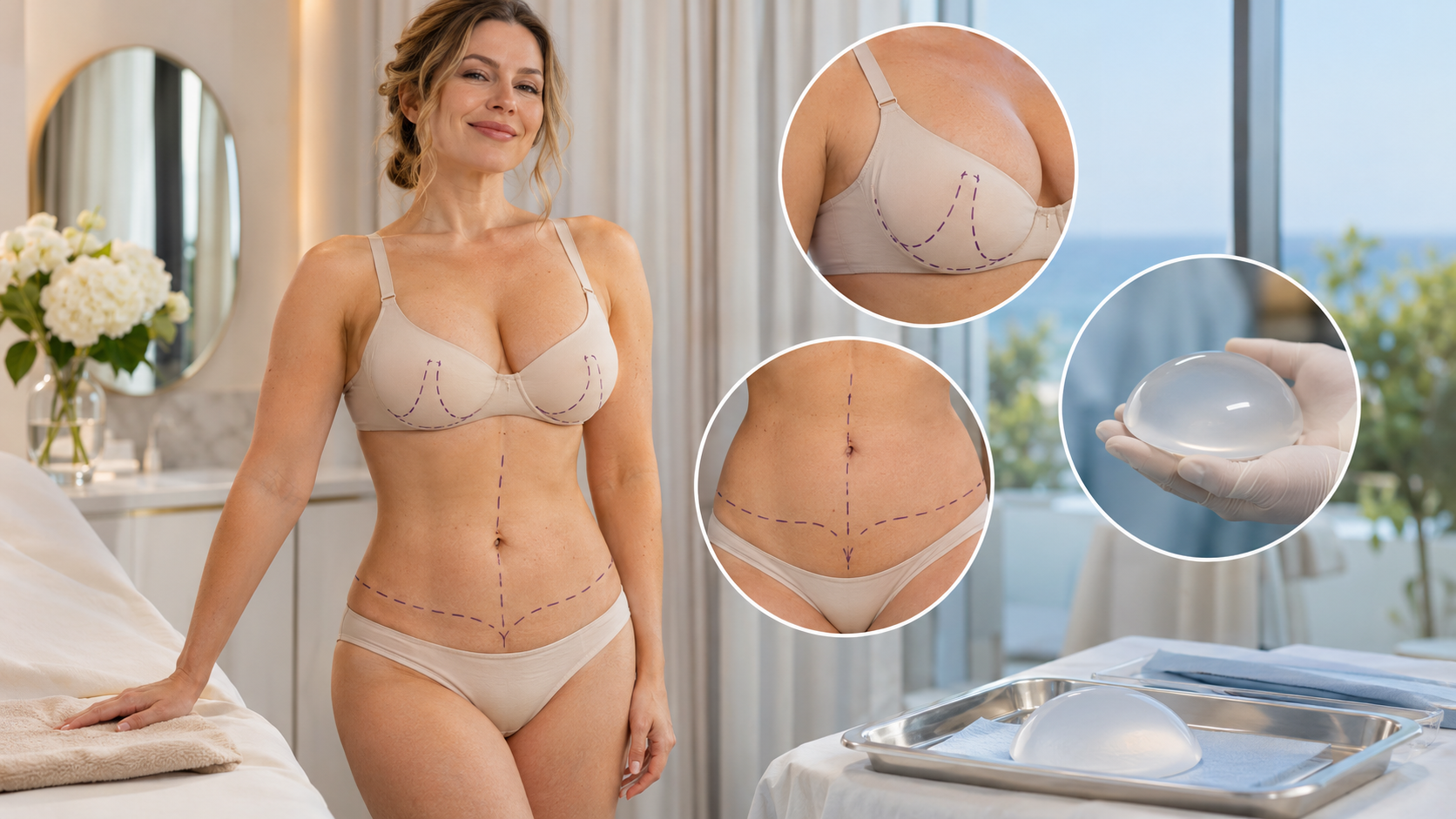
Considering an FDL tummy tuck with breast lift and implants after major weight loss can raise an important question: can the abdomen and breasts be reshaped safely during one operation? A fleur-de-lis (FDL) tummy tuck addresses loose skin in two directions, while a breast lift with implants aims to reposition drooping tissue and restore volume. Combining all three elements may be appropriate for carefully selected patients, but it is a more involved plan than a standard tummy tuck or breast uplift alone.
Table of Contents
This guide explains who might benefit, the scars and recovery involved, why surgeons sometimes recommend staging, and what to discuss if you have previously had gastric sleeve or other weight-loss surgery.
What is an FDL tummy tuck with breast lift and implants?
An FDL tummy tuck, also called fleur-de-lis abdominoplasty, removes abdominal skin through both a low horizontal incision and a vertical incision along the midline. It is mainly considered when loose skin hangs across the abdomen and folds from side to side following substantial weight loss. The vertical component lets the surgeon reduce excess width that an ordinary horizontal tummy tuck may leave behind.
A breast lift (mastopexy) reshapes breast tissue, removes excess skin and raises the nipple-areola position when needed. Breast implants may be added to increase volume, especially upper-breast fullness lost with weight reduction. The three components address different problems: abdominal skin excess, breast drooping and loss of breast volume.
The American Society of Plastic Surgeons (ASPS) explains that fleur-de-lis surgery adds a vertical abdominal scar and is usually reserved for patients needing substantial correction. An implant is not automatically necessary for a mastopexy, and an FDL is not the right tummy tuck for every post-bariatric patient.
Who might consider this combination after major weight loss?
People who have lost substantial weight after a gastric sleeve, gastric bypass or sustained non-surgical weight loss sometimes experience loose abdominal folds and deflated, lower-positioned breasts. When weight is stable, this may be an appropriate time to discuss body-contouring options.
A surgeon will assess the amount and direction of abdominal skin excess, remaining breast volume, nipple position, scarring, body mass index (BMI), nutrition and overall medical health. The goal is to determine which procedures are truly necessary, not to fit everyone into a fixed three-part package.
For patients with ongoing weight loss, a major concern is that further reductions in body fat can change breast volume and the way the abdomen looks after surgery. The clinical review of plastic surgery after massive weight loss describes weight stability of several months as an important selection criterion, while also noting the additional medical and nutritional considerations in post-bariatric patients.
Not everyone who has lost weight needs an implant. Someone with enough remaining breast tissue may obtain the desired appearance from reshaping alone. Our article on recurrent breast sagging after a post-sleeve lift discusses the effects of future weight changes.
Why choose fleur-de-lis instead of a standard tummy tuck?
After extensive weight loss, the abdominal skin can hang vertically and also remain excessively wide. A conventional abdominoplasty mainly removes skin through a low horizontal incision, which may not sufficiently address central horizontal looseness. An FDL adds a vertical removal pattern to narrow and reshape the central abdomen.
This extra correction requires a trade-off: a visible midline scar plus the low horizontal scar. The incisions meet at a T-shaped junction, which can be more vulnerable to healing difficulties where tissue tension and blood supply must be carefully managed.
A 2025 surgical review of body-contouring incisions describes how fleur-de-lis excision is designed to address skin laxity in more than one direction. The StatPearls abdominoplasty reference specifically identifies wound-healing problems at the T-point as a concern with this technique.
By contrast, an extended tummy tuck mainly carries the horizontal incision farther towards the hips. It is not interchangeable with FDL, and neither should be confused with a circumferential 360-degree body lift. Our extended versus standard tummy tuck comparison explains those distinctions.
How does the breast lift with implants work?
A breast lift moves and reshapes the breast tissue to improve drooping. Incisions may be around the areola, extend vertically to the breast crease, or form an inverted-T pattern, depending on the excess skin and desired change. Implant placement is a separate decision based on breast anatomy and volume goals.
After major weight loss, the breast skin may have reduced elasticity and the tissue may be relatively thin. An implant can add fullness but also adds weight and can create additional demands on the skin and supporting structures. Choosing a larger implant simply to fill loose skin does not guarantee a longer-lasting lift.
The ASPS breast lift safety guidance confirms that implants can be placed at the same time as mastopexy or in another operation, depending on individual factors. Patients should discuss the chosen implant type, positioning, planned incisions and whether a more conservative or staged approach better fits their tissue quality.
Our guide to breast implants over or under the muscle explores another part of the decision.
Can FDL tummy tuck, breast lift and implants all be done together?
Sometimes, but the fact that each procedure is individually possible does not establish that all three should be combined. Combining them may reduce the number of separate hospital admissions or travel journeys, yet it also creates a longer, more complex operation and simultaneous healing needs in the abdomen and breasts.
The surgeon and anaesthetist should assess estimated operating time, blood-clot risk, wound-healing capacity, BMI, medical conditions and the extent of tissue removal. Other proposed additions, such as extensive liposuction, can further alter the risk-benefit balance.
A 2026 systematic review and meta-analysis combined eight studies involving 138,020 patients. It found no statistically significant difference in overall complications between combined abdominal and breast surgery and all isolated procedures grouped together, but considerable differences between studies. Compared specifically with isolated breast surgery, combined procedures had a higher complication risk; compared with abdominoplasty alone, the difference was not statistically significant.
These findings have important limits. The review included a mixture of tummy tuck and breast techniques; it did not establish the safety of FDL plus augmentation-mastopexy as a unique three-component operation for every patient. Risk also depends on which procedure is used as the comparison. The authors rated the evidence certainty from moderate to very low.
A 2023 analysis of 26,771 plastic surgery cases similarly found that certain combined operations, particularly combinations involving augmentation or trunk liposuction, had elevated complication rates after adjustment. This supports careful patient selection rather than a blanket yes-or-no rule.
Should the operations be performed together or in stages?
There is no universal best sequence. A surgeon might consider a single operation for a medically suitable patient with stable weight, manageable surgical duration and adequate recovery support. Another patient may benefit from FDL first, followed by a breast lift with implants after abdominal recovery, or from a breast lift first with implants delayed until tissue position has settled.
| Decision factor | One combined operation | Staged operations |
|---|---|---|
| Time under anaesthesia | One, generally longer procedure | Two or more separate procedures |
| Early healing | Abdominal and breast wounds heal together | Each area can recover at a different time |
| Movement and assistance | Abdominal and upper-body restrictions overlap | Recovery tasks can be less overlapping |
| Travel and time away from work | May involve one journey and one main recovery | May involve more trips and time off |
| Suitability | Requires a sufficiently favourable risk assessment | May be preferred when surgery is extensive or risk factors need managing |
| Overall risk | Not automatically safer because there is one anaesthetic | Not risk-free; additional operations have their own risks |
Discuss what would genuinely be gained or lost by staging. A plan should not be driven solely by saving a flight, and a surgeon should be willing to recommend fewer procedures if that is safer or more consistent with your goals.
What are the main risks of the combined procedure?
Each component carries recognised risks, and their interactions need consideration. Possible abdominal complications include wound separation, infection, delayed healing, fluid collection (seroma), bleeding, altered skin sensation and unfavourable scarring. FDL’s T-junction needs particular attention.
Breast lift risks include poor wound healing, changes in nipple or breast sensation, asymmetry, fat necrosis and, rarely, partial or complete loss of nipple-areola tissue. Breast implants add risks such as capsular contracture, malposition, rupture, infection and the possibility of future surgery.
The US Food and Drug Administration (FDA) stresses that breast implants are not lifetime devices. Implant-associated anaplastic large cell lymphoma (BIA-ALCL), other rare implant-capsule malignancies and systemic symptoms also warrant informed discussion. The probability and type of complication depend on individual circumstances and the implant used.
Major surgery and reduced postoperative mobility also increase concern about deep vein thrombosis (DVT) and pulmonary embolism. Your clinical team should plan individual clot-risk prevention, early safe mobilisation and any appropriate medication. Do not start or stop blood-thinning medication independently.
A 2010 study of 499 patients after major weight loss, including 154 who had an FDL component, found broadly similar abdominal complication rates between FDL and transverse-only abdominoplasty except for a higher rate of wound infection in the FDL group after adjustment. This study did not examine the exact combination of FDL, breast lift and implants, so it cannot supply an individual risk estimate for that plan.
What scars should you expect?
FDL usually leaves a low horizontal scar across the lower abdomen and a vertical midline scar that may extend well above the navel. Depending on the method, the navel may have an additional scar around its new opening. The final markings depend on the location of loose skin and previous scars.
A breast lift may leave a scar around the areola, down the lower breast, and possibly along the breast crease. Implant insertion may be incorporated into this pattern or require planning appropriate to the chosen technique.
All surgical scars are permanent, although their colour and texture often change considerably during maturation. Healing varies, and an FDL scar is typically harder to conceal than the low horizontal scar of a conventional tummy tuck. A surgeon should show realistic, consented examples of mature outcomes in patients with comparable skin excess.
Ask specifically about scar positioning, the T-junction, previous abdominal incisions and any history of poor healing or prominent scars. Scar visibility is an important trade-off to accept before proceeding.
How long after gastric sleeve or bypass should you consider surgery?
Most body-contouring teams prefer a period of stable weight after the main phase of bariatric weight loss. A review of post-massive-weight-loss plastic surgery describes considering body contouring about a year after bariatric surgery when weight has remained stable for at least three to six months in appropriately selected patients. Those figures are general clinical guidance, not automatic clearance.
Additional weight loss after breast surgery can change breast fullness and skin tension. Weight regain can also affect both the abdomen and the breasts. If your weight is still changing significantly, discuss whether waiting could help the surgeon plan a more durable result.
Weight stability is only part of the assessment. Someone who is still struggling with vomiting, poor dietary tolerance, anaemia or other medical issues may not be ready even if their weight has stopped falling.
Why are protein and vitamin levels important before FDL and implants?
After gastric sleeve or bypass, dietary intake and nutrient status need ongoing monitoring. In a procedure with substantial abdominal and breast incisions, wound healing is a key concern, particularly if the patient has a history of reduced protein intake or nutritional deficiencies.
The British Obesity and Metabolic Surgery Society (BOMSS) guidance recommends lifelong nutritional follow-up after bariatric surgery, including regular monitoring of blood count, ferritin, folate, vitamin B12 and other nutrients according to the operation and clinical history. Deficiencies should be assessed and corrected before additional elective surgery where clinically indicated.
For an FDL and breast procedure, a surgeon may work with the bariatric team or dietitian to review protein adequacy, weight history, supplements and relevant blood results. Not every patient needs every possible test, and normal-looking skin does not prove that nutrition is sufficient.
Our gastric sleeve aftercare blood-test guide and protein-tracking guide offer further context.
What does recovery involve when abdomen and breasts heal together?
After an FDL tummy tuck, the abdomen may feel tight and the surgeon may recommend keeping the hips slightly flexed early in recovery. Dressings, compression garments and drains may be used. After a breast lift with implants, the breasts may be swollen or sore, with a support bra and restrictions on reaching, pushing or lifting.
When these restrictions overlap, ordinary tasks such as getting out of bed, washing, dressing or using the toilet can be harder. A patient may need assistance to avoid straining the abdomen while not pushing heavily with the arms and chest.
The ASPS tummy tuck recovery guidance and breast lift recovery guidance both emphasise wound care, support garments and individual instructions for returning to activity. With a combined procedure, do not assume the timetable for a standard tummy tuck alone will apply.
Short, assisted walks are commonly encouraged when medically appropriate to support circulation, but vigorous exercise, lifting and strenuous movement need the surgeon’s clearance. Scars and swelling may continue to change for many months.
Arrange help with meals, luggage, childcare and household tasks. If travelling abroad, confirm who will check both the abdominal T-junction and breast incisions before you return home.
What symptoms require prompt medical attention?
Contact the surgical team if you develop increasing redness, spreading warmth, new or worsening wound drainage, fever, wound separation, rapidly increasing swelling, marked breast asymmetry or pain that is becoming more severe instead of gradually improving.
A sudden change in breast size or shape may indicate bleeding or another issue that warrants assessment. A darkening nipple-areola area, a poorly healing abdominal junction or a new collection of fluid should also be reported promptly rather than treated at home with unapproved creams.
Sudden chest pain, breathlessness, fainting or a painful swollen leg needs urgent medical assessment because a blood clot or another serious problem may be involved. Postoperative warning signs should never be ignored to avoid an extra hospital stay or a change to travel plans.
What will an implant mean for the long term?
A breast implant can help restore volume lost after major weight reduction, but it does not permanently prevent breast skin from stretching or drooping again. Normal ageing, further weight changes and tissue quality continue to influence the result.
The FDA advises that implants are not lifetime devices and may require additional surgery. Silicone gel implant recipients should discuss the recommended ultrasound or MRI surveillance schedule with their surgeon. Implants also do not replace routine breast screening or assessment of new breast symptoms.
If long-term implant maintenance is a concern, ask whether a lift using your own breast tissue could achieve an acceptable shape without implants. Our comparison of breast lifts, reductions and implants can help frame this discussion.
Questions to ask before choosing this combination
- Why is an FDL needed rather than a standard or extended tummy tuck?
- Exactly where will the vertical, horizontal and breast scars sit?
- Is abdominal muscle repair planned, and how will it affect recovery?
- How much breast skin and volume have I lost after weight loss?
- Could breast lift alone meet my goals, or is an implant necessary?
- What implant type and size are proposed, and what long-term monitoring is required?
- How long is the anticipated operation, and what makes combining all components reasonable for me?
- Would staging the procedures materially change my risk or recovery plan?
- Have my weight stability, medical history and nutritional results been assessed?
- What is the plan for clot prevention, wound checks, drains, travel and help after discharge?
- If healing is delayed or a revision is required, who will coordinate further care and how will costs be explained?
Request an explanation of the actual proposed surgical plan, not only the name of the package. A responsible consultation should include alternatives, potential complications, scarring and the possibility that the surgeon advises against operating on all three areas at the same time.
CK Health Turkey: planning post-weight-loss body contouring
CK Health Turkey in Antalya supports international patients exploring plastic surgery and body-contouring options after significant weight loss. If you are considering FDL abdominoplasty together with breast lifting and implants, a detailed individual assessment should review the distribution of loose skin, breast tissue, medical history, weight trend and nutritional follow-up.
The treating plastic surgeon and anaesthesia team must decide whether a combined operation is clinically appropriate or whether a staged or more limited plan is preferable. Coordinators can support consultation and travel planning, but they cannot guarantee suitability, complication-free results or an exact recovery time.
To discuss your circumstances and receive information about the assessment and treatment process, contact CK Health Turkey with details of previous weight-loss treatment, current weight stability and the changes you hope to achieve.
An FDL tummy tuck with breast lift and implants can address several changes after major weight loss, but it also brings extensive incisions and overlapping recovery demands. Understanding why each component is needed, weighing combined surgery against staging, and addressing nutritional and medical risks before booking are more important than fitting the entire transformation into one operation.