Highlights
- Lipo 360 for slim women focuses on refining body proportions and addressing localized fat deposits rather than achieving significant weight loss.
- Ideal candidates must have stable weight, good skin elasticity, and enough safely treatable fat to avoid visible surface irregularities or hollows.
- The procedure carries risks such as contour deformities, and results depend heavily on individual anatomy and realistic expectations rather than a specific volume of fat removed.
Liposuction 360 for slim women can be an option when someone is already close to a healthy, stable weight but has small pockets of fat around the waist, abdomen or back. The aim is to refine proportions rather than achieve major weight loss. However, being slim does not automatically make someone a good candidate: having enough safely treatable fat, good skin elasticity and realistic expectations matters more than a label such as “skinny lipo”.
Table of Contents
This guide explains what Lipo 360 actually involves, what changes a slimmer patient might notice, the risks of removing too much fat, and when a different approach—or no operation—may be more appropriate.
What is liposuction 360 for slim women?
“Lipo 360” is a commonly used term for liposuction planned around the circumference of the torso, often including the abdomen, flanks (love handles) and selected parts of the back. The exact regions vary by clinic and surgeon. It does not mean that fat must be removed from every part of the body, and the phrase is not a standardised guarantee about how much fat will be taken.
For a woman who is already slim, a carefully planned procedure may address a modest waist bulge or lower-back deposit that looks disproportionate to the rest of her body. The desired change may be a smoother transition from waist to hip rather than a dramatic reduction in dress size.
The International Society of Aesthetic Plastic Surgery (ISAPS) notes that suitable liposuction patients often have localised fat deposits, stable weight and reasonable skin elasticity. Being significantly overweight is not a requirement, but there must be a clear anatomical area for the operation to improve.
The most useful consultation question is not “Am I thin enough?” but “Which specific fat deposits can be safely reduced, and what difference will that actually make?”
Can you get Lipo 360 if you are already skinny?
Possibly. The NHS explains that liposuction generally works best in people who are not overweight and whose skin is firm and elastic. The American Society of Plastic Surgeons (ASPS) similarly describes good candidates as healthy adults with localised fat, good muscle tone, stable weight and realistic goals.
But a low BMI is not a green light to operate. A person may be slim because they have relatively little subcutaneous fat to remove. In that case, the scope for contour improvement may be small, while the risk of creating an uneven surface remains.
Body composition also differs substantially at the same BMI. Two women may weigh the same but have different fat distribution, muscle development, abdominal wall anatomy and skin elasticity. A surgeon should examine the areas directly rather than propose a standard fat-removal volume based on photographs or a numerical BMI alone.
If you are underweight, have recently lost a large amount of weight, have nutritional problems or are experiencing distress about small, normal body features, a careful medical and expectations assessment is especially important. The surgeon may recommend against liposuction if there is no meaningful, safely treatable fat pocket.
Which areas can Lipo 360 treat on a slim body?
What is usually described as 360-degree liposuction involves assessing the torso as a continuous contour, rather than assuming that every region needs suction.
Lower abdomen
Some slim women have a persistent lower-abdominal fat pad despite stable weight. The surgeon should determine whether the contour comes from superficial fat, normal anatomy, muscle separation, posture, an underlying hernia or loose skin. Liposuction only addresses suitable fat deposits.
Flanks and waist
Small deposits above the hips can influence the waist-to-hip transition. Limited, balanced contouring may provide an improvement, but aggressively reducing the waist can create visible hollows or exaggerate natural asymmetry.
Lower and upper back
Fat around the lower back or bra-line area may be considered when it creates a distinct bulge. On a slender patient, however, the surgeon must assess how much tissue remains to support a smooth transition to the surrounding skin.
Hips and adjacent contour
A hip dip is frequently a normal feature of pelvic and muscular anatomy rather than an abnormal fat deposit. Removing fat around it cannot guarantee a rounded hip or an “hourglass” shape; excessive removal can actually make a depression more obvious.
The ASPS identifies the abdomen, waist, back, hips and several other regions as potential liposuction targets. The fact that an area can be treated does not mean it should be included in every patient’s surgical plan.
How much fat can be removed from a slim woman?
There is no clinically meaningful universal minimum or maximum volume for all slim women. The safe amount depends on accessible subcutaneous fat, health, the regions treated, fluid management and the surgeon’s assessment. A slimmer patient may need only a modest amount of removal to change a specific contour—or may not have enough removable fat for a worthwhile result.
Online descriptions promising removal of a fixed number of litres regardless of body type should raise questions. Removing more fat does not automatically produce a better appearance. Too little tissue left beneath the skin can contribute to visible irregularities and may make future revision difficult.
ASPS liposuction safety information notes that large-volume liposuction requires special safety considerations. Those considerations are not an invitation to seek large volumes on a small frame. Instead, ask your surgeon to describe the intended contour and their approach to preserving a natural-looking fat layer.
What results can slim women realistically expect?
Results depend on anatomy, skin contraction and how the treated areas blend with one another. A small reduction in a defined fat pocket may make clothes fit differently or create a smoother waistline, but the procedure cannot promise a particular waist measurement, dress size or photograph-like body shape.
Some visible results may be obscured by swelling for weeks or months. The NHS guidance explains that it can take up to six months for treated areas to settle completely. The initial postoperative appearance should not be taken as the final contour.
Fat cells removed during liposuction do not simply regenerate in the same pattern, but remaining fat cells can increase in size if weight is gained. The result may last for years with reasonably stable weight, although ageing, pregnancy and hormonal or body-composition changes can alter proportions.
Ask to review consented before-and-after images from patients with similar starting anatomy, not only dramatic transformations of people who had much more fat available to remove. Small refinements can be worthwhile, but they should be worth the costs, scars, recovery and surgical risks.
Why can over-liposuction be especially noticeable on a slim frame?
Patients with relatively thin fat layers may have less margin for error when trying to remove superficial deposits. Aggressive or uneven fat removal can produce depressions, ridges, rippling or differences between the two sides. Although contour irregularities can occur in any patient, a thin underlying layer may make changes more visible.
A 2024 systematic review and meta-analysis of liposuction complications identified contour deformity as the most frequently reported complication in its pooled results, with an estimated prevalence of 2.35% (95% confidence interval 1.05%–5.16%). The included studies had differing patients and techniques; this is not a validated risk percentage specifically for slim women having Lipo 360.
Another 2024 meta-analysis covering 21,776 isolated aesthetic liposuction patients reported an overall complication estimate of 12%, with variation between studies and complication definitions. These two reviews should not be treated as directly interchangeable: they pooled different evidence and outcome definitions.
The practical message is that conservative surgical planning matters. An experienced surgeon should explain where tissue will be left in place to maintain smooth transitions, how symmetry will be assessed and whether the anticipated improvement justifies the risk of contour irregularities.
Does Lipo 360 tighten loose skin?
Liposuction removes fat. It does not reliably remove significant excess skin, repair separated abdominal muscles or replace a tummy tuck. A patient may be slim yet have loose skin after pregnancy or major weight loss, and suctioning away more fat can make that looseness more obvious.
In an April 2026 ASPS discussion of body contouring and skin quality, surgeons emphasised assessing skin thickness, elasticity, stretch marks and prior weight changes when planning fat removal. Skin that cannot retract appropriately may leave an unsatisfactory contour even if the intended fat deposit is reduced.
Some devices use ultrasound, laser or radiofrequency energy alongside liposuction, and they are sometimes promoted for skin tightening. Evidence about long-term skin-tightening benefits varies by method, and these techniques also have risks such as heat injury. None should be described as a guaranteed substitute for removing substantial excess skin.
If your main issue is a hanging fold, pronounced skin laxity or abdominal wall separation, the surgeon may discuss other options, including tummy tuck surgery. That does not mean every slim patient with mild skin laxity needs surgery; sometimes the safer option is to leave the area untreated.
Lipo 360 vs 360 body lift: what is the difference?
These procedures have similar-sounding names but involve very different operations.
| Feature | Lipo 360 | 360 body lift |
|---|---|---|
| Main purpose | Reduce selected fat deposits around the torso | Remove and reposition excess skin around the lower body |
| Incisions | Usually small access incisions | Longer, often circumferential incisions |
| Skin removal | Not its main function | Central part of the procedure |
| Muscle repair | Not performed by liposuction alone | May be included if planned and indicated |
| Typical concern | Localised fat with reasonably elastic skin | Substantial loose skin, often after major weight loss |
| Recovery | Depends on extent of suction and other procedures | Often more extensive due to longer incisions and skin removal |
A body lift is not automatically appropriate just because someone wants “360-degree contouring”. For a more detailed explanation, read our 360 body lift versus traditional tummy tuck guide.
Can Lipo 360 create an hourglass waist without a BBL?
Liposuction may make the waist appear more defined if there is treatable fat around the abdomen and flanks. However, an hourglass silhouette is also affected by rib cage width, pelvis, muscle and natural fat distribution. A surgeon cannot change all these structures through liposuction.
Some patients inquire about adding a Brazilian butt lift (BBL) to transfer fat into the buttocks or hips. A slim patient may have limited donor fat, and fat transfer is a separate operation with its own significant safety requirements. It should never be treated as an automatic part of Lipo 360 or a guaranteed route to a particular body shape.
Adding procedures increases complexity and may change the risk and recovery plan. Our guide to combined plastic surgery explains why decisions about multiple procedures should be based on individual medical assessment rather than promotional packages.
Does BMI determine whether slim women qualify?
BMI is one part of a wider preoperative review, but it cannot reveal the thickness or distribution of fat in the abdomen and back, nor the elasticity of the overlying skin. The surgeon should review body weight history, recent changes, relevant illnesses, pregnancy plans, medicines and what you actually want to change.
The ASPS candidate guidance describes adults near a healthy weight with elastic skin and specific contour concerns as suitable candidates, but this is not an automatic approval based on a BMI threshold. Being healthy and at a stable weight is important.
If your weight is still dropping, it may be better to wait until the body contour has stabilised. If you have a history of significant weight fluctuations or an eating disorder, those circumstances deserve sensitive evaluation before deciding whether elective cosmetic surgery is appropriate.
Importantly, you should not be encouraged to gain weight solely to create more fat for a procedure or to undergo fat removal where there is no meaningful clinical benefit.
What are the risks of Lipo 360 in a slim patient?
In addition to the possibility of visible hollows or asymmetry, liposuction can cause bruising, persistent swelling, numbness, pigmentation changes, seroma, bleeding or infection. More serious but less common risks include deep vein thrombosis, pulmonary embolism, injury to deeper structures and complications involving fluid or anaesthesia.
ASPS lists irregular contours, loose skin, fluid collection, nerve or vessel injury and thromboembolic events among recognised liposuction complications. No amount of marketing around “high definition” or “skinny” surgery eliminates those risks.
A 2026 multicentre prospective cohort study involving 1,248 liposuction patients reported that contour irregularities, prolonged swelling, seroma and fibrosis were among the more frequent complications during follow-up. The study included different treatment areas and body types, so its findings cannot predict outcomes specifically for low-BMI patients or for every version of circumferential liposuction.
The goal is not to alarm patients but to support informed consent. Ask what the surgeon plans to remove, how contour defects would be handled, whether any technique has additional thermal risks and what care would be available after returning home.
Is VASER or high-definition liposuction better for thin women?
“VASER” refers to a form of ultrasound-assisted liposuction; power-assisted, conventional suction-assisted and other techniques are also used. High-definition liposuction generally describes an aesthetic contouring approach rather than one universally standardised device or guaranteed result.
A 2026 systematic review of contemporary isolated cosmetic liposuction techniques found reported contour improvement across approaches but limited high-quality comparative evidence. Much of the evidence on satisfaction, long-term skin tightening and recovery was qualitative or heterogeneous, making strong claims that one method is superior for all patients unjustified.
The right technique is the one the surgeon can use safely and appropriately for your anatomy, not necessarily the newest device or the one advertised as producing the most dramatic abs. Ask whether energy-assisted suction is expected to offer a meaningful benefit in your case and what additional risks are involved.
What happens during surgery and recovery?
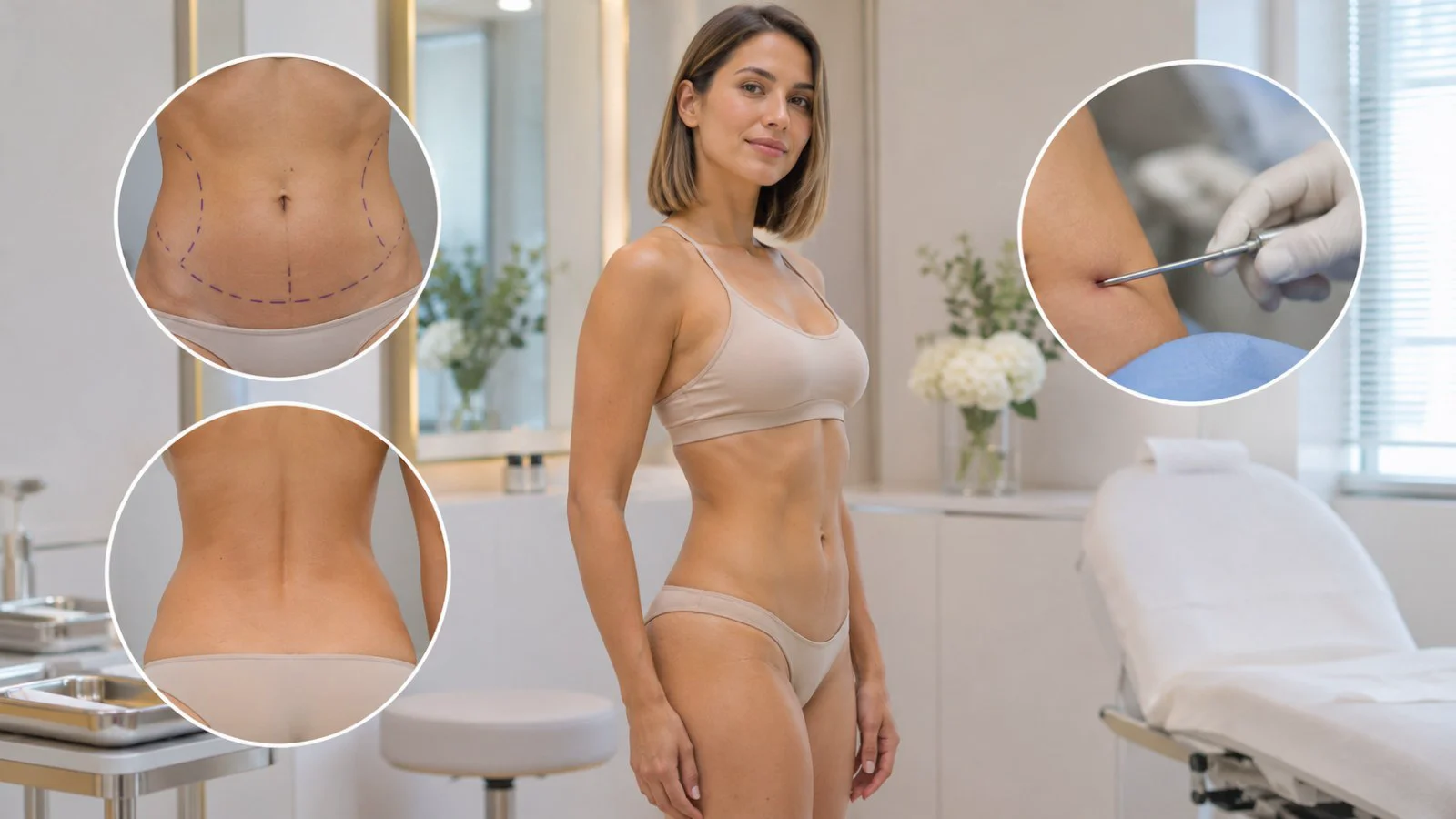
The surgeon first assesses and marks the selected regions while considering how the waist, abdomen and back fit together. Small incisions are made, fluid is introduced into the planned areas, and fat is reduced with the chosen technique. The type of anaesthesia and whether an overnight stay is needed depend on the extent of treatment and your clinical status.
Immediately afterwards, bruising, swelling and tenderness are common. The team may recommend a compression garment and give individual advice about wound care, medicines, walking and follow-up. Garments should be fitted and worn as instructed; tighter compression is not automatically better.
The ASPS recovery guide describes substantial activity limits during the first week, improvement through weeks two and three, and gradual increases in activity over subsequent weeks. The NHS notes that visible swelling can continue for months. Recovery may be longer if several large areas were treated or other procedures were performed.
Do not judge the result from photographs taken immediately after surgery. Swelling can temporarily hide contour changes or make the body appear uneven before healing progresses. Contact your surgical team if symptoms worsen rather than improve.
Can you travel to Turkey for Lipo 360 safely?
International patients should investigate the surgeon’s credentials, the hospital or licensed facility, the anaesthesia plan and the availability of postoperative follow-up. A lower price or package convenience does not replace clinical assessment.
The NHS guidance on cosmetic surgery abroad advises patients to meet the operating surgeon, confirm how complications would be treated and check travel insurance exclusions. It also recommends not flying for at least five to seven days after liposuction as a general minimum, while recognising that major surgery and air travel increase blood-clot risk. An individual surgeon may advise a longer stay.
If you live in the UK, discuss who will manage concerns once you return and how you would obtain urgent local care if needed. Even a relatively limited amount of liposuction can result in a complication that makes a planned flight inappropriate.
See our recovery and stay-planning guide for broader questions about surgery abroad.
Questions to ask before booking Lipo 360
- Which specific areas have enough fat to treat safely, and which should be left alone?
- Are my concerns caused by fat, loose skin, muscle separation or natural bone structure?
- How subtle or noticeable is the expected change in a body similar to mine?
- Could removing fat expose more skin laxity or create visible contour depressions?
- Why is circumferential treatment preferable to a smaller, targeted procedure?
- Which technique is planned, and are there additional risks related to energy-assisted devices?
- What incisions, garments and recovery restrictions should I expect?
- Who will assess me if I develop swelling, asymmetry or another complication after returning home?
- Would doing nothing or postponing surgery be a reasonable alternative?
Ask for realistic examples of patients with similar starting proportions rather than comparing yourself with a different body type. A responsible surgeon should be comfortable advising against surgery if the likely benefit is too small or the risk is too high.
CK Health Turkey: individual body-contouring assessment
CK Health Turkey in Antalya supports international patients exploring plastic surgery and body-contouring procedures in Turkey. For someone considering Lipo 360 while already slim, the consultation should begin with body proportions, weight stability, skin quality and the specific areas of concern—not an assumption that every part of the waist and back needs fat removal.
The operating plastic surgeon and anaesthesia team must evaluate whether liposuction is suitable, explain the planned technique and risks, and agree on a recovery and follow-up plan. Patient coordinators can assist with communication and travel arrangements but cannot replace medical clearance or guarantee a particular waistline or body shape.
To discuss your circumstances and the consultation process, contact CK Health Turkey for an individual assessment.
Ultimately, liposuction 360 for slim women can sometimes refine localised fat deposits, but the best plan may involve less liposuction than a standard package—or none at all. Stable weight, sufficient safely treatable fat, good skin elasticity and realistic expectations matter more than an advertised number of treatment zones. Choose a surgeon who prioritises natural contour and safety over removing the largest possible volume.