Highlights
- Hair extensions should generally be removed before a facelift because they can obstruct surgical incisions, interfere with scalp cleaning, and prevent proper wound care.
- Metal-based extension attachments may pose safety risks by interfering with operating room equipment or imaging technology, necessitating their disclosure to the surgical team.
- Patients should consult their surgeon well in advance to determine if professional removal is required, as hospital policies vary based on the extension type and specific incision plan.
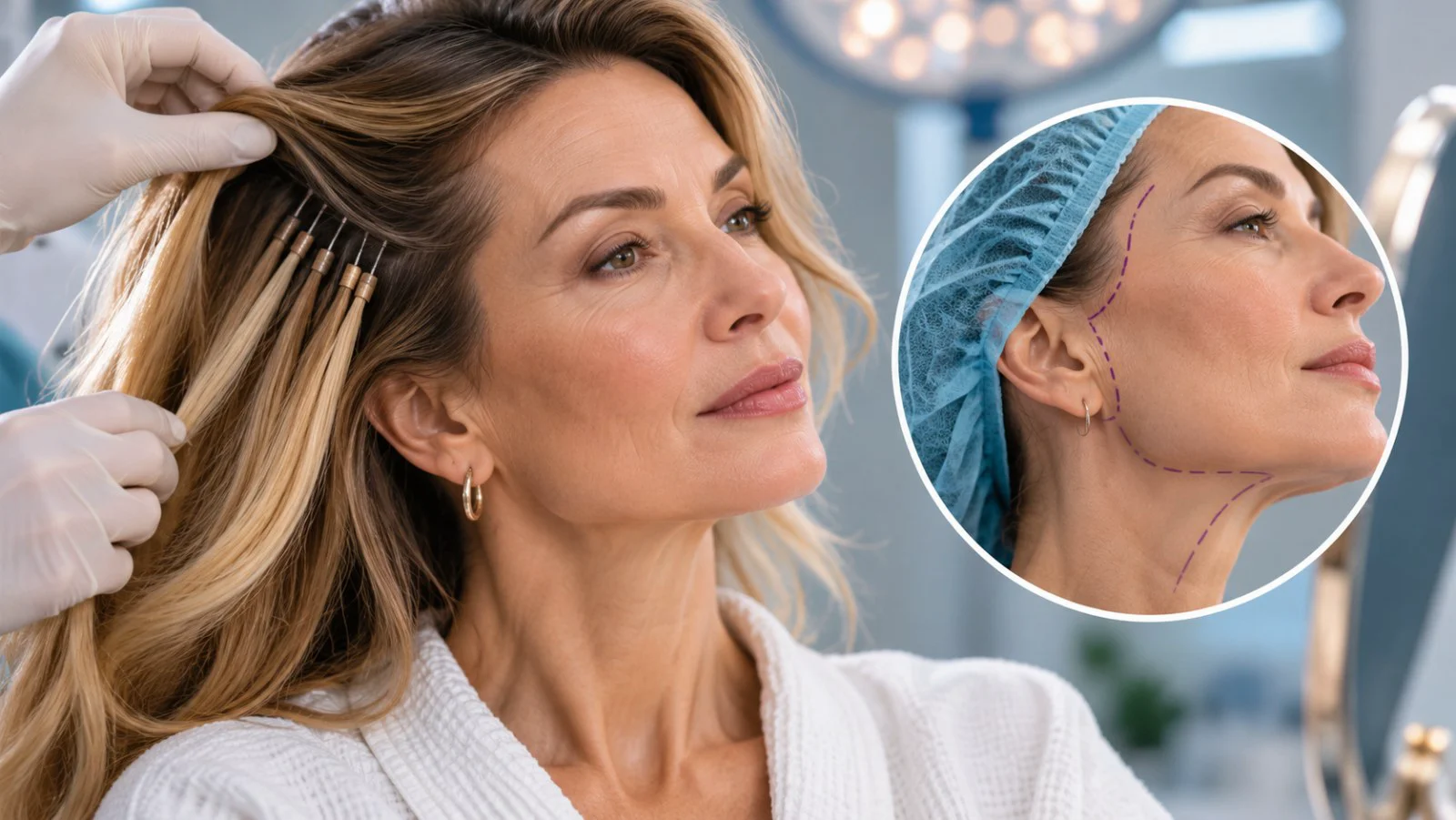
Do you need to remove hair extensions before facelift surgery? In many cases, you should plan for removal or at least a detailed review by your surgeon before the operation. Facelift incisions may pass through the hairline at the temples and behind the ears, exactly where tape-ins, bonds, wefts or extension beads can sit. The concern is access to the scalp, safe positioning and wound care, not simply how your hair will look afterwards.
Table of Contents
The answer depends on the type and location of your extensions and your hospital’s operating-room policy. This guide explains what to disclose, which attachments commonly need removing and when you may be able to have your extensions fitted again.
Should you remove hair extensions before facelift surgery?
Ask your operating surgeon before the procedure and be prepared to remove extensions if requested. Some hospitals require their removal as a routine preoperative measure, while other teams may decide based on the attachments, incision plan and whether the hair can be positioned away from the surgical field. Do not assume that keeping extensions is safe simply because they feel secure.
Cambridge University Hospitals NHS Foundation Trust explicitly tells patients to remove hair extensions before surgery. Northern Lincolnshire and Goole NHS Foundation Trust also advises removal of metal-based extensions because they may interfere with equipment used during an operation.
These are hospital preparation policies rather than clinical trials proving that every tape-in extension creates a specific facelift complication. Your own surgeon and anaesthesia team should confirm what is required. If your extensions cannot be removed at home, tell the team early enough to arrange professional removal rather than discovering the issue on the morning of surgery.
Why can extensions interfere with facelift incisions?
A facelift, also known as rhytidectomy, often uses carefully placed incisions around the ears and hairline. According to the American Society of Plastic Surgeons (ASPS), a traditional facelift incision may start at the temple hairline, pass around the ear and finish in the lower scalp. The specific position changes with the surgical technique and the patient’s anatomy.
Extensions attached close to these areas can make it more difficult to see the skin, mark an incision, clean the scalp, position hair out of the sterile field or close the wound without catching attached strands. Weft tracks, adhesive tapes and bonded tips can also lie where a dressing or head bandage needs to sit.
Even if the attachment does not directly cross an incision, it may pull on nearby hair when the surgical team moves or secures your head. That is why showing the surgeon the attachment points, not just the finished hairstyle, is important.
A mini facelift, full facelift and neck lift may involve different incision patterns. Do not rely on another patient’s instructions if you are having a different procedure. For more information about surgical approaches, see our deep plane facelift and SMAS comparison.
Do different types of hair extensions need different preparation?
Yes. Your surgeon needs to know whether the extensions can be unclipped immediately or whether they are fixed with glue, tape, heat bonds, microbeads, stitching or braiding.
| Extension type | What may matter for surgery | Preparation to discuss |
|---|---|---|
| Clip-in extensions | Clips and removable hair pieces can obstruct access or press on the scalp | Usually straightforward to remove before arriving at hospital |
| Tape-in extensions | Adhesive tabs can sit near temple or behind-ear incisions | Ask whether your stylist should remove them in advance |
| Keratin or fusion bonds | Fixed bonds may be difficult to move away from the operating field | Arrange professional removal if the surgeon requests it |
| Micro-ring or microbead extensions | Metal fittings may conflict with operating-room policy or equipment | Disclose the material and expect possible mandatory removal |
| Sew-in wefts, braids or extensions | Tracks and tension may limit scalp access, cleaning or positioning | Show the surgeon the exact placement and ask about removal |
This is a practical comparison, not a rule that one extension type is medically safe and another is always forbidden. The surgical team must decide based on the scalp, planned incisions, operating-room equipment and aftercare requirements.
Are metal hair-extension beads a safety issue in theatre?
They may be. Some hospitals specifically require metal-based extensions to be removed before operations because of the equipment used in the operating environment. Metal fittings must be disclosed in the preoperative assessment rather than hidden under the hair.
There is also published evidence that certain metal extension attachments can create problems during magnetic resonance imaging. A 2022 case report described metallic microbeads that posed a potential heating and injury concern during an MRI examination under anaesthesia.
An MRI-specific risk does not prove that all metal hair beads cause burns during ordinary facelift surgery. The point is that attachment material matters and that different medical equipment has different requirements. Do not try to judge compatibility yourself. Tell the surgeon and anaesthetist whether your extensions contain metal and ask whether they must be removed.
Hair clips, pins, metal combs and jewellery may also be subject to hospital removal policies. The American College of Obstetricians and Gynecologists’ general surgical preparation guidance includes wigs and hair accessories among items patients may be asked to take off before an operation.
Does having extensions increase the risk of infection?
Extension attachments can make parts of the scalp harder to inspect and clean, especially if glue residue, product build-up or irritation is present near the incision area. A surgical team needs adequate access to prepare the skin and monitor wound healing. That is a practical reason to consider removal, but it is not evidence that every extension wearer has a measurably higher facelift infection rate.
Some specialist facial surgery practices explicitly request removal of extensions, weaves and braids when possible during facelift preparation. However, high-quality studies comparing facelift infection outcomes with and without hair extensions are lacking. It would be misleading to claim a specific percentage increase in infection from tape-in or keratin extensions alone.
What is well established is the importance of appropriate surgical-site preparation. The World Health Organization (WHO) guidelines advise against unnecessary hair removal before surgery and recommend clippers rather than a razor if natural hair must be removed to permit the procedure.
Do you need to shave your hair before a facelift?
Usually, no routine shaving of your natural hair should be assumed. Removing extension attachments is different from shaving the patient’s own hair. Facelift incisions can often be planned within or along the hairline, and the surgeon may carefully separate or secure existing hair rather than remove it.
The WHO’s evidence-based guidance and a Cochrane review of preoperative hair removal found that shaving with a razor can increase surgical-site infection compared with leaving hair alone or using clippers. The evidence does not support shaving just because an operation will involve the scalp.
If any natural hair needs trimming for access, let the clinical team decide how it should be done. Do not shave your temples, sideburns or scalp with a razor at home unless you have received explicit, procedure-specific instructions. Shaving can cause small skin abrasions near the intended incision.
Could extensions damage the hairline around a facelift?
Long-term tension from extensions is a separate issue worth discussing. Hair that is repeatedly pulled by heavy extensions, tightly sewn tracks or braids may develop traction alopecia, a type of hair loss associated with tension on follicles.
The American Academy of Dermatology includes hair extensions and weaves among hairstyles that can contribute to traction alopecia. A 2023 JAMA Dermatology clinical review explains that repeated tension can cause scalp tenderness, inflammation and, if prolonged, potentially permanent thinning.
Facelift surgery itself also carries a separate risk of temporary or lasting hair loss along the incisions, as acknowledged by the ASPS and the NHS. These mechanisms should not be confused: extension-related tension is not the same as a surgical incision complication.
If your hairline is already thin or the extensions feel tight, show the surgeon before the operation. That information may affect the discussion about incision placement, scar visibility and when it is sensible to reapply extensions.
How far in advance should hair extensions be removed?
There is no evidence-based universal rule requiring removal exactly seven, fourteen or thirty days before a facelift. The timing depends on the extension type, the possibility of scalp irritation after removal, your surgeon’s preferences and hospital policy.
Removable clip-ins can usually be taken off easily, while bonded or sewn-in systems may require a hairdresser experienced with that method. Ask about removal during the initial consultation rather than waiting for the final preoperative call.
If professional removal leaves adhesive residue, tender areas, broken skin or redness, contact the surgical team. They may need to inspect the scalp and confirm that the planned incision area is suitable. Do not apply aggressive solvents, scrape glue off the skin or pull out bonded strands yourself near the operation date.
Patients travelling to Turkey should ideally resolve this question before flying. Finding an unfamiliar salon immediately before surgery can make it harder to remove complex bonds safely or deal with irritation if it occurs.
What if your extensions cannot be removed easily?
Tell the surgeon exactly what system you have and where it is attached. Photos showing the base of the extension, with the hair parted near the temples and behind each ear, may help the team assess the situation before an in-person examination.
Do not cut through sewn-in tracks, pull out micro-rings with household tools or try to dissolve keratin bonds with a product that has not been recommended for your extension system. A professional stylist may be able to remove them with less trauma.
If the attachments block the planned surgical field or violate facility policy, the operation may need to be postponed until removal is completed. It is better to discuss that possibility in advance than risk a last-minute surprise on surgery day.
How should you wash your hair before facelift surgery?
Many surgical teams ask patients to wash their hair and scalp before surgery and arrive without hairspray, gel, mousse or other styling products. Follow the exact washing and skin-preparation instructions from your own hospital, including any prescribed antiseptic products.
For example, the Cambridge University Hospitals preoperative advice tells patients to bathe or shower thoroughly before admission and to remove hair extensions. The Aesthetic Society’s facelift preparation advice also highlights planning hair colouring and other grooming activities around surgery.
Do not use scalp exfoliants, harsh adhesive removers or new chemicals to make the hairline feel extra clean. An irritated scalp is not a better surgical surface. If you have dandruff, inflamed follicles, dermatitis or a scalp infection, disclose this before the operation.
Can you keep extensions that are far from the incisions?
Possibly in some circumstances, but the decision belongs to the surgeon and hospital. An attachment at the back of the head may still affect head positioning, cleaning, dressings or the use of equipment. The absence of a bond at the temple does not automatically make the entire hairstyle suitable for theatre.
Likewise, some techniques that use shorter incisions may interfere less with hair at the back of the head, but they still require a clean and accessible operative field. A facelift incision plan cannot be inferred reliably from the words “mini”, “SMAS” or “deep plane” alone.
Ask for a clear answer about your exact extensions rather than relying on a general online statement that all hair must come out or all hair may stay in.
When can you reinstall hair extensions after a facelift?
There is no clinically established universal number of weeks for refitting extensions after a facelift. The safest timing depends on whether the incisions have closed, whether stitches or staples have been removed, whether swelling or numbness remains, and how much tension the extension system places on the hairline and scalp.
Clinical aftercare instructions show that restrictions on hair treatments vary. The University of Michigan facelift instructions advise waiting for surgeon approval before using hair colour or permanent solutions, with an example restriction of eight weeks for colouring or highlighting. NHS guidance notes that facelift stitches may be removed after approximately seven to fourteen days, although deeper healing continues beyond this.
Neither hair-colour timing nor stitch-removal timing is automatic clearance for new extensions. Refitting involves pulling, separating and sometimes heating or applying adhesive to the hair near healing skin. Ask the surgeon when those actions may safely resume and whether attachments should avoid particular parts of the scalp longer.
Until you receive clearance, choose low-tension styling that avoids incisions. Do not use tight braids, heavy wefts or adhesive near fresh scars simply to hide the signs of surgery.
How should you care for your hair during the first weeks of recovery?
Facelift recovery often involves head dressings, swelling, tenderness and temporary numbness near the ears or hairline. You may find combing, washing and styling difficult at first. Follow the surgeon’s schedule for bathing, shampooing and wound cleaning.
The ASPS facelift recovery guidance advises patients to ask when washing their face and hair is permitted and when they may visit a hairdresser. A University of Mississippi Medical Center instruction sheet allows gentle scalp washing early in recovery but restricts hair sprays, conditioners and heat styling initially. These are examples of practice-specific protocols, not a schedule that overrides your surgeon’s instructions.
Temporary scalp numbness means heat from dryers or styling tools can cause injury before you notice the temperature. Keep combs and brushes away from sutures, do not pick at scabs and avoid styles that pull on the temple or behind-ear incision lines.
If you notice new redness, worsening tenderness, wound discharge or a problem with an incision, seek medical advice before visiting a salon.
What should international patients ask before travelling for a facelift?
If you are visiting Antalya for treatment, explain your hair-extension system during the initial consultation. Include the application method, any metal components, how long removal takes and whether a stylist needs to assist.
Before travelling, confirm:
- Whether complete removal is required. Ask about both the surgeon’s incision plan and the hospital’s operating-room policy.
- When removal should happen. Arrange any salon appointment early enough to address skin irritation or residue.
- What hair preparation is expected. Check washing instructions and which styling products to avoid.
- How your hair will be managed after surgery. Ask about dressings, washing, stitches, staples and head positioning.
- When refitting can be considered. Obtain clearance from the operating surgeon, especially for heavy or bonded systems.
Also plan practical support for early recovery, including transport from the hospital, comfortable accommodation and scheduled wound checks. See our guide to recovery and stay planning for surgery in Turkey.
CK Health Turkey: planning facelift surgery with hair extensions
CK Health Turkey in Antalya supports international patients exploring facial plastic surgery and related treatment options. If you wear tape-ins, microbeads, keratin bonds, sew-in wefts or another type of extension, it is useful to mention them before your consultation so the question can be considered alongside the proposed facelift technique.
The operating plastic surgeon and anaesthesia team are responsible for deciding whether your extensions must be removed, how the scalp should be prepared and when postoperative styling can resume. Patient coordinators can help communicate the type of extensions you have and arrange consultation or travel details, but cannot substitute for clinical clearance.
For an individual assessment of your facelift options and surgery preparation, contact CK Health Turkey and ask the team what information to provide about your hair extensions.
Ultimately, managing hair extensions before facelift surgery is a practical part of surgical safety and recovery planning. Some extensions are removable in seconds; others require a stylist and may sit precisely where incisions or dressings are needed. Tell the surgical team what you wear, arrange any required removal before the operation and wait for confirmation that the scalp has healed before having extensions fitted again.