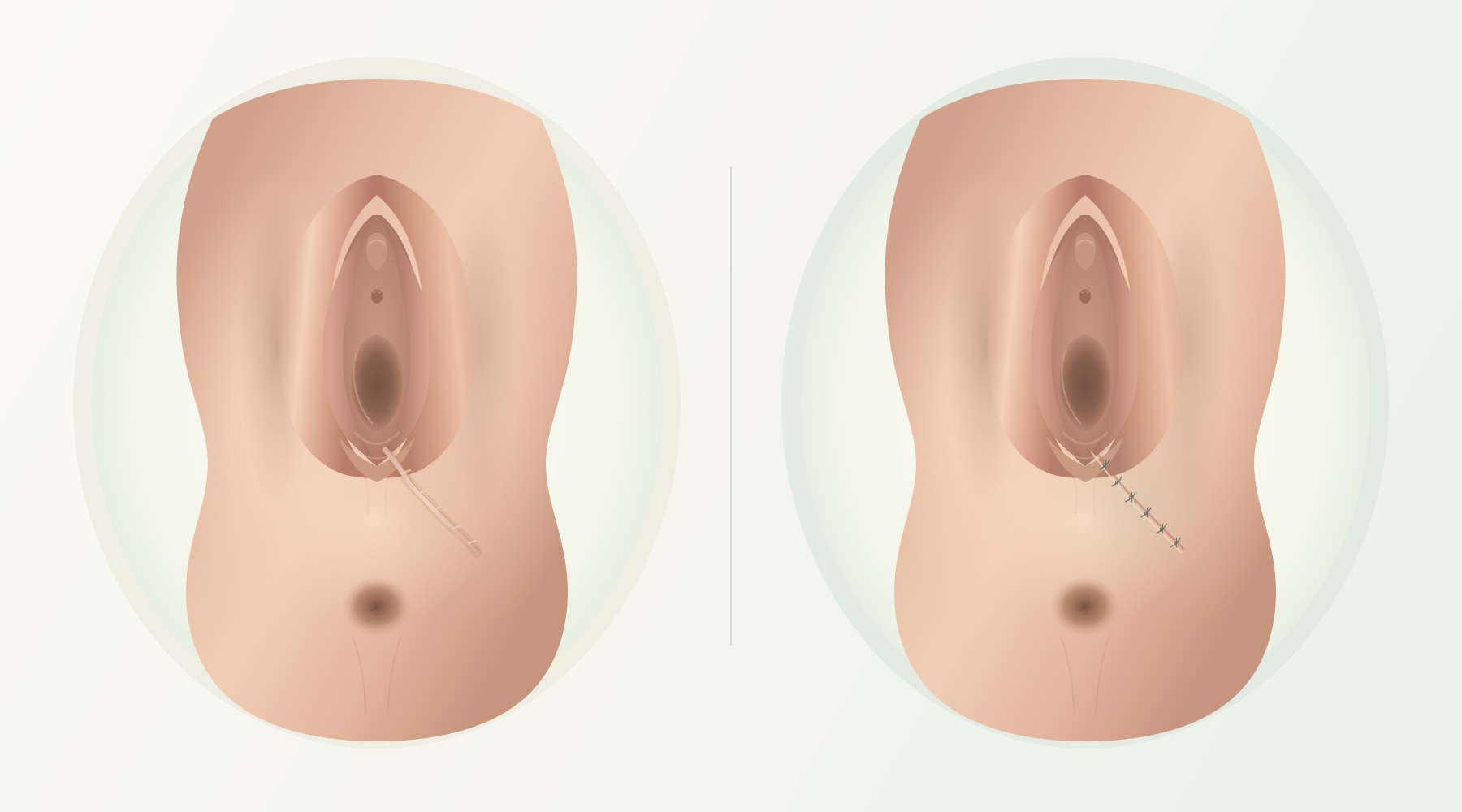
Perineoplasty after episiotomy may be considered when a childbirth scar has healed but continues to cause discomfort, tightness or a change in the shape of the perineum. However, not every painful episiotomy scar needs surgery. A careful examination is essential to identify whether the problem comes from scar tissue, pelvic floor muscles, vaginal dryness or another treatable condition.
Table of Contents
This guide explains when scar revision may help, which alternatives should be explored, what the operation involves and what to expect during recovery.
What is perineoplasty after episiotomy?
The perineum is the area between the vaginal opening and the anus. An episiotomy is a surgical cut made in this region during childbirth in certain clinical circumstances. It is repaired with stitches after delivery, and most wounds heal without requiring another operation.
Perineoplasty is an operation that may reshape or reconstruct tissues around the vaginal opening and perineal body. When performed to address a problematic childbirth scar, the procedure is often described as revision perineoplasty, perineal scar revision or secondary perineal repair. Its precise purpose depends on the patient’s examination findings.
The goal might be to release a tight scar, remove an area of painful or distorted tissue, or reconstruct a poorly healed perineal area. It is not necessarily the same as a cosmetic procedure marketed as vaginal tightening, and it does not automatically repair deeper pelvic floor injuries.
The Royal College of Obstetricians and Gynaecologists (RCOG) explains that an episiotomy is repaired after birth and normally improves as healing progresses. Persistent or worsening symptoms deserve assessment rather than an assumption that further surgery is required.
Why can an episiotomy scar remain uncomfortable?
In the weeks after giving birth, tenderness, swelling and irritation around stitches can be part of healing. But discomfort that continues well beyond the expected recovery period may have more than one cause.
Tight or tethered scar tissue
Scar tissue is less elastic than normal skin. In some patients, an area of scarring may pull on nearby tissues and become uncomfortable during movement, sitting or sexual activity. The shape of the vaginal opening or the perineal body may also feel different after a difficult repair or wound breakdown.
Granulation tissue
Sometimes healing produces a small area of red, raised granulation tissue that remains tender or bleeds. This does not necessarily mean the wound is infected or that a full perineoplasty is needed. RCOG guidance on perineal wound breakdown notes that granulation tissue may settle without treatment and can sometimes be managed in clinic, including with silver nitrate; surgical removal is uncommon.
Pelvic floor muscle problems
The pelvic floor can be weak, tense or poorly coordinated following childbirth. Painful penetration may relate to muscle guarding or spasm rather than to the visible scar itself. A physiotherapist specialising in pelvic health can help assess this. Surgery aimed only at the scar may not improve symptoms driven mainly by muscle dysfunction.
Hormonal changes and vaginal dryness
After childbirth, and particularly during breastfeeding, vaginal dryness can contribute to irritation or pain with intercourse. Appropriate lubricants, moisturisers and other treatments discussed with a clinician may be more useful than scar revision when this is the primary problem.
Persistent pain can also have overlapping causes. A clinician should ask about bowel and bladder symptoms, previous tears, pelvic pressure and any changes in sensation rather than focusing only on appearance.
When might perineoplasty be recommended after episiotomy?
Revision surgery may be considered after examination when a clearly identified scar or structural defect is associated with ongoing symptoms and simpler treatments have not provided adequate relief. Examples include a tight scar that causes localised pain, an anatomically distorted perineum after wound breakdown, or persistent superficial pain during penetration attributed to the scar.
The assessment should establish whether the discomfort is reproduced by touching or gently stretching the scar and whether the visible anatomy explains the symptoms. The surgeon should also discuss what can realistically change, the possibility that discomfort may persist and whether a separate pelvic floor problem requires treatment.
An episiotomy scar that looks unusual but causes no symptoms does not automatically need correction. Decisions about appearance should be made only after an informed discussion of potential benefits, permanent scarring and risks.
People who experienced a third- or fourth-degree tear, anal sphincter injury, difficulty controlling wind or stool, or possible fistula require specialist assessment. A routine perineoplasty is not a substitute for treatment of an anal sphincter injury or other deeper obstetric complication. See the RCOG guidance on severe perineal tears for why these injuries need dedicated care.
Can perineoplasty help with pain during intercourse?
It may help selected patients whose pain is caused by an identifiable scar or distortion of the perineum. It should not be presented as a guaranteed solution for every case of painful intercourse, also called dyspareunia.
A small prospective study of revision perineoplasty followed nine women with persistent postpartum pain and perineal anatomical distortion. Researchers reported improvements in pain and sexual functioning after surgery. These findings are encouraging for carefully selected patients, but the study had only nine participants and lacked a control group, so it cannot predict individual success rates or prove superiority over non-surgical care.
Another register-based study published in 2024 examined outcomes at one year after second-degree tears or episiotomy. It found that pain during intercourse could persist after either type of birth injury and that wound complications and earlier perineal pain were associated with worse later outcomes. This research illustrates why persistent symptoms merit proper follow-up; it does not show that all affected patients need surgery.
If pain is primarily caused by pelvic floor muscle tension, vaginal dryness, vulval sensitivity, infection or another condition, revision of the scar alone may offer little benefit. A thorough diagnosis comes before selecting treatment.
Perineoplasty vs non-surgical scar treatment
The choice depends on the underlying problem rather than on how long the scar has been present.
| Finding or concern | Potential first steps | When surgery may enter the discussion |
|---|---|---|
| Newly healed scar with improving tenderness | Review healing, gentle care, time | Usually not indicated while symptoms are settling |
| Persistent local scar tightness | Specialist examination, pelvic health physiotherapy, guided scar care | Consider revision if a structural scar problem remains symptomatic |
| Red, tender granulation tissue | Clinical assessment; sometimes office-based treatment | Occasionally if persistent despite appropriate care |
| Pain mainly linked to muscle spasm | Pelvic floor assessment and physiotherapy | Scar surgery may not address the main cause |
| Distorted perineal anatomy after failed healing | Specialist review of the original injury and symptoms | Reconstructive perineal repair may be considered |
A personalised plan may use more than one approach. For example, physiotherapy and scar revision are not always alternatives: some patients need pelvic rehabilitation before or after a procedure.
How is perineoplasty performed?
The surgeon begins by reviewing the affected area, discussing symptoms and confirming which tissues are causing difficulty. If revision surgery is appropriate, the procedure may involve removing a problematic segment of scar, releasing tissue that is pulling abnormally and repairing or reapproximating affected superficial tissues to restore the perineal shape.
The extent of repair varies. Some procedures are limited to a small scar, while others require more extensive reconstruction of the perineal body. The proposed technique, anaesthetic, incision placement, stitches and expected aftercare should be described in advance.
Importantly, this is not automatically an operation on the entire vagina. A scar revision at the vaginal entrance is different from internal vaginoplasty or the repair of a pelvic organ prolapse. These procedures can sometimes be discussed together, but they have different goals and risks.
CK Health Turkey has a separate explanation of vaginoplasty versus perineoplasty, which may help clarify the terminology before a consultation.
How long after episiotomy should you consider revision surgery?
There is no evidence-based waiting period that fits every patient. Many episiotomy wounds heal over the first several weeks, while the scar continues to soften and change for longer. Elective revision generally requires time for healing and for any infection or wound complication to be addressed.
NHS guidance describes soreness after episiotomy as common in the early weeks and advises assessment when scar tissue continues to cause problems. This does not establish a universal date for surgery; the appropriate timing depends on symptoms, the tissue examination and what has already been tried.
Someone with an open wound, fever, increasing discharge or suspected infection needs prompt medical care rather than an elective cosmetic consultation. In contrast, a person with a long-healed scar and persistent symptoms may be assessed for revision even if childbirth took place years earlier.
Pregnancy plans matter too. Future vaginal childbirth may change the repaired area or lead to another tear, so the surgeon should discuss possible implications without promising that a future episiotomy can be prevented.
What is recovery like after perineoplasty?
Recovery depends on how much tissue is revised, whether muscle reconstruction is involved, the patient’s medical history and any complication. Swelling, discomfort and temporary tenderness around the stitches are expected early on. Your team should provide specific instructions for cleaning, pain management and avoiding strain on the repair.
Early wound care
Gentle hygiene and keeping the area clean are important. Follow the surgical team’s recommendations about washing and drying; do not apply unapproved products to a fresh wound. Avoid constipation and straining through appropriate hydration, diet and any medicines prescribed for you.
Contact the team if pain is increasing rather than improving, the wound separates, discharge develops an unusual odour or you feel feverish. These symptoms require review rather than waiting for a routine appointment.
Sitting, work and exercise
Some activities may be uncomfortable while the area is swollen or tender. Sitting positions that place pressure directly on the wound may need adjustment, and physical work or exercise may be restricted. There is no fixed return-to-work date that applies to every revision; ask your surgeon to consider the repair and your daily activities.
When can you resume sexual activity?
Penetrative intercourse and anything that stretches the repair generally need to wait until the wound has healed and your surgeon confirms that it is safe. A fixed online timeline cannot account for variation in repair size, discomfort or healing problems.
Even after wound closure, comfort may take longer to return. If pain persists, ask whether pelvic floor physiotherapy or other assessment would help. Avoid treating discomfort as something you must simply tolerate.
What are the risks and limitations?
Perineoplasty and scar revision can cause bleeding, infection, wound separation, delayed healing, new or persistent scarring, changes in sensation, discomfort with intercourse and dissatisfaction with the result. Excessive tightening may itself contribute to pain. Depending on the nature of the surgery, nearby tissues can also be injured, although individual risk varies.
A new scar forms wherever tissue is cut and repaired. Therefore, revision aims to improve a specific problem—not to guarantee that the area will be scar-free or return to its exact pre-birth appearance.
It is also possible that the structural result looks satisfactory but symptoms do not improve because another source of pain remains. A specialist should explain the degree of uncertainty, alternative treatments and the possibility of further care before seeking consent.
How do you know whether scar revision or pelvic floor therapy is right?
Persistent postpartum pain should be assessed as a whole rather than assigned automatically to scar tissue. A clinician may examine the episiotomy scar, assess tenderness, look for granulation tissue or signs of infection, and check the support and function of the pelvic floor.
Depending on symptoms, referral to a pelvic health physiotherapist, gynaecologist, urogynecologist or colorectal specialist may be appropriate. Some patients have mixed symptoms and benefit from a coordinated plan rather than a single treatment.
Before making a surgical decision, consider asking:
- Is the pain coming from the visible scar, muscle tension, dryness or another condition?
- Is there a structural defect that surgery can realistically correct?
- Could physiotherapy, scar management or treatment of granulation tissue help first?
- Will this operation involve only the perineum or any deeper vaginal tissues?
- Could the repair increase tightness or lead to painful scarring?
- How might future childbirth affect the result?
- What follow-up and support will be available if recovery is slower than expected?
If you have problems controlling stool or wind, passing stool through the vagina, severe persistent pain or signs of a deep tear, explain these symptoms immediately. They may require different specialist investigations or treatment.
Perineoplasty after episiotomy and future pregnancy
Having perineal scar revision does not automatically prevent a future pregnancy or mean that every future delivery must be by Caesarean section. However, a further vaginal birth can stretch the area and may change the outcome of a previous repair.
If you experienced a serious tear involving the anal sphincter, future birth planning requires additional counselling. The RCOG patient information on third- and fourth-degree tears explains that choices in future pregnancies depend on symptoms, previous injuries and individual preferences.
For a scar-related procedure, your surgeon should discuss whether delaying elective revision until after a planned pregnancy might be more sensible. This is a personal decision informed by the severity of current symptoms and the timing of future family plans.
CK Health Turkey: discussing treatment after an episiotomy
CK Health Turkey in Antalya supports international patients seeking information about genital aesthetic and related surgical treatment options. If you have an old episiotomy scar, it can help to describe when the delivery occurred, whether the wound had any complications, and whether your main concern is discomfort, scar tightness or a change in perineal anatomy.
An appropriate clinical assessment must determine whether a scar revision, pelvic floor treatment or another type of care would address the underlying problem. Patient coordination can help with practical questions about consultation and travelling for treatment, but a procedure and its likely benefits should never be assumed before examination.
To ask about a personalised assessment and your possible treatment options, contact CK Health Turkey for further guidance.
Ultimately, perineoplasty after episiotomy is most relevant when a persistent, clearly identified scar or perineal defect is causing symptoms that may respond to revision. Accurate diagnosis, realistic expectations and appropriate consideration of non-surgical care are more important than choosing an operation based on the scar’s appearance alone.