Highlights
- Breast augmentation involves choosing between subglandular (over the muscle) and submuscular (under the muscle) placement, each offering distinct aesthetic and recovery profiles.
- Placing implants over the muscle allows for a faster recovery and prevents muscle-flexing distortion, but it carries a higher risk of visible rippling and capsular contracture.
- Under-the-muscle placement provides a more natural contour and lower complication rates, though it requires a longer healing period and may cause temporary animation deformity.
Deciding on breast augmentation involves several crucial structural choices beyond just size and implant material. Selecting between breast implants over vs under the muscle directly shapes recovery time, long-term silhouette, and overall surgical outcomes. Understanding how these pocket placements interact with your natural anatomy allows you to make an informed decision alongside your plastic surgeon.
Table of Contents
Understanding Surgical Pocket Placements
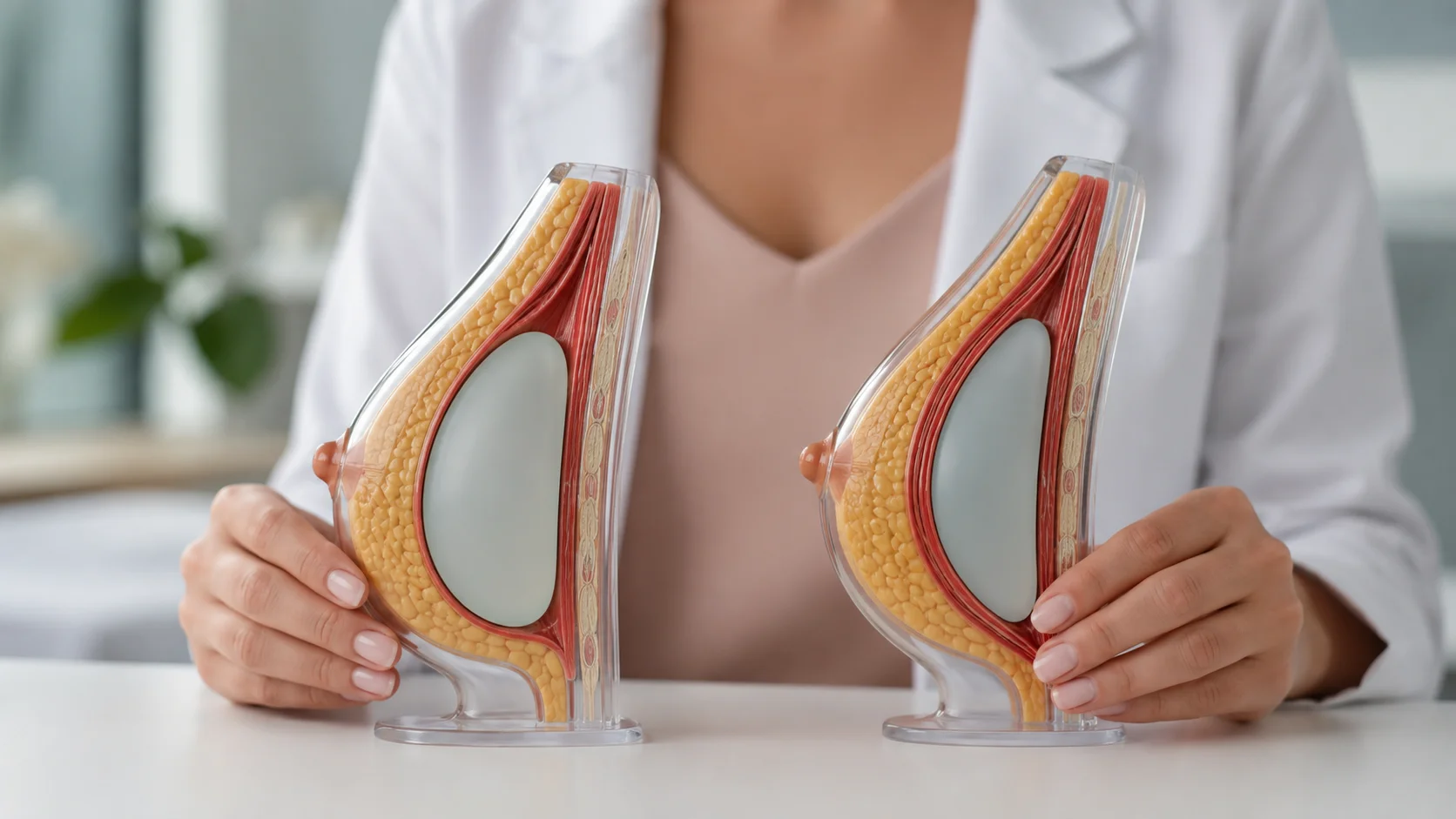
Breast augmentation surgery positions the silicone or saline device in a specifically crafted pocket within the chest wall. The two classic locations are subglandular placement (over the chest muscle) and submuscular placement (under the chest muscle). In modern aesthetic surgery, dual-plane placement—a hybrid method where the upper portion of the implant sits beneath the muscle while the lower portion sits directly behind breast tissue—is also widely utilized to capture the benefits of both approaches.
The anatomical foundation of this decision relies on your existing tissue depth, skin elasticity, and overall body composition. During subglandular placement, the surgeon inserts the implant directly behind the native breast gland and in front of the pectoralis major muscle. Conversely, submuscular and dual-plane techniques position the implant beneath the pectoral muscle, using the muscle layer as a natural cushion and stabilizing hammock for the device.
Breast Implants Over the Muscle: Features, Benefits, and Drawbacks
Subglandular placement, commonly referred to as placing breast implants over the muscle, is a straightforward surgical approach that leaves the chest wall muscles completely intact. This position mimics natural anatomy by resting the implant directly beneath the natural glandular tissue.
Key Advantages of Over-the-Muscle Placement
- Easier Recovery: Because the pectoralis major muscle is not dissected or lifted, post-operative pain is generally milder and full physical recovery is faster.
- No Animation Deformity: Athletic patients do not experience implant distortion, flexing, or shifting when contracting their chest muscles during workouts.
- More Immediate Projection: Over-the-muscle placement provides immediate upper-pole fullness, creating a dramatic, lifted cleavage profile without waiting for the muscle to relax over several months.
Potential Disadvantages
- Higher Visibility and Rippling: Patients with thin skin or minimal natural breast tissue may experience visible implant edges or surface rippling over time.
- Mammogram Interference: Positioned directly in front of the muscle, subglandular implants can create more shadow on diagnostic mammograms, requiring specialized view techniques.
- Increased Risk of Sagging: Without the support of the pectoral muscle, larger implants may succumb to gravity earlier, leading to premature ptosis (sagging).
Breast Implants Under the Muscle: Features, Benefits, and Drawbacks
Placing implants beneath the major chest muscle—known clinically as submuscular or subpectoral placement—provides an added layer of soft tissue coverage over the top half of the implant.
Key Advantages of Under-the-Muscle Placement
- Natural Contour and Blend: The overlaying muscle gradually tapers the upper boundary of the implant, preventing a harsh “stuck-on” appearance and offering a seamless transition from the collarbone down.
- Concealment of Rippling: The muscle layer hides surface irregularities and implant edges, making it ideal for women with low body fat or minimal natural breast tissue.
- Lower Rate of Capsular Contracture: Clinical research consistently shows that submuscular tissue coverage reduces the risk of scar tissue tightening around the implant pocket.
Potential Disadvantages
- Longer Recovery Period: Disrupting the pectoral muscle fibers leads to greater initial soreness, tight chest sensations, and a restricted lifting schedule for several weeks.
- Animation Deformity: Strong chest muscle contractions during heavy lifting or push-ups can cause the implants to shift outward or flex noticeably.
- Extended “Drop and Fluff” Phase: Submuscular implants initially sit high on the chest wall; it can take several months for the muscle to stretch and allow the implants to drop into their final natural position.
Clinical Research and Scientific Insights
Evaluating long-term safety data provides valuable clarity when weighing breast implants over vs under the muscle. A comprehensive 2026 meta-analysis published in PubMed-indexed plastic surgery literature evaluated over 51,000 patient records comparing subglandular, submuscular, and dual-plane breast augmentations. The findings revealed that capsular contracture rates were significantly lower in submuscular and dual-plane placements (approximately 1.8% to 2.0%) compared to pure subglandular placements (approximately 6.8%). However, above-the-muscle placement eliminated muscle contraction-induced deformities completely and delivered reduced early post-operative discomfort. These scientific findings confirm that surgical plane selection should be customized based on a patient’s individual anatomical tissue coverage and lifestyle priorities rather than a single universal standard.
Direct Comparison: Over vs. Under the Muscle
| Evaluation Factor | Over the Muscle (Subglandular) | Under the Muscle (Submuscular / Dual-Plane) |
| Ideal Candidate | Adequate natural tissue, active athletes | Thin tissue coverage, seeking subtle transition |
| Recovery Time | 1 to 2 weeks | 2 to 4 weeks |
| Capsular Contracture Risk | Moderately higher | Significantly lower |
| Animation Deformity | None | Possible during strong chest flex |
| Upper Pole Naturalness | Defined, high projection | Soft, sloped transition |
| Rippling Visibility | Higher in thin patients | Lower (concealed by muscle) |
| Mammogram Clarity | Requires expert technician views | Clearer separation from glandular tissue |
How to Choose the Right Placement for Your Body
Selecting the optimal pocket placement requires a personalized evaluation of your body structure and everyday habits. Plastic surgeons evaluate several physical indicators during your initial consultation:
- Pinch Test Measurement: Your surgeon pinches the skin and fat tissue over your upper breast area. If the pinch thickness is less than 2 centimeters, placing the device under the muscle usually yields a more natural result without visible edges.
- Activity and Fitness Level: If you are a swimmer, bodybuilder, or weightlifter who frequently engages the pectoral muscles, over-the-muscle or subfascial placement avoids muscle flexing distortion.
- Existing Breast Sag (Ptosis): Patients with mild sagging may benefit from over-the-muscle placement, as it allows the implant and natural breast tissue to age and drop together at a similar rate.
- Desired Final Aesthetic: If you prefer a dramatic, high-cleavage, push-up look, subglandular placement achieves immediate fullness. If you prefer a subtle, tear-drop shape that blends smoothly into the upper chest, under-the-muscle is generally preferred.
Why Choose CK Health Turkey for Breast Augmentation
Navigating plastic surgery options requires high-level surgical expertise and personal care. For international patients seeking premium plastic surgery, CK Health Turkey stands out as a top-tier destination in Antalya. Operating in accredited, state-of-the-art hospital facilities, CK Health Turkey connects patients with board-certified plastic surgeons who specialize in advanced breast augmentation techniques, including dual-plane and submuscular pocket creations.
Choosing medical travel through CK Health Turkey offers significant advantages:
- All-Inclusive Medical Packages: Comprehensive care packages bundle high-grade FDA-approved implants, hospital surgical fees, VIP airport transfers, and luxury accommodation into a transparent price point.
- Customized Surgical Planning: Board-certified surgeons perform detailed physical assessments to determine whether over or under the muscle placement aligns with your specific body type and aesthetic goals.
- Dedicated Patient Support: From initial online consultation through post-operative aftercare, multi-lingual patient coordinators guide you through every step of your recovery journey.
To explore your personalized breast augmentation options and receive a tailored surgical plan, visit the official CK Health Turkey website to schedule a consultation with a cosmetic surgery specialist.
Making the final choice between breast implants over vs under the muscle comes down to balancing your natural soft-tissue thickness, exercise routine, and long-term aesthetic preferences. While under-the-muscle placement provides enhanced tissue coverage and lower contracture rates, over-the-muscle placement offers a smoother recovery without muscle-flexing distortion. Partnering with an experienced plastic surgeon ensures your chosen placement delivers a balanced, beautiful result tailored specifically to your body.