Highlights
- Patients must be able to perform an emergency stop, check blind spots, and wear a seat belt comfortably before returning to driving.
- Driving is typically restricted for four to six weeks post-surgery, but the exact timing depends on surgeon clearance and the cessation of sedating painkillers.
- A 360 body lift affects multiple healing areas, making it essential to test movements in a stationary car before attempting to drive on the road.
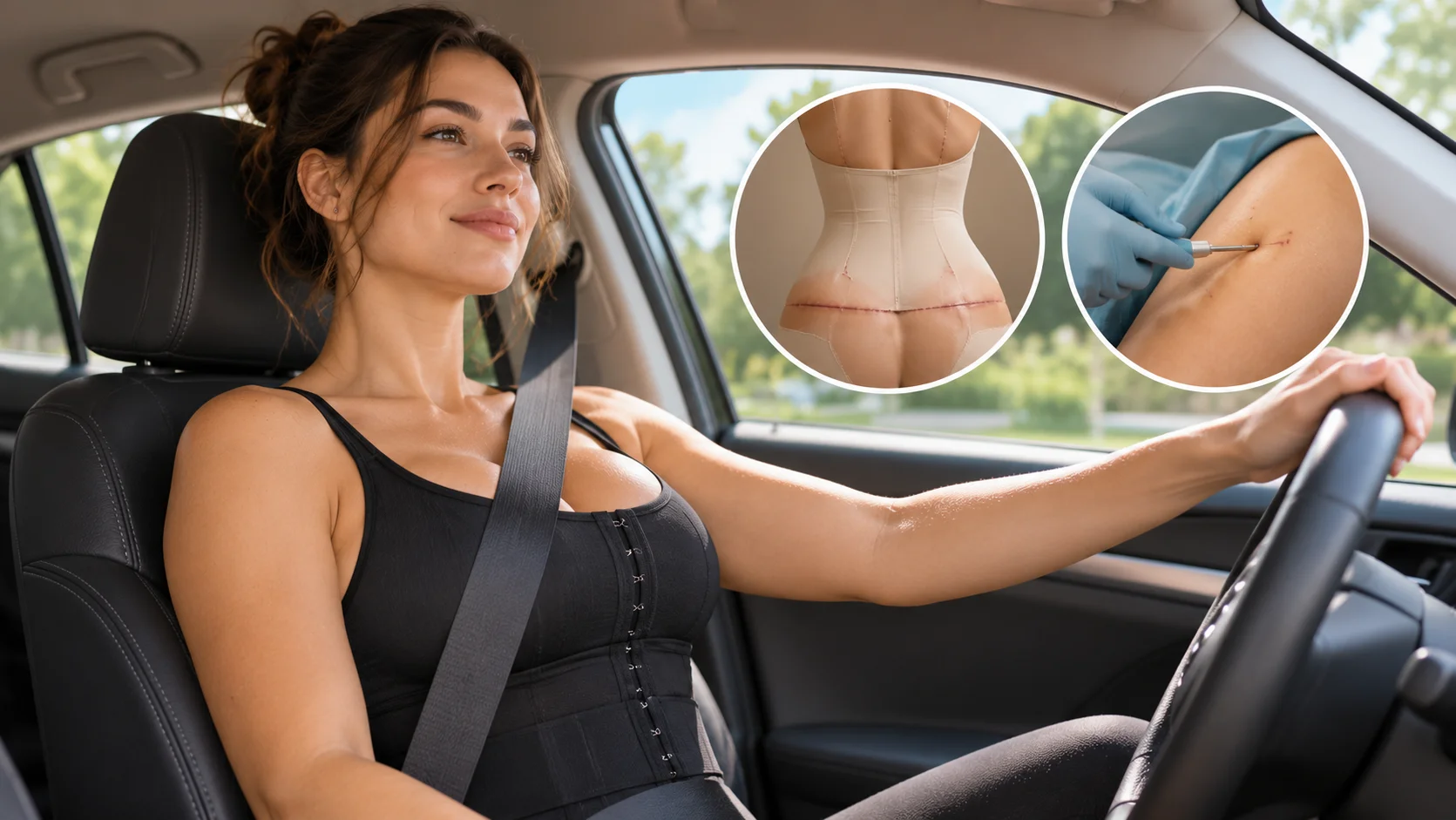
Driving after 360 body lift and liposuction requires more than feeling well enough to sit in a car. A circumferential body lift can leave healing incisions around your abdomen, hips and back, while liposuction adds tenderness and swelling in the areas treated. Steering, checking blind spots, wearing a seat belt and performing an emergency stop can all become difficult during recovery.
Table of Contents
There is no single driving date that suits every patient. This guide explains when driving may be considered, how to assess your readiness, and why travelling as a passenger is different from safely taking control of the vehicle.
When can you start driving after 360 body lift and liposuction?
A 360-degree body lift, often called a circumferential lower body lift, is more extensive than a small liposuction procedure. It may involve removing loose skin around the abdomen, waist, outer thighs and lower back, sometimes alongside abdominal muscle repair. Recovery restrictions depend on the exact incision pattern and any additional liposuction.
The NHS guidance on abdominoplasty says patients are generally unable to drive for a few weeks after surgery, with advice from their surgeon and insurer. The American Society of Plastic Surgeons (ASPS) emphasises that body-lift patients should ask their surgeon specifically when they may return to driving. Neither source establishes a universal timetable for a combined 360 body lift with liposuction.
Some general NHS abdominal-surgery guidance discusses a return around four to six weeks, depending on the operation and recovery. This is only context from other abdominal procedures, not a medical clearance rule for circumferential body lift patients. You may need more or less time based on your wounds, pain, mobility and medications.
Do not drive until your surgeon has cleared you, your medication does not impair you, and you can safely control the car—including during an unexpected emergency stop.
Why driving is harder after a circumferential body lift
A standard tummy tuck generally focuses on the front of the abdomen. A 360 body lift extends the treatment around the waist and back and may also improve the buttock or thigh contour through skin repositioning. That means the seat, backrest and belt can contact multiple healing regions at once.
Sitting in an ordinary position may pull on the abdominal incision or press against the lower-back component of the scar. Rotating to look over your shoulder can stretch the sides and waist. Moving between the pedals, especially if you must brake suddenly, may engage abdominal muscles and create discomfort.
If liposuction was also performed along the flanks, abdomen, back or thighs, bruising and deep tenderness may make these movements less comfortable. The NHS liposuction guidance notes that swelling can last for months, but the important driving issue is whether symptoms restrict safe movement now.
For a broader comparison of the operations, see our 360 body lift versus traditional tummy tuck guide.
Five things that should be true before you drive
The following checklist is more useful than simply counting days since surgery. It is based on principles in UK DVLA medical guidance and the Royal College of Anaesthetists’ advice about driving after an operation.
- You are fully alert. You have recovered from anaesthesia or sedation and are not dizzy, confused, sleepy or otherwise impaired.
- Pain is not distracting you. You can sit, move your arms and legs, and turn your torso without pain that would interrupt your concentration.
- Your medicines allow safe driving. Your clinician or pharmacist has reviewed any strong painkillers, muscle relaxants or other sedating drugs and confirmed how they affect driving.
- You can perform all necessary driving actions. You can brake decisively, use the pedals and controls, turn to check traffic, and manage a seat belt without hesitation or guarding.
- Your surgeon and insurance arrangements support the return. Your recovery is sufficiently advanced, and you have checked any applicable medical or insurance requirements.
Being able to walk around your home or return to desk work does not necessarily mean you can control a vehicle safely. The difference is the ability to respond quickly and forcefully to a situation you did not expect.
Why an emergency stop is the most important practical test
An emergency stop requires rapid movement from the accelerator to the brake and enough force to stop the car. Depending on your procedure, abdominal tightening, swelling or painful thighs can make sudden pedal movement uncomfortable.
University Hospitals Sussex NHS guidance describes the ability to make an emergency stop, wear a seat belt and look over your shoulder as conditions for returning to driving after abdominal surgery. This guidance is not specific to cosmetic body lifts, but the safety tasks themselves are relevant.
Once your surgeon has said it is appropriate to assess your readiness, you may be advised to practise the required movement in a parked car with the engine off. Do not take the car onto a road to find out whether braking hurts. If even a stationary movement causes sharp pulling or hesitation, tell your surgeon and wait longer.
Driving a vehicle with an automatic gearbox does not eliminate the need for rapid braking, safe steering and body positioning. A manual vehicle also requires coordinated clutch operation, so its demands may be greater for some patients.
Can you wear a seat belt over your body-lift incisions?
Wearing a properly positioned seat belt is essential for vehicle safety. However, after a 360 body lift, the lap section may lie close to the lower abdominal incision while the seatback presses against healing tissue in the lower back.
The British Association of Aesthetic Plastic Surgeons (BAAPS) advises that liposuction patients should not drive until they can wear a seat belt comfortably and feel safe. Pain caused by the belt may therefore be a useful sign that you are not yet ready.
Do not drive without a belt, place it behind your back, route it incorrectly or alter its anchoring points to avoid pressure. Such modifications undermine occupant protection. Ask the surgical team how to position yourself and whether any specific temporary cushioning is safe without changing proper belt fit or interfering with the restraint system.
If the belt causes significant wound pain or you cannot sit fully supported, arrange another driver and discuss the problem at follow-up.
Can you drive while taking painkillers?
Some prescribed postoperative pain medicines reduce concentration, cause dizziness or slow reaction time. Opioid medicines such as morphine, oxycodone, codeine or tramadol can affect driving, particularly when first started, after a dose increase or when combined with other sedating medicines.
NHS Inform’s advice on strong painkillers says not to drive when sleepy, dizzy, poorly coordinated or unable to concentrate, and to seek advice when medicines change. UK legal rules depend on the drug, prescription circumstances and whether driving is impaired. It is inaccurate to claim that every prescribed opioid is automatically illegal in every circumstance, but recent postoperative use often creates a practical safety concern.
Do not assume a medicine is harmless for driving simply because it was prescribed by a doctor or because you do not feel very drowsy. Anti-sickness drugs, sleep medicines and certain muscle relaxants may also contribute to impairment.
Talk with the prescribing clinician about when driving is safe. Never stop necessary pain medicine or other prescriptions solely to get behind the wheel sooner. Pain that becomes poorly controlled can itself interfere with safe driving.
How do anaesthesia and the first 24 hours affect driving?
After general anaesthesia or sedation, judgement, coordination and reflexes may be affected even when you feel awake. The Royal College of Anaesthetists advises against driving for at least 24 hours after general anaesthesia or sedation, and longer when the operation or recovery makes driving unsafe.
A 360 body lift normally requires substantially more recovery than the initial period after anaesthesia. Therefore, a 24-hour no-driving instruction is a minimum anaesthetic precaution, not permission to drive the next day.
Arrange for a responsible adult or professional transfer service to take you from hospital to your accommodation. The ASPS body-lift preparation guidance also recommends planning a driver and assistance after discharge.
Driving restrictions after body lift compared with liposuction alone
The procedures may have very different recovery demands, even when performed together.
| Factor | 360 body lift | Liposuction alone | When combined |
|---|---|---|---|
| Incisions | Longer cuts around the lower trunk | Usually smaller access incisions | Both incision patterns need protection |
| Sitting pressure | Can affect abdomen, hips and back | Depends on treated fat areas | Pressure may occur across several healing regions |
| Turning to check traffic | May pull on circumferential incision | May hurt if flanks or back were treated | Assess the more limiting restriction |
| Emergency braking | Can strain the abdomen and lower body | May aggravate tenderness | Must be possible without hesitation or pain |
| Return to driving | Often requires several weeks of recovery | Depends on extent of treatment | Individual surgeon clearance, not a fixed date |
The ASPS liposuction recovery guidance shows that activity and swelling can improve over weeks, but patients with a combined operation must follow instructions that account for the larger procedure. An isolated liposuction timeline cannot be applied directly to a 360 body lift.
Can you sit in a car as a passenger before you can drive?
Often, yes, because you do not need to steer, brake or maintain the same alertness and reaction time required of a driver. However, sitting as a passenger can still be uncomfortable and is not risk-free immediately after major surgery.
You may need help entering the vehicle and lowering yourself into the seat without pulling on the abdominal or back incisions. The surgical team should show you how to move safely and manage any drains or compression garment. Keep your seat belt correctly fastened throughout travel.
If you are still required to keep your hips slightly flexed, ask whether the seat can be adjusted to accommodate this without compromising belt placement. Do not lie flat across the back seat or travel in a position that leaves you unrestrained.
For a hospital-to-hotel transfer, arrange a driver who can assist with bags and allow extra time. A transfer that is medically acceptable as a passenger does not imply that you are ready to drive yourself.
Does a long car journey increase blood-clot risk after surgery?
Recent major surgery and prolonged sitting can both increase the risk of deep vein thrombosis (DVT). This is especially relevant if you are planning to drive or ride for several hours soon after a body lift.
The US Centers for Disease Control and Prevention (CDC) identifies travel longer than four hours by car, air, train or bus as a situation that can contribute to venous blood-clot risk. Recent surgery, reduced mobility and some existing medical conditions are additional risk factors.
The NHS DVT guidance advises avoiding prolonged stillness, moving regularly when possible, maintaining hydration and seeking individual advice if you have risk factors. It also notes that people may need prescribed clot-prevention measures after surgery.
Do not plan a long self-drive journey simply because you have reached a certain number of weeks. Ask your surgeon whether travelling is appropriate, how often to stop and walk, whether any special thrombosis precautions apply, and what symptoms require urgent assessment. These considerations may continue even after the incisions have healed enough for short journeys.
Our guide to blood clot concerns after surgery discusses related risks, although a flight and car journey have different practical arrangements.
What if you are travelling home from Turkey?
International patients recovering in Antalya should discuss the journey home before booking transport. Depending on your recovery, you may need assistance between the hospital, accommodation and airport, followed by a flight and another drive on arrival.
These stages are separate decisions. Being fit to fly as a passenger does not mean being fit to drive a car after landing. Jet lag, fatigue, swelling, long periods seated and prescribed medicines may create additional challenges.
If a companion is travelling with you, arrange for them to handle driving and luggage if possible. Confirm the airport transfer plan, appropriate passenger seating, mobility assistance if indicated and the contact details for postoperative concerns.
Our guide to flying home after body lift surgery and post-surgery stay-planning guide provide additional context.
What about drains, compression garments and swelling?
Patients may be discharged with drains or compression garments following body lift and liposuction, depending on the surgeon’s approach. Tubes can catch during transfers, while a restrictive garment may make turning or sitting difficult.
The ASPS body-lift recovery guidance describes wound dressings and drains as possible parts of early care. They do not automatically prohibit every movement, but you must be able to enter the car, sit securely and use all controls without risking displacement or impaired concentration.
Do not remove a prescribed compression garment just to make driving more comfortable unless your surgeon approves it. If a garment prevents you from safely looking over your shoulder or using the pedals, you are not ready to drive.
Ask whether drains must be removed before you drive and how to secure them during necessary passenger journeys. The correct answer depends on the exact drainage system and wound condition.
Is it safe to drive two weeks after a 360 body lift?
Two weeks is too early to assume readiness solely from the calendar. Some patients will still have swelling, fatigue, a flexed posture, wounds requiring attention or pain medication. The NHS tummy tuck guidance describes an inability to drive for a few weeks, and a circumferential body lift may involve an even larger treatment area.
Conversely, it would be misleading to prescribe one fixed six-week or eight-week ban to everyone. The surgeon must evaluate how you have healed, the activities you can perform and any complications.
If you have an important appointment during early recovery, arrange a driver rather than testing your ability in traffic. Ask the clinical team at each postoperative review when a return-to-driving assessment would be reasonable.
How should you return to driving once cleared?
Once your surgeon has approved driving, you are free of impairing medication effects and you can perform the necessary movements comfortably, a gradual return may be more sensible than beginning with a long journey.
- Check seat and belt comfort. Make sure the belt sits correctly and the backrest does not cause significant pain around healing incisions.
- Assess movement while parked. With the engine off, confirm that you can turn to look behind you, use all pedals and perform the necessary braking movement without pain or delay.
- Review medication and alertness. If you feel sleepy, dizzy, weak or distracted by pain, do not drive.
- Check insurance and clinical restrictions. Follow the advice of your treating surgeon and any applicable insurer requirements.
- Begin with a short, familiar journey. Avoid planning a long motorway trip or driving alone far from help on your first day back.
- Stop if symptoms interfere. Increasing pain, swelling or difficulty turning or braking means you should stop in a safe place and arrange further advice.
This is a practical readiness approach, not a medical test that can replace your surgeon’s review. No home checklist can guarantee safe driving if you have ongoing impairment.
UK driving rules, the DVLA and insurance after surgery
For UK patients, the DVLA’s medical guidance states that recovery from surgery generally does not need to be reported unless it affects driving and is likely to persist for more than three months. You must still be fit to drive, remain in control of the vehicle and comply with any relevant medical or licensing requirements.
UK government guidance also advises discussing the timing of driving after surgery with your doctor and checking that your insurance continues to cover you. Different standards can apply to commercial or vocational licences.
These are UK-specific requirements. If you drive in Turkey or another country, local licensing and insurance rules may differ. The medical safety principles—alertness, mobility, control of the vehicle and appropriate recovery—still apply.
Warning signs that mean driving should wait
Delay driving and speak to your surgical team if you develop new wound problems, increasing pain, fever, spreading redness, unusual drainage or substantial swelling that limits movement. Dizziness, medication-related drowsiness and weakness are also reasons not to drive.
Seek prompt medical assessment for a new painful, swollen leg, particularly if one-sided. Sudden shortness of breath, chest pain, fainting or coughing blood requires emergency care because a pulmonary embolism is one possible cause.
The ASPS specifically warns body-lift patients to seek immediate medical attention for chest pain, breathing difficulty or unusual heartbeats. Do not drive yourself to emergency care if you may be seriously unwell.
Questions to ask your surgeon before driving again
- When is my next assessment of driving readiness after my 360 body lift and liposuction?
- Does my abdominal or back incision need any particular protection when sitting?
- Can I wear a seat belt normally without pressure that might affect my wounds?
- Am I allowed to turn my torso fully and make a sudden braking movement?
- Are any of my prescribed medicines unsafe for driving?
- How should I manage any remaining drains or compression garments in a vehicle?
- Would a long drive create extra blood-clot risk, and what precautions are appropriate?
- If I am returning from Turkey, who should drive me after the airport transfer or flight?
- What changes or warning signs should prompt me to stop driving and contact the clinical team?
Ask for clear instructions before discharge and revisit the question during follow-up. A specific plan is especially important if you usually drive every day for work or rely on a car for school runs and medical appointments.
CK Health Turkey: planning travel and recovery after body lift
CK Health Turkey in Antalya supports international patients considering plastic surgery and body-contouring procedures, including treatment planning and practical coordination during the journey. If you are exploring a circumferential body lift with liposuction, discuss your usual driving needs and travel arrangements before surgery.
The operating surgeon and clinical team must determine when you can safely resume driving based on the procedures performed, medications, wound healing and mobility. A coordinator can assist with consultation and transport planning but cannot issue a blanket driving clearance or guarantee when you will be safe to drive after a complex operation.
To learn more about assessment, surgery and postoperative support, contact CK Health Turkey and explain any travel or driving requirements that affect your recovery plans.
Ultimately, driving after 360 body lift and liposuction should resume only when you can wear a seat belt correctly, turn and brake without hesitation, remain fully alert and follow your surgeon’s advice. The calendar can help you organise support, but safe vehicle control—not a fixed number of days—is what should determine your return to the road.