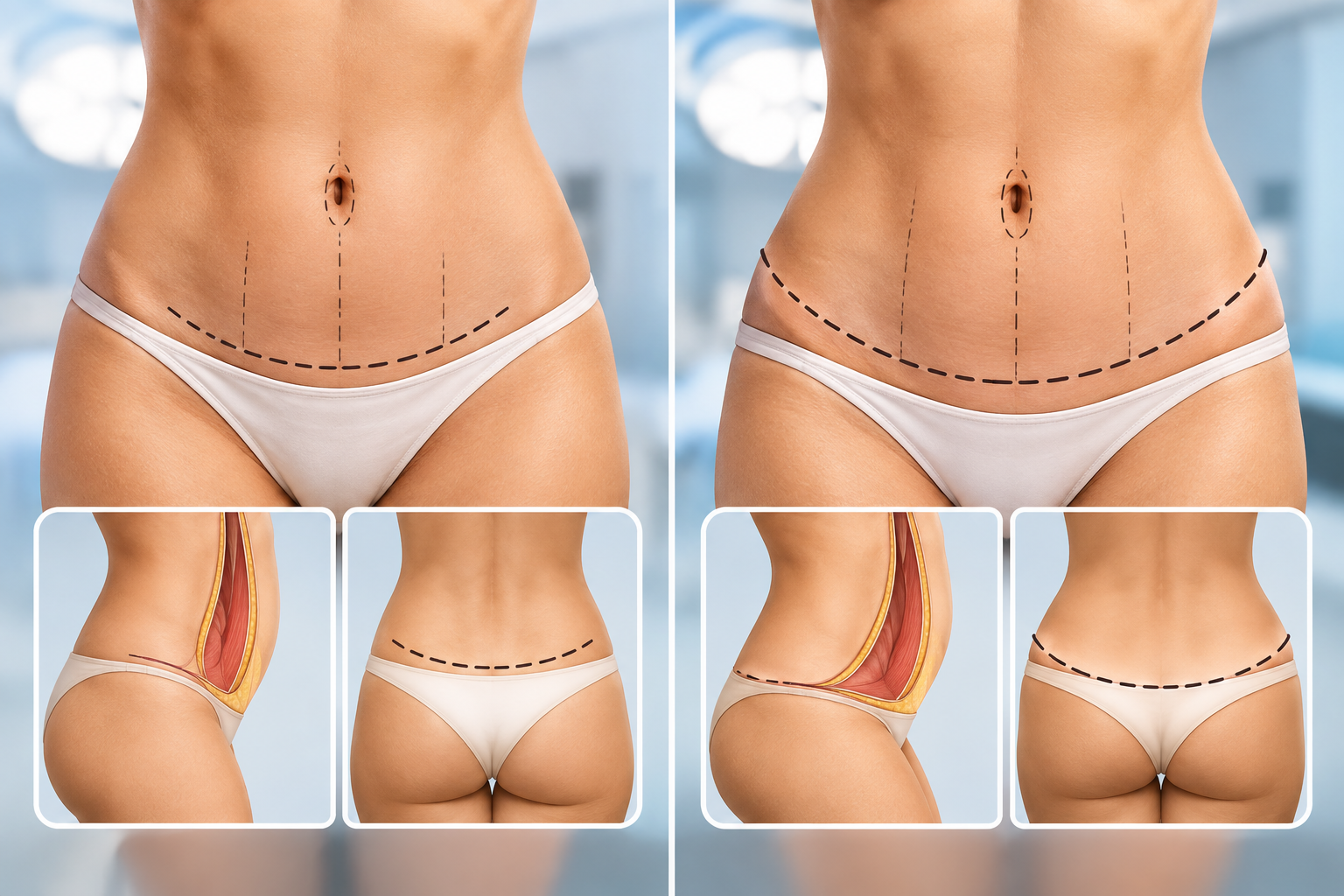
A tummy tuck is not a single, one-size-fits-all operation. When comparing extended tummy tuck vs standard tummy tuck, the main difference is how far the surgery reaches beyond the front of the abdomen and into the flanks or hips.
Table of Contents
Both procedures can remove excess skin and improve abdominal contour, but they are designed for different patterns of skin laxity. Understanding the difference can help you discuss the most appropriate option with your plastic surgeon.
Extended Tummy Tuck vs Standard Tummy Tuck: Key Differences
A standard tummy tuck, also called a traditional or conventional abdominoplasty, mainly treats loose skin across the front of the abdomen. An extended tummy tuck continues the horizontal incision farther around the sides of the body so that excess skin extending toward the flanks and hips can also be removed.
| Feature | Standard Tummy Tuck | Extended Tummy Tuck |
|---|---|---|
| Main treatment area | Front of the abdomen | Abdomen plus flanks and lateral hips |
| Incision | Usually runs across the lower abdomen, generally between the hip areas | Longer incision that extends farther around the sides |
| Loose flank skin | May improve indirectly, but is not the main target | More directly addresses excess skin at the waist and flanks |
| Belly button | Usually repositioned in a full standard tummy tuck | Usually repositioned |
| Muscle repair | Can be performed when clinically appropriate | Can also be performed when clinically appropriate |
| Scar length | Shorter than an extended tummy tuck | Longer because treatment continues laterally |
| Recovery | Major abdominal surgery with a structured recovery period | May require a somewhat more demanding recovery because a larger area is treated |
| Often considered for | Excess skin concentrated on the abdomen | Excess skin that continues from the abdomen into the flanks or hips |
The word “extended” does not automatically mean “better.” The aim is to match the surgical design to where your excess skin actually sits. A longer operation and scar are only worthwhile if the extra lateral correction is needed.
What Is a Standard Tummy Tuck?
A standard tummy tuck is designed to improve the contour of the abdomen above and below the belly button. The surgeon removes excess lower abdominal skin, re-drapes the remaining tissues and creates a new opening for the belly button when required.
If the abdominal muscles or their connective tissue have separated, a condition commonly associated with pregnancy or major weight changes, the surgeon may also perform a repair or plication as part of the operation. Whether this is needed depends on examination rather than on the name of the tummy tuck alone.
A standard tummy tuck may be suitable when most of the loose skin is located at the front of the body and does not extend significantly around the waist. It can create a flatter abdominal profile, but it is not primarily designed to remove broad rolls of loose skin from the flanks or back.
What Is an Extended Tummy Tuck?
An extended tummy tuck is a more laterally extensive form of abdominoplasty. Instead of ending the skin excision near the front of the hips, the incision continues farther around the sides. This allows the surgeon to remove excess skin and soft tissue that continues beyond the abdomen.
The American Society of Plastic Surgeons describes the extended tummy tuck as an option for people with substantial excess or sagging skin affecting the abdomen and flanks. Published surgical literature has also described extended abdominoplasty as an intermediate option for patients whose laxity is too broad for a conventional tummy tuck but does not necessarily require a full circumferential body lift.
This can be particularly relevant after significant weight loss. When the skin has stretched around the waist rather than only at the front, limiting surgery to the central abdomen can leave residual looseness at the sides. Extending the excision can improve continuity between the abdomen, waist and lateral hip region.
Who May Be Better Suited to a Standard Tummy Tuck?
A standard tummy tuck may be considered when:
- Loose skin is mainly concentrated on the front of the abdomen.
- The flanks have relatively good skin tone.
- You want correction above and below the belly button without a longer lateral scar.
- Pregnancy has left abdominal skin laxity or muscle separation, but the sides of the waist do not need major skin removal.
- Your surgeon believes a conventional incision can achieve a balanced contour without extending around the hips.
The decision should be based on the pattern of skin excess while standing, sitting and bending, not just on how the abdomen looks from the front.
Who May Be Better Suited to an Extended Tummy Tuck?
An extended tummy tuck may be considered when:
- Loose skin continues from the lower abdomen into the flanks.
- There is a prominent lateral skin fold or “dog ear” that would be difficult to correct with a standard incision.
- You have lost a substantial amount of weight and excess skin wraps partly around the waist.
- The goal is to improve the transition between the abdomen, waist and lateral hips.
- A standard tummy tuck would likely leave significant untreated skin at the sides.
It is important to distinguish an extended tummy tuck from a circumferential body lift. An extended tummy tuck reaches farther around the flanks, but a circumferential procedure continues around the body and addresses a broader belt-like distribution of excess skin.
How Do the Scars Compare?
Scar length is one of the clearest practical differences. A standard tummy tuck creates a low horizontal scar across the lower abdomen. Surgeons usually plan the line so that it can sit beneath underwear or swimwear where anatomy allows.
An extended tummy tuck requires a longer scar because the excision continues toward the flanks and lateral hips. The exact position and length depend on your anatomy, previous scars, skin redundancy and the surgeon’s operative plan.
Longer does not necessarily mean more noticeable once fully healed, but it does mean there is more scar to manage. Scar maturation can continue for many months. Genetics, skin type, tension on the wound, smoking, infection and individual healing response can all influence the final appearance.
Does an Extended Tummy Tuck Tighten the Muscles More?
Not necessarily. The amount of muscle or fascial repair is based on what the surgeon finds in the abdominal wall, not simply on whether the skin excision is standard or extended.
Both procedures can include repair of abdominal wall laxity when appropriate. Equally, not every patient requires the same degree of plication. A consultation should therefore separate two questions: how much skin needs to be removed, and whether the abdominal wall itself needs tightening.
Can Liposuction Be Combined With Either Procedure?
Yes, liposuction can sometimes be combined with a standard or extended tummy tuck when it is appropriate for the patient and surgical plan. It may be used to refine areas of localized fat that skin excision alone does not address.
However, liposuction and skin removal solve different problems. Liposuction reduces selected fat deposits, while abdominoplasty removes excess skin and reshapes the abdominal envelope. If the main problem is loose hanging skin, liposuction alone will not provide the same correction.
The volume and location of liposuction must also be planned carefully because tissue blood supply and overall operative risk matter in body contouring surgery.
Recovery: Is an Extended Tummy Tuck Harder to Recover From?
Both operations require a real postoperative recovery period. Patients can expect swelling, tightness, reduced mobility at first and restrictions on exercise and heavy lifting. Compression garments, drains and specific wound-care instructions may also form part of the plan depending on surgical technique.
An extended tummy tuck treats a larger surface area and has a longer incision, so recovery can be somewhat more demanding for some patients. The American Society of Plastic Surgeons notes that extended tummy tuck recovery may be longer than recovery from less extensive forms of abdominoplasty.
There is no single return-to-work date that applies to everyone. Your job, procedure extent, pain control, wound healing and whether other operations were performed at the same time all affect the timeline. A desk-based worker and someone with a physically demanding job may receive very different advice.
Walking is usually encouraged early as part of postoperative care, while strenuous exercise and heavy lifting are restricted until the surgical team confirms that healing is adequate.
What Does the Evidence Say About Risks?
Abdominoplasty is major surgery, and both standard and extended procedures carry risks including bleeding, infection, seroma, wound-healing problems, changes in skin sensation, unfavourable scarring and blood clots. Individual risk is influenced by factors such as smoking, BMI, diabetes, previous surgery and the extent of the operation.
A large analysis of 55,596 abdominoplasty patients published in Aesthetic Surgery Journal compared several techniques. Major complications recorded in the database occurred in 2.11% of conventional abdominoplasty patients and 2.47% of extended abdominoplasty patients. This difference should be interpreted carefully because the groups were not identical and the database focused on defined major complications rather than every minor postoperative issue.
The more useful message for patients is that procedure choice is only one part of risk assessment. Research has repeatedly identified factors such as active smoking and higher BMI as important contributors to wound and postoperative complications. This is why a proper preoperative assessment matters as much as the name of the operation.
Standard vs Extended Tummy Tuck After Weight Loss
After major weight loss, excess skin often behaves differently from skin laxity after pregnancy alone. It may extend across the abdomen, flanks, hips and sometimes the lower back. In this situation, choosing a procedure based only on the front view can lead to an incomplete plan.
If skin laxity is concentrated centrally, a standard tummy tuck may still be enough. If it continues laterally, an extended tummy tuck may create a smoother transition. If the looseness is circumferential, your surgeon may discuss a body lift or another staged body-contouring strategy instead.
The key is to choose the smallest operation that adequately treats the actual distribution of excess skin. More extensive surgery should have a clear anatomical reason.
Standard vs Extended Tummy Tuck After Pregnancy
Pregnancy can stretch abdominal skin and contribute to separation of the rectus muscles. Many patients primarily need correction at the front of the abdomen, making a standard tummy tuck a common option.
However, pregnancy-related changes are not identical in every person. If skin laxity extends clearly toward the flanks or there has also been major weight change, an extended approach may be considered. Future pregnancy plans should also be discussed because another pregnancy can stretch repaired tissues and alter the cosmetic result.
How Does a Surgeon Decide Between the Two?
A plastic surgeon will usually assess:
- Where the loose skin starts and ends.
- Whether excess tissue continues into the flanks or back.
- The position and quality of existing scars.
- Abdominal wall laxity or muscle separation.
- Body weight and weight stability.
- Smoking or nicotine use.
- Medical conditions and previous operations.
- Your priorities regarding contour, scar length and recovery.
Photographs can help with planning, but a physical examination remains important because skin mobility and tissue laxity are difficult to judge from images alone.
CK Health Turkey: Planning Tummy Tuck Surgery in Antalya
CK Health Turkey supports international patients considering plastic surgery in Antalya with treatment planning and patient coordination throughout the surgical journey. For someone deciding between a standard and extended tummy tuck, the most important step is a personalised assessment of where the excess skin is located and what degree of correction is appropriate.
The clinical team can review your medical history, photographs and treatment goals, then explain the proposed incision, expected scar length, recovery considerations and whether an alternative body-contouring procedure may be more suitable.
If you are considering tummy tuck surgery in Turkey, you can contact CK Health Turkey or visit the CK Health Turkey website to request a personalised assessment and discuss the options with the team.
Choosing between extended tummy tuck vs standard tummy tuck comes down to anatomy, not simply to wanting the “bigger” procedure. A standard tummy tuck is often enough when loose skin is concentrated on the front of the abdomen, while an extended tummy tuck may be more appropriate when laxity continues into the flanks and hips. The safest and most proportionate choice should be made after an individual surgical assessment.