Fibrosis and skin tethering after liposuction can make a treated area feel unusually firm or look dimpled, puckered or uneven. Some lumps and surface changes are part of normal postoperative swelling, while others reflect scar tissue or a contour problem that needs assessment. Knowing the difference helps patients avoid unnecessary treatments and recognise when to contact their surgeon.
Table of Contents
This guide explains what fibrosis and tethering mean, how they develop, which treatments may help and why the timing of any revision matters.
What is fibrosis and skin tethering after liposuction?
Fibrosis describes an increase in fibrous connective tissue during healing. After liposuction, the body repairs the channels created in the fat beneath the skin. Collagen deposition is a normal part of that process, but in some areas the healing tissue can become unusually dense or irregular. Patients may notice firmness, small nodules or patches that feel different from the surrounding fat.
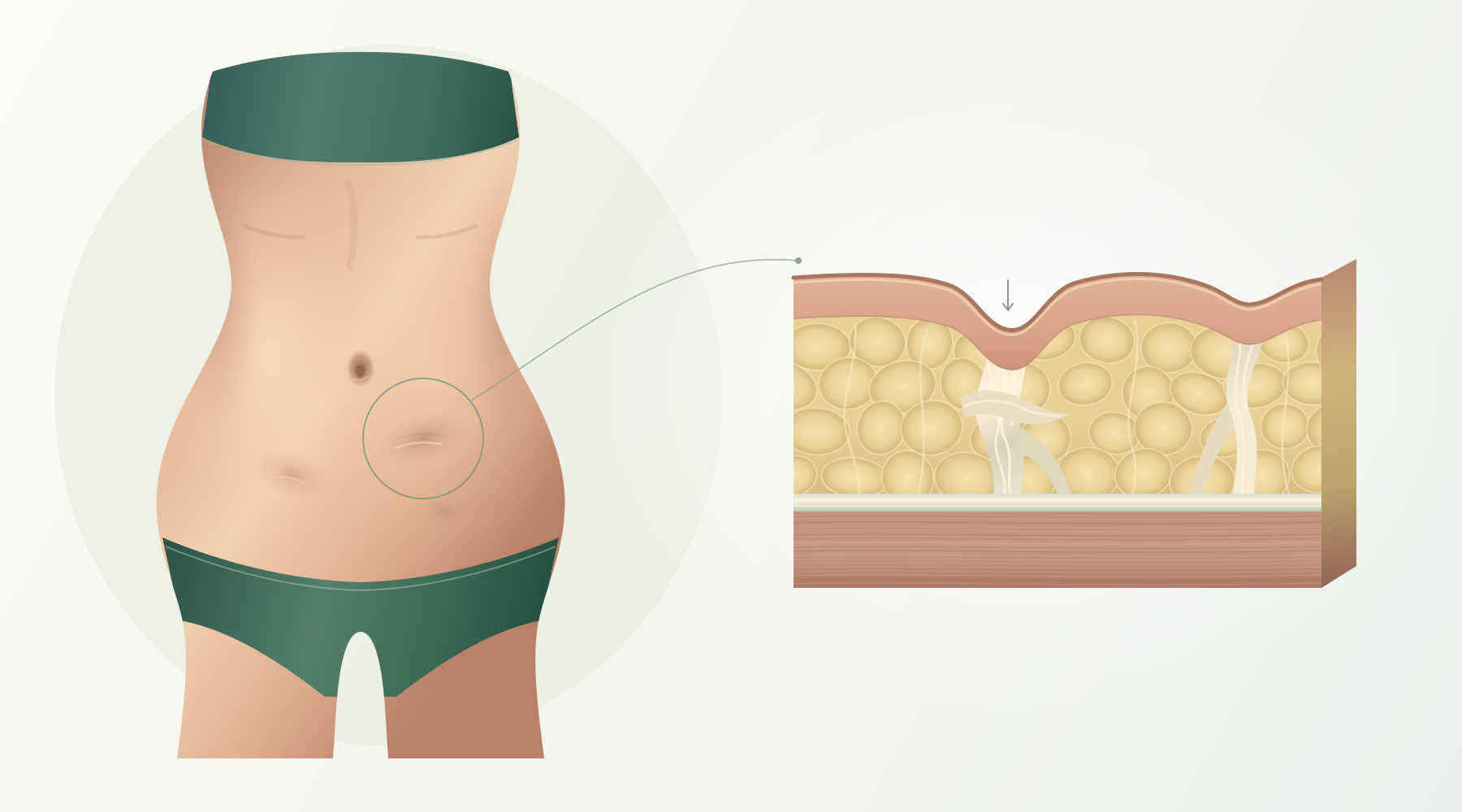
Skin tethering describes an area of skin that appears pulled down or fixed to deeper tissue rather than moving smoothly over it. The skin may form a dimple, groove or depression that becomes more noticeable when standing, bending or stretching. A tether can involve fibrous adhesions, but the same appearance may also result from excessive fat removal, uneven remaining fat or pre-existing skin laxity.
These terms are related but not interchangeable: you can feel firm tissue without visible tethering, and you can have a visible indentation without a substantial hard lump. Identifying the actual cause matters because treatment for an adhesion is not necessarily suitable for missing fat or loose skin.
Why does scar tissue form after liposuction?
Liposuction removes subcutaneous fat using a thin instrument called a cannula. As the tissue heals, inflammation and the normal wound-repair process help close the small channels left behind. Swelling and changes in tissue firmness can last for weeks or months while the area settles.
Sometimes scar tissue becomes more concentrated or attaches superficial tissue to deeper layers. Multiple factors may contribute to an uneven result, including the depth and distribution of fat removal, healing differences between areas, previous surgery, the amount of loose skin and postoperative complications such as fluid collections.
A peer-reviewed review of unfavourable liposuction outcomes describes surface irregularities associated with overly superficial or extensive suctioning, fibrosis with adhesions, garment-related pressure and redundant skin. It is therefore important not to attribute every visible dent to fibrosis alone.
There is no reliable way to predict an individual person’s scarring simply from the type of liposuction advertised. The surgical technique and the condition of the tissue are more important than marketing labels such as “traditional”, “VASER” or “high definition”.
How can you recognise fibrosis or skin tethering?
The appearance and feel vary. Patients often describe a hard patch, an uneven ridge, a small lump or skin that seems stuck in one place. Some changes are visible at rest; others only appear in certain positions or when the surrounding skin is moved.
Firm lumps and bands under the skin
Early firmness can be caused by healing and swelling. More established fibrous tissue may feel like a thickened band or a localised hard spot. A lump that is enlarging, increasingly painful or associated with redness should not be assumed to be harmless fibrosis.
Dimples, grooves and pulled-down skin
A tether may create a persistent depression or line, especially when skin is stretched. The area may feel less mobile when gently examined by a clinician. Similar features can occur where too much superficial fat has been removed or the remaining fat layer is uneven.
Asymmetry and changes with movement
Irregularities may be more obvious when the abdominal muscles tense, the hips bend or the arms are raised. Photographs taken in consistent lighting and the same standing position can help your surgeon understand whether the contour is improving over time.
However, appearance alone cannot establish the diagnosis. A surgeon may need to distinguish fibrous scar tissue from swelling, a seroma, haematoma, fat necrosis, loose skin or residual uneven fat.
Is it normal to feel hard lumps after liposuction?
Some swelling and firmness are expected during recovery. The American Society of Plastic Surgeons (ASPS) describes bruising, swelling and gradual improvement across the first six weeks and beyond. The American Academy of Dermatology also notes that results may take months to become clear.
A hard patch shortly after surgery does not by itself mean permanent fibrosis. Early postoperative swelling can be uneven, and compressed tissue may feel firmer before it softens. Nevertheless, persistent or worsening changes should be reviewed, particularly if accompanied by heat, redness, drainage or unusual pain.
There is no universal deadline by which every lump will disappear. The timing depends on the amount treated, the technique, individual healing and whether the finding represents swelling, scar tissue or a different complication.
Fibrosis vs swelling vs a seroma: key differences
Several postoperative problems can look similar to patients. A clinical examination—and sometimes imaging—is needed when the findings are uncertain.
| Finding | Typical features | What matters most |
|---|---|---|
| Postoperative swelling | General fullness, changing firmness or fluctuating asymmetry | Often improves gradually; persistent or worsening swelling needs review |
| Fibrosis or induration | Firm patch, nodule or band beneath the skin | Assess how long it has been present and whether it is changing |
| Skin tethering | Fixed dimple, groove or skin pulled towards deeper layers | Identify adhesions versus fat loss or lax skin |
| Seroma | Localised fluid collection that may feel fluctuant or swollen | May need clinical assessment and ultrasound |
| Infection or another complication | Increasing pain, warmth, redness, discharge or fever | Needs prompt medical attention, not cosmetic massage |
A seroma is a collection of fluid, not simply a solid scar. Likewise, a soft depression caused by uneven fat removal is not automatically treatable by breaking up fibrosis. This is why attempting to diagnose or aggressively massage a new lump at home can be unhelpful.
How common is fibrosis after liposuction?
The frequency depends on how researchers define and record it. A 2024 systematic review and meta-analysis included 60 studies representing 21,776 patients who had aesthetic liposuction. The pooled estimates were approximately 2% for contour irregularity and 1% for fibrosis or induration, with substantial differences between studies.
These figures do not mean that only one in every hundred patients will ever feel temporary firmness. The analysis grouped reported complications using the definitions available in each study; ordinary postoperative tissue hardening may not have been counted as a complication. The authors also warned that inconsistent reporting limited identification of reliable risk factors.
A separate 2024 prospective study of patients undergoing secondary liposculpture identified depressions, firm nodules and adhesions as distinct patterns in people already seeking correction. Its findings help illustrate the different forms of persistent irregularity, but they should not be used as the prevalence of fibrosis among all liposuction patients.
Does fibrosis after liposuction go away on its own?
Some postoperative firmness softens as inflammation resolves and the treated tissue remodels. This can take several months. Early irregularity therefore does not always justify immediate treatment, especially when the area is still swollen.
Established tethering, a deep groove or contour loss caused by insufficient remaining fat may persist despite the passage of time. A distinction must be made between tissue that is temporarily firm and an anatomical defect that needs a specific intervention.
It is reasonable to keep follow-up appointments and document the changes rather than deciding after a few weeks that surgery has failed. On the other hand, pain that is increasing or a lump that develops new concerning features should be assessed promptly rather than simply waiting six months.
Can massage or lymphatic drainage help liposuction fibrosis?
Gentle, clinician-approved techniques may help some patients manage postoperative swelling and comfort. Manual lymphatic drainage is sometimes included in postoperative care plans, but there is limited high-quality evidence that it reliably breaks down established deep fibrotic adhesions or corrects a fixed contour depression.
Any massage should follow the operating surgeon’s instructions regarding timing, pressure, wounds and the condition of the tissues. Forceful kneading of a painful, swollen or recently operated area may aggravate discomfort or interfere with healing. If a fluid collection, infection or other complication is suspected, it should be evaluated before any massage.
A review of liposuction complications discusses approaches such as lymphatic massage and external ultrasound for selected contour problems, but the evidence base is not strong enough to guarantee correction of tethering. Our article on lymphatic drainage massage after tummy tuck explores postoperative massage considerations more broadly; it is not a substitute for an individual liposuction aftercare plan.
Do compression garments prevent fibrosis and skin tethering?
Surgeons often recommend compression after liposuction to support tissues during recovery and help manage swelling. The correct garment, level of pressure and duration depend on the operation and the surgeon’s assessment. The ASPS recommends following individual instructions about compression and postoperative follow-up.
More compression is not necessarily better. A garment that folds, digs in or creates excessive pressure over a narrow line may contribute to discomfort or contour marks. The surgical review cited above describes examples of indentation associated with poorly fitting garments.
A compression garment cannot reliably release established fibrous attachments, replace lost fat or correct severe skin laxity. If it causes persistent pain, numbness or a pronounced groove, ask your surgical team to check its fit rather than tightening it further yourself.
How is persistent skin tethering diagnosed?
A plastic surgeon usually starts with the surgical history and an examination. They may assess the treated area while standing and lying down, observe the skin during movement, and gently assess the mobility and thickness of the tissues. Previous photographs and operative records can be helpful.
Questions may include when the irregularity appeared, whether the area is tender, whether it has been changing, and whether the operation involved additional energy-based devices or procedures. If a lump’s nature is uncertain, an ultrasound may be appropriate to check for a fluid collection or another underlying problem.
For a persistent contour defect, the examination aims to identify whether the problem is predominantly fibrous tethering, missing volume, residual excess fat, loose skin or a combination. The answer determines which revision options are realistic.
What treatments are available for persistent fibrosis?
There is no single treatment that corrects every form of fibrosis or contour irregularity. Options depend on the cause, severity, duration, symptoms and condition of the skin and fat beneath it.
Observation and supervised conservative care
When the area is still changing during the normal healing period, the surgeon may recommend observation, appropriate compression, gentle movement and selected aftercare. Some mild firmness and swelling settle without a corrective procedure.
Scar release or subcision
If a clear fibrous band pulls the skin down, a surgeon may discuss releasing the tethering tissue. The technique must be adapted to the depth and location of the adhesion. Releasing a band does not automatically restore volume that was lost during the original liposuction.
Fat grafting to an area with volume loss
Where a depression is partly caused by missing subcutaneous fat, carefully planned fat transfer may help restore contour. Its suitability depends on local tissue quality and the availability of donor fat. Fat survival varies and more than one procedure may sometimes be required.
Targeted revision liposuction
If irregularity is caused mainly by uneven residual fat, selective revision liposuction may be considered. Removing more fat from an area that is already overtreated can worsen depressions, so the surgeon must evaluate whether the problem truly involves excess tissue.
Skin removal or more extensive reconstruction
In selected patients, skin laxity and severe abdominal contour irregularities may need a larger corrective operation rather than a minimally invasive treatment. A 2024 case series of abdominal irregularity correction describes combining direct treatment of fibrosis with contour adjustment and, in some cases, abdominoplasty. Because this was a selected case series, it cannot establish that this approach is best for all patients or guarantee a particular result.
Some publications discuss injections or device-based treatments for postoperative fibrosis, but the evidence for specific agents and protocols is limited. They should not be used without specialist diagnosis and discussion of possible adverse effects. Avoid online advice to inject medication or use intense massage devices on a recent surgical site.
When is revision liposuction or scar release considered?
Elective revision is often delayed until swelling and tissue remodelling have had sufficient time to settle. A surgical review of unfavourable liposuction outcomes discusses waiting at least six months before correcting certain persistent contour problems. This is a common planning principle, not an inflexible rule for every diagnosis or technique.
If a patient has an actively worsening problem, suspected infection, significant fluid collection or another complication, evaluation and treatment should not be delayed to meet a cosmetic revision timetable.
Revision may carry additional risks because prior surgery has altered the anatomy and left scar tissue. Possible complications include recurrent tethering, asymmetry, seroma, poor healing, sensory changes and incomplete improvement. Clear expectations are essential, especially when the original defect has more than one cause.
When should you contact your surgeon urgently?
Some symptoms need prompt medical review rather than reassurance that the area is developing fibrosis. Contact your surgical team if you develop increasingly severe pain, spreading redness, fever, warmth, discharge, a rapidly enlarging lump, new wound breakdown or a painful fluid-filled swelling.
Seek urgent emergency care for chest pain, sudden shortness of breath, fainting or significant new one-sided leg swelling, as these can signal serious postoperative complications such as a blood clot. The ASPS lists infection, fluid accumulation, blood clots and contour irregularities among recognised liposuction risks.
Do not assume a new red or painful lump is benign scar tissue without examination, and do not attempt to drain it yourself.
How can you reduce the risk of contour irregularities?
Not all complications can be prevented, but good preparation and aftercare are important. Choose a suitably qualified surgeon experienced in the specific treatment area, discuss previous procedures and skin quality, and ask what result is realistic given the existing tissues.
- Understand the plan: Ask which fat layers will be treated, whether your skin is expected to contract well and how the surgeon aims to avoid over-resection.
- Follow postoperative instructions: Wear the prescribed garment as directed and attend follow-up appointments.
- Check garment fit: Report painful folds, narrow pressure marks or significant discomfort rather than adding extra compression.
- Avoid unapproved treatments: Do not start aggressive massage, heat devices, injections or topical therapies without clearance.
- Track changes: Use consistent photographs and describe when lumps, swelling or dimples first appeared.
- Report unusual symptoms: Early assessment matters if redness, fever or worsening pain develops.
Technique-related questions are covered in more detail in our liposuction techniques comparison and liposuction complications guide.
Questions to ask about liposuction fibrosis treatment
If you are seeking a second opinion or a revision procedure, use the consultation to establish what the surgeon believes is causing the problem. Useful questions include:
- Is the irregularity due to fibrosis, true adhesions, uneven fat thickness, loose skin or a combination?
- Could this still improve through normal healing, and how will we assess progress?
- Would examination or imaging be useful before deciding on treatment?
- What conservative treatments, if any, are appropriate for my situation?
- If revision is proposed, what exactly will be released, added or removed?
- What scars, recovery requirements and risks would corrective surgery involve?
- How likely is incomplete improvement or a need for further treatment?
Ask to see a clear explanation of the likely outcome for your individual tissues rather than assuming that a technique advertised online will provide the same result in every case.
CK Health Turkey: discussing concerns after liposuction
CK Health Turkey in Antalya supports international patients exploring plastic surgery and body-contouring options. If you are concerned about a persistent firm patch, dimple or irregular contour after liposuction, it may help to share when and where the original operation was performed, how your recovery progressed and when the change first appeared.
A qualified plastic surgeon should assess the tissue and determine whether the finding is part of healing, needs medical investigation or may benefit from a corrective procedure. International-patient coordination can support the consultation and travel-planning process, but the suitability and outcome of a revision cannot be established without an individual assessment.
For guidance on arranging a personalised consultation, contact CK Health Turkey and describe your concerns and surgical history.
Fibrosis and skin tethering after liposuction are not always permanent, and not every visible indentation is caused by scar tissue. The most helpful next step is an accurate diagnosis that separates normal healing from established adhesions, uneven fat removal or another complication, allowing treatment decisions to be made with realistic expectations.