
Highlights
- Natural chest anatomy, including the sternum, ribs, and breast spacing, determines the potential for cleavage more than implant volume alone.
- Underlying chest wall shapes like sunken or protruding contours can influence implant projection and symmetry, requiring customized surgical planning rather than a one-size-fits-all approach.
- Larger implants do not guarantee tighter cleavage and can lead to complications if they exceed the anatomical boundaries of the breast base and tissue coverage.
How chest shape affects breast implant cleavage is an important question for anyone considering breast augmentation. Implants can add breast volume and change contour, but they cannot completely override the shape of the chest underneath. Understanding your natural anatomy helps you discuss realistic results and safe implant positioning with your surgeon.
Table of Contents
How chest shape affects breast implant cleavage
Cleavage is influenced by the space between the breasts, their natural position on the chest, and the way breast tissue projects forwards and towards the centre. Breast implants may enhance fullness, but the sternum (breastbone), ribs, breast bases, skin and existing breast tissue determine how much change is possible.
A person with breasts naturally positioned close together may develop more visible cleavage after augmentation than someone with widely spaced breasts, even when the same implant volume is used. This does not mean that one chest shape is better than another. It means the surgical plan must be based on individual measurements rather than a photograph or an advertised cup size.
The American Society of Plastic Surgeons (ASPS) discusses breast spacing, tissue coverage and implant dimensions as important parts of planning cleavage. The organisation also notes that bras and clothing change how cleavage appears, so photographs showing a push-up effect are not a reliable guide to an unsupported surgical result.
Understanding three common chest-wall shapes
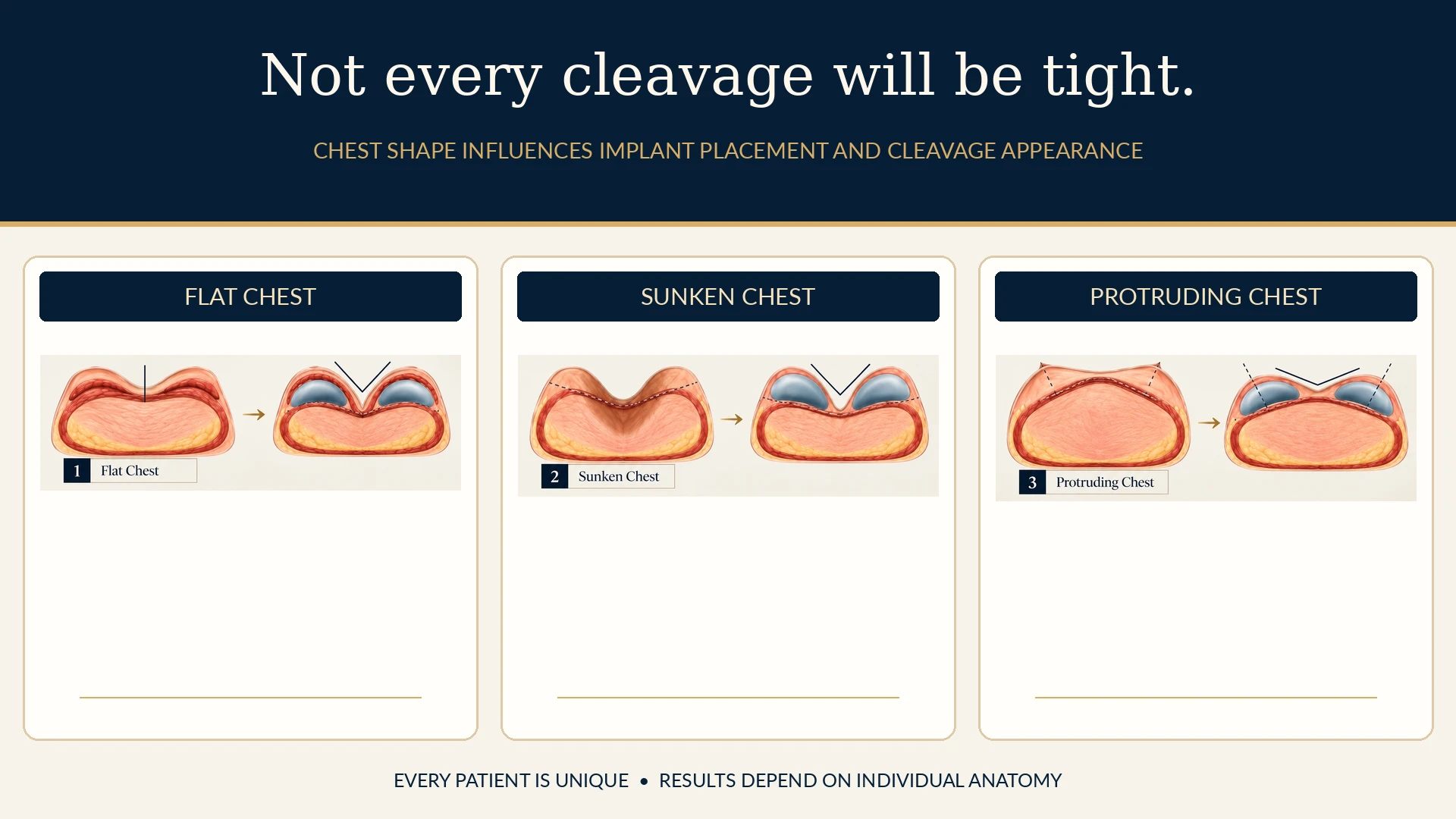
Educational diagrams sometimes group chest anatomy into “flat”, “sunken” and “protruding” shapes. These labels are a simple visual explanation, not three universal medical diagnoses. Real anatomy exists on a spectrum; the breasts themselves may be asymmetrical even when the underlying chest wall is relatively symmetrical.
1. Relatively flat or even chest wall
When the front of the chest is relatively even, the breasts and implants may sit on a more symmetrical foundation. In some patients, the breasts naturally point forwards with moderate space between them. Depending on the width of the breast bases and the available skin and tissue, augmentation may increase fullness in the inner and upper breast.
However, a relatively flat chest does not guarantee close cleavage. If the natural breasts are widely positioned or the breastbone area is broad, a central gap can remain. Attempting to force implants beyond the appropriate anatomical boundaries may compromise their support and position.
2. Sunken or inward-curving chest wall
A sunken chest can describe an inward depression around the sternum. A more pronounced anatomical form is called pectus excavatum. The depth and symmetry of this depression vary substantially. Depending on the rib contour and breast position, the chest may make one or both breasts appear angled differently before surgery.
Breast augmentation does not correct the underlying breastbone depression. In some patients, chest-wall geometry can influence the direction in which an implant projects, including towards the centre. That does not automatically create desirable cleavage: excessive medial movement can contribute to abnormal implant positioning. A surgeon may need to adjust implant dimensions, pocket placement or expectations rather than simply selecting a larger size.
If a sunken chest is significant or associated with breathing problems, exercise limitation or chest symptoms, assessment by an appropriate clinician may be needed independently of any cosmetic plan. An implant is not a treatment for a structural chest-wall condition.
3. Protruding or outward-projecting chest wall
A protruding chest describes a more forward-projecting sternum or rib contour. A pronounced form is known as pectus carinatum. In some anatomies, the chest slopes away from the midline, potentially influencing how breast tissue and implants point and how far apart the breasts appear.
For a patient whose breasts already point outward, an implant may increase size while leaving a noticeable space between them. Implant width, projection and placement require careful assessment; a larger implant is not automatically a solution. The priority is stable positioning with a natural relationship to the patient’s breast and chest dimensions.
A 2024 narrative review of pectus excavatum and pectus carinatum describes the varied structural shapes and presentations of these chest-wall conditions. Importantly, its findings are about chest-wall anatomy generally; they do not provide a formula for predicting cosmetic implant outcomes in an individual patient.
Chest shape and implant cleavage: a practical comparison
| Chest characteristic | Possible influence on breast appearance | What the surgeon assesses |
|---|---|---|
| Relatively even or flat chest | Implant projection may be more symmetrical, depending on breast tissue | Breast-base width, sternum width and natural breast spacing |
| Sunken sternum or inward contour | Implant direction and visible symmetry may be affected | Depth of depression, right–left differences and pocket boundaries |
| Protruding sternum or outward contour | Breasts may appear to project farther apart in some patients | Rib slope, breast orientation and implant dimensions |
| Wide natural breast spacing | Some central separation may remain after augmentation | Intermammary distance, soft-tissue coverage and safe implant position |
These are possible tendencies, not guaranteed outcomes. People with similar chest-wall shapes can have very different breast tissue, skin elasticity, symmetry and results.
Why larger breast implants do not always create tighter cleavage
Cleavage is not controlled by implant volume alone. A larger implant can increase overall fullness, but it also has a particular width and projection. If it is too wide for the existing breast base, it may push the outer contour farther towards the armpit or strain the surrounding tissue without solving the central gap.
Some patients can safely achieve greater inner-breast fullness with a carefully selected implant. Others have anatomical limits that cannot be bypassed without increasing the risk of an unnatural appearance or malposition. Choosing the correct implant is a balance between desired volume, tissue support, implant width and long-term positioning.
In an ASPS discussion of common augmentation questions, a plastic surgeon specifically cautions that larger implants do not necessarily produce more cleavage. This is useful when comparing before-and-after photographs: overall size and the space between breasts are two different features.
What does the surgeon measure before selecting an implant?
An appropriate consultation involves more than choosing a bra size or a number of cubic centimetres. Measurements and examination help establish the safe range of options.
- Breast-base width: The natural width of each breast guides the dimensions of the implant that may fit comfortably within its tissue envelope.
- Intermammary distance: The amount of tissue and space between the two breasts helps explain how much natural central separation may remain.
- Chest-wall curvature: The shape and angle of the ribs and sternum may affect breast orientation, projection and symmetry.
- Skin and tissue coverage: Thin tissue, significant laxity or existing asymmetry can change implant visibility and the risk of rippling or displacement.
- Nipple position and breast fold: The relationship between the nipple, breast footprint and inframammary fold helps guide implant pocket planning.
- Previous surgery and goals: Scarring, earlier implants or a desire for a lift can change what is appropriate.
Surgeons may use measurements, clinical photographs and, where appropriate, imaging or implant sizers to explain options. No simulation or sample photograph can guarantee the final appearance on your body.
Does implant placement above or below the muscle change cleavage?
Breast implants can be positioned in different planes, including behind breast tissue and in a position partially or fully involving the chest muscle. The appropriate plane depends on tissue coverage, anatomy, implant selection and other clinical factors. Placement may influence the visible upper contour and the way implants move, but no one plane guarantees close cleavage in every chest shape.
For example, a patient with limited natural breast tissue may need to discuss implant visibility and rippling, while someone with an unusual chest-wall contour may require additional attention to the implant pocket boundaries. Correcting apparent outward breast orientation can be more complicated than changing the plane alone.
Our existing guide, Breast Implants Over vs Under the Muscle, explains these placement options in more detail. A personal examination remains essential before a surgeon recommends either approach.
Can implants be moved closer together to create cleavage?
Implant pockets are carefully created spaces within the breast and chest tissues. Their boundaries affect where implants sit. In some cases, a surgeon may adjust pocket position to improve symmetry or breast spacing. However, the tissues that separate the breasts must be respected.
Trying to move implants too close to the centre can contribute to symmastia, an abnormal joining or loss of the natural separation between the breasts. This is different from an attractive cleavage line and can be difficult to correct. Implant malposition can also occur laterally, with implants appearing too far apart.
A 2021 peer-reviewed review of revision breast augmentation discusses how excessive medial dissection and implants that are too large or wide can contribute to medial malposition. It also identifies chest-wall conditions, including pectus excavatum and pectus carinatum, as relevant factors in implant positioning. These are clinical considerations, not proof that a particular chest shape will necessarily develop a complication.
For patients hoping to minimise breast spacing, this is a particularly important point: safe anatomy should take priority over an artificially narrow gap. Your surgeon should explain both what may improve and what may remain unchanged.
Do you need a breast lift as well as implants?
Volume loss and breast drooping are not the same issue as a wide intermammary gap. Breast augmentation can increase volume and projection, but it does not reliably correct significant sagging. If the nipple and breast tissue sit low relative to the breast fold, a breast lift (mastopexy) may be discussed separately or in combination with augmentation.
A lift changes the skin envelope and breast position; implants primarily provide or restore volume. Combining them may be useful in selected patients but adds complexity and its own risks. The ASPS patient guidance on breast augmentation explains that significant drooping may require a lift rather than implants alone.
These choices should not be driven solely by the appearance of cleavage in a low-cut top. The surgeon will also consider nipple position, breast symmetry, scarring, tissue quality and the likelihood of a stable result.
Why photographs may create unrealistic cleavage expectations
Two photos can show very different degrees of cleavage even if the person’s breast anatomy has not changed. Clothing, a supportive or push-up bra, posture, shoulder position, lighting and camera angle all influence the appearance. Breast augmentation before-and-after photographs should be assessed in comparable positions and without clothing that artificially presses the breasts together.
When reviewing examples, look for patients with a similar natural breast width, chest-wall contour and preoperative spacing rather than only a similar desired size. Ask the surgeon to discuss the limitations of the closest comparable cases. Even then, your own healing and tissue response will be individual.
Implants also settle as postoperative swelling decreases. Early photographs are not necessarily representative of the longer-term appearance. The ASPS describes how swelling and tissue adjustment affect results after breast augmentation.
What are the risks and limitations of breast augmentation?
Breast augmentation is major surgery. Potential complications include infection, bleeding, wound-healing problems, changes in nipple sensation, capsular contracture, implant rupture, rippling, asymmetry and implant displacement. Some people require additional surgery. Breast implants are not lifetime devices.
The NHS breast enlargement guidance advises discussing the implant type, position, expected results and follow-up arrangements, and explains important short- and long-term risks. Rare implant-associated illnesses and cancers are also part of a responsible implant discussion. A surgeon should explain risks relevant to the implant surface and product selected.
These considerations matter especially when a patient requests very large implants or unusually close placement to achieve a particular cleavage appearance. A safe, durable breast contour may require accepting some natural separation between the breasts.
Questions to ask at your breast augmentation consultation
- What does my natural chest-wall shape mean for implant projection and cleavage?
- How wide are my breast bases and how much spacing can realistically change?
- Which implant width and projection fit my tissue and desired outcome?
- Would positioning the implant closer to the centre increase my risk of malposition?
- Is one breast or side of my chest shaped differently from the other?
- Could breast lift surgery or another approach be more appropriate?
- What are my individual risks, recovery requirements and follow-up arrangements?
You can also explore our related guide to choosing breast implant size before discussing possible implant dimensions with a clinician.
Breast augmentation consultations with CK Health Turkey
At CK Health Turkey in Antalya, patients considering breast augmentation can enquire about treatment planning and international-patient coordination. Sharing your goals, medical background and concerns about breast spacing helps the team understand what you want to discuss with the clinical professionals involved in your assessment.
Whether your chest wall is relatively even, inward-curving or more prominent, the suitable implant size and surgical technique require individual examination. A personalised consultation should address realistic cleavage expectations, potential asymmetry, implant options, safety and postoperative follow-up. No specific breast shape or result can be promised from a diagram alone.
To ask about breast augmentation options in Antalya and the next steps for a personal assessment, contact CK Health Turkey.
Ultimately, how chest shape affects breast implant cleavage comes down to the interaction between the rib cage, natural breast spacing, tissue support and carefully selected implant dimensions. Fuller breasts do not always mean closer cleavage, and the best surgical plan is one that respects your anatomy while helping you make an informed decision about the result you can realistically expect.