Highlights
- Hyperbaric oxygen therapy (HBOT) significantly accelerates the healing process after plastic surgery by delivering 100% pure oxygen under increased pressure to hypoxic tissues.
- The treatment reduces postoperative swelling and bruising while preventing serious complications such as tissue necrosis and surgical site infections.
- Clinical research shows that HBOT promotes faster scar maturation and allows patients to return to their daily activities much sooner than standard recovery benchmarks.
Undergoing a cosmetic procedure is a significant commitment to your appearance, but the ultimate result depends heavily on your postoperative recovery. Incorporating hyperbaric oxygen therapy after plastic surgery has emerged as one of the most effective methods to minimize bruising, accelerate wound healing, and protect compromised tissue. By delivering pure oxygen under increased atmospheric pressure, this advanced recovery treatment ensures your body receives the vital resources required to heal rapidly and smoothly.
Table of Contents
Understanding How Oxygen Accelerates Surgical Healing
Plastic surgery procedures, whether invasive body contouring or delicate facial delicate work, inevitably disrupt localized blood vessels and microcirculation. When microvascular connections are cut or stretched, the surrounding tissue experiences localized hypoxia—a state where cells are deprived of essential oxygen. Hypoxia leads to prolonged inflammation, delayed tissue repair, increased swelling, and in severe cases, skin flap necrosis.
Under normal atmospheric conditions, humans breathe roughly 21% oxygen. This oxygen is transported through the body almost entirely by binding to hemoglobin in red blood cells. However, when tissue is inflamed or blood flow is restricted following surgery, red blood cells cannot easily pass through microcapillaries to nourish damaged area.
Hyperbaric oxygen therapy (HBOT) overcomes this physical bottleneck through basic gas laws. By placing the patient inside a pressurized chamber—typically set between 1.5 and 2.5 atmospheres absolute (ATA)—and administering 100% pure medical-grade oxygen, the treatment dramatically increases the amount of gas dissolved directly into liquid blood plasma.
This oxygen-saturated plasma diffuses up to four times deeper into hypoxic tissues than red blood cells can reach. The influx of dissolved oxygen triggers immediate physiological repair mechanisms:
- Neovascularization: Stimulates the creation of new capillary networks, restoring blood supply to surgical sites.
- Fibroblast Proliferation: Enhances the activity of connective tissue cells responsible for producing structural collagen.
- Edema Reduction: Promotes microvascular constriction, which decreases fluid buildup without reducing tissue oxygen levels.
- Phagocytosis Support: Empowers white blood cells to destroy harmful bacteria, preventing surgical site infections.
Benefits of Hyperbaric Oxygen Therapy After Plastic Surgery
While traditional surgical aftercare relies primarily on rest, compression garments, and lymphatic drainage, hyperbaric oxygen chamber treatments act at a cellular level to enhance every phase of physiological healing.
Reduction of Postoperative Edema and Bruising
Swelling and fluid accumulation are the most common complaints following extensive procedures like tummy tucks, facelifts, and high-definition liposuction. Fluid retention puts physical pressure on delicate skin flaps, impairing capillary flow and causing uncomfortable tightness. HBOT induces hyperoxic vasoconstriction, which reduces fluid leakage from blood vessels into interstitial spaces while simultaneously flooding the area with dissolved oxygen. This dual action flushes out broken red blood cells responsible for discoloration, resolving severe bruising in days rather than weeks.
Prevention of Tissue Necrosis and Flap Failure
In complex surgeries involving tissue repositioning—such as abdominoplasty, breast reduction, or facelift surgery—the blood supply to the edges of skin flaps can become compromised. Tissue necrosis (skin death) is a distressing complication requiring secondary corrective surgeries. HBOT acts as an insurance policy for vulnerable surgical flaps by driving life-saving oxygen directly into ischemic tissues until new blood vessel networks can establish themselves.
Faster Scar Maturation and Wound Closure
Collagen synthesis requires high concentrations of cellular energy and oxygen. By maintaining elevated tissue oxygen levels, hyperbaric sessions allow fibroblasts to synthesize organized, high-quality collagen fibers rapidly. This leads to faster surgical incision closure, reduced risk of wound breakdown (dehiscence), and softer, flatter, less visible scars over the long term.
Lowering the Risk of Surgical Site Infections
Infections can ruin an otherwise flawless surgical outcome. Anaerobic bacteria thrive in low-oxygen environments created by surgical trauma. The hyperoxic environment generated inside a hyperbaric chamber acts as a potent antimicrobial agent, killing anaerobic pathogens and enhancing the bactericidal capabilities of neutrophils.
Scientific Evidence: What Clinical Research Shows
Clinical research consistently supports the clinical application of hyperbaric medicine in aesthetic and reconstructive plastic surgery. A prospective study published in Plastic and Reconstructive Surgery – Global Open evaluated 296 patients undergoing aesthetic surgical procedures—including liposculpture, abdominoplasty, and breast interventions—who received postoperative hyperbaric oxygen therapy. The researchers documented exceptionally low complication rates (10.7% overall) with zero reported cases of surgical site infections or skin necrosis. Furthermore, patients demonstrated significantly accelerated recovery times, returning to daily work within 3 days for breast surgeries, 10 days for liposuction, and 21 days for full abdominoplasty, outperforming standard international surgical benchmarks.
Procedures That Benefit Most from HBOT Aftercare
While hyperbaric medicine benefits nearly all surgical recoveries, certain aesthetic procedures yield dramatic advantages due to their scope and mechanical impact on tissue blood flow.
Abdominoplasty (Tummy Tuck)
Tummy tucks involve extensive skin detachment, tissue tightening, and significant tension along the lower abdominal suture line. This tension creates localized ischemia at the incision margin. HBOT prevents skin breakdown along the central scar, accelerates fluid clearance, and significantly alleviates tightness.
Facelift and Neck Lift
Facial surgery demands perfection, as any skin flap failure or severe scarring is immediately visible. Because facial skin flaps are thin and delicate, hyperbaric treatment protects the hairline and earlobe incision sites, reduces post-op facial swelling, and restores natural skin tone much faster.
Breast Reconstruction and Augmentation
Whether recovering from mastopexy (breast lift), reduction, or implant-based reconstruction, preserving nipple-areola complex viability is paramount. Oxygen therapy ensures robust microvascular perfusion to the nipple-areola complex and minimizes internal capsular contracture risks driven by subclinical inflammation.
High-Definition Liposuction and Body Contouring
Extensive liposuction creates widespread subcutaneous trauma and tissue void spaces that naturally collect seroma fluids. Hyperbaric chambers accelerate the reattachment of skin layers to underlying muscle fascia while rapidly clearing deep tissue bruising.
Step-by-Step Guide: What to Expect During an HBOT Session
If your plastic surgeon incorporates hyperbaric medicine into your aftercare protocol, knowing what to expect can help you feel confident and comfortable throughout your sessions.
- Pre-Session PreparationYou will change into 100% pure cotton garments provided by the medical facility to prevent static electricity. You must remove all cosmetics, body lotions, jewelry, and electronic devices prior to entering the hyperbaric chamber.
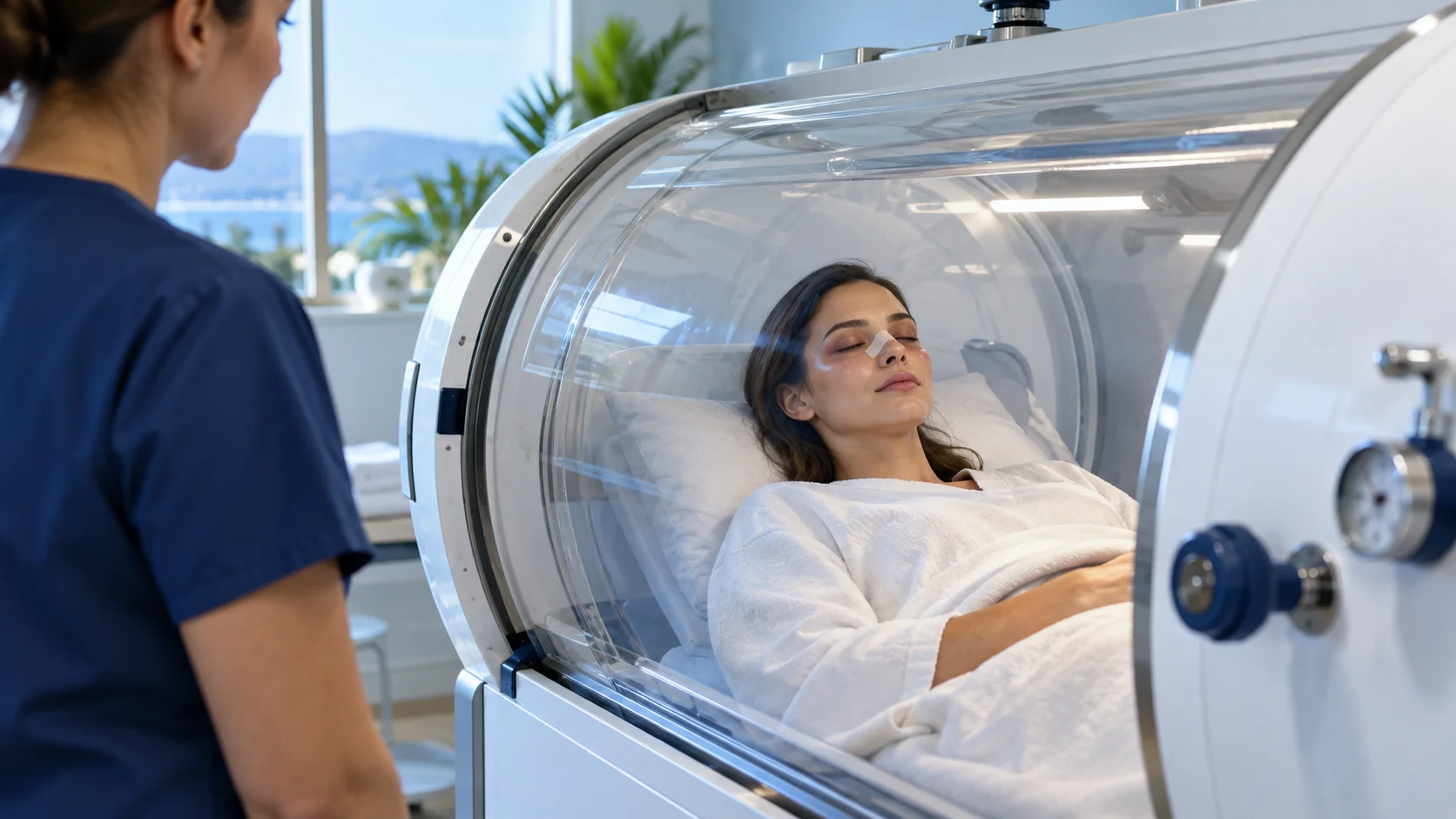
- Entering the ChamberYou will lie down comfortably inside a clear, state-of-the-art monoplace chamber or sit comfortably in a spacious multiplace chamber alongside a trained hyperbaric technician.
- Pressurization PhaseAs the chamber pressurizes to the prescribed therapeutic depth (usually 1.5 to 2.0 ATA), you will experience a gentle sensation in your ears similar to taking off in an airplane. You can equalize ear pressure easily by swallowing, yawning, or pinching your nose and blowing gently.
- Therapeutic Treatment PhaseOnce full treatment pressure is reached, you will breathe 100% medical oxygen for 60 to 90 minutes. During this time, you can relax, listen to music, watch a movie, or nap while the oxygen saturates your body.
- Depressurization PhaseThe technician slowly reduces chamber pressure back to normal sea level over 10 to 15 minutes. Your ears will automatically equalize as the pressure relaxes.
- Post-Treatment RoutineAfter stepping out of the chamber, you can immediately resume your standard post-op recovery routine, put on your compression garments, and return to your hotel or home resting area.
Hyperbaric Oxygen Therapy After Plastic Surgery vs Standard Recovery
Comparing the recovery metrics highlights why surgeons increasingly recommend hyperbaric medicine alongside standard postoperative protocols.
| Recovery Parameter | Standard Postoperative Protocol | HBOT-Enhanced Recovery Protocol |
| Peak Bruising Duration | 14 to 21 days | 5 to 8 days |
| Severe Edema Resolution | 4 to 8 weeks | 2 to 3 weeks |
| Microvascular Oxygen Tension | Low (localized surgical hypoxia) | Extremely High (up to 400% plasma saturation) |
| Surgical Site Infection Risk | Standard baseline risk | Significantly reduced |
| Flap Necrosis Risk in Compromised Cases | Moderate to High | Low (promotes tissue salvage) |
| Return to Light Work | 14 to 28 days (procedure dependent) | 7 to 14 days (procedure dependent) |
| Scar Maturation Progress | 6 to 12 months | Accelerated initial collagen organization |
Safety, Protocol Duration, and Candidate Criteria
Hyperbaric oxygen therapy is an FDA-approved medical modality with an exceptional safety profile when administered by certified hyperbaric specialists.
Recommended Number of Sessions
A typical aesthetic surgery protocol consists of 5 to 10 sessions lasting 60 to 90 minutes each. Ideally, the first session takes place within 24 to 48 hours post-surgery to combat peak inflammatory cycles immediately. Patients undergoing extensive combination surgeries (such as a Mommy Makeover) may benefit from up to 12 sessions.
Candidate Criteria and Contraindications
Most healthy individuals undergoing elective cosmetic surgery are excellent candidates for HBOT. However, absolute and relative contraindications must be screened prior to treatment:
- Untreated Pneumothorax: An untreated collapsed lung is an absolute contraindication.
- Severe Claustrophobia: Mild claustrophobia can be managed with spacious chambers or light sedatives, but severe cases require assessment.
- Recent Ear or Sinus Surgery: Unresolved middle ear barotrauma can make pressure equalization difficult.
- Active Pulmonary Disease: Severe COPD or asthma requires clearance by a hyperbaric physician.
CK Health Turkey: Premium Aftercare for International Surgery Patients
For patients traveling abroad for plastic surgery, medical tourism destinations like Turkey offer world-class surgical expertise combined with luxury recovery facilities. CK Health Turkey stands out as a premier healthcare provider in Antalya, delivering comprehensive medical care packages designed specifically for international patients seeking seamless cosmetic transformations.
At CK Health Turkey, patient care extends far beyond the operating room. Understanding that exceptional surgical results depend on meticulous aftercare, CK Health Turkey integrates advanced postoperative recovery modalities—including professional lymphatic therapy and hyperbaric support—into their personalized treatment pathways.
International patients at CK Health Turkey enjoy an end-to-end medical journey, featuring certified plastic surgeons, multilingual patient coordinators, VIP airport transfers, and stay arrangements at partner luxury recovery hotels. By choosing a clinic that prioritizes advanced postoperative technologies, patients drastically shorten their downtime and enjoy a stress-free recovery environment before flying home.
If you are planning your cosmetic journey and want to ensure the safest, fastest recovery possible, reach out to the medical experts at CK Health Turkey today to explore tailored plastic surgery and aftercare packages.
Combining advanced surgical techniques with hyperbaric oxygen therapy after plastic surgery gives your body the ultimate advantage in tissue repair, swelling control, and scar refinement. By prioritizing cellular oxygenation immediately following your procedure, you protect your surgical investment and achieve your aesthetic goals with confidence and peace of mind.