Highlights
- A surgical brow lift involves repositioning forehead tissues through incisions for a more substantial and long-lasting result.
- A thread lift uses sutures under the skin to provide a modest, temporary lift with shorter recovery time and no surgical incisions.
- The choice between procedures depends on the degree of brow descent, desired longevity, and the patient's tolerance for surgical risks and recovery.
Choosing between a surgical brow lift vs thread lift can be confusing when both promise a higher, more open-looking eyebrow position. They are not interchangeable procedures: surgery repositions the brow and forehead tissues through incisions, while a thread lift uses sutures placed beneath the skin to create a more limited, temporary lift. The right approach depends on where your eyebrows sit, how much lifting you need and which risks and recovery requirements you are comfortable accepting.
Table of Contents
This guide compares the results, longevity, scars, recovery and limitations of both treatments, including what to ask if your main concern is hooded eyes or a drooping outer brow.
Surgical brow lift vs thread lift: what is the main difference?
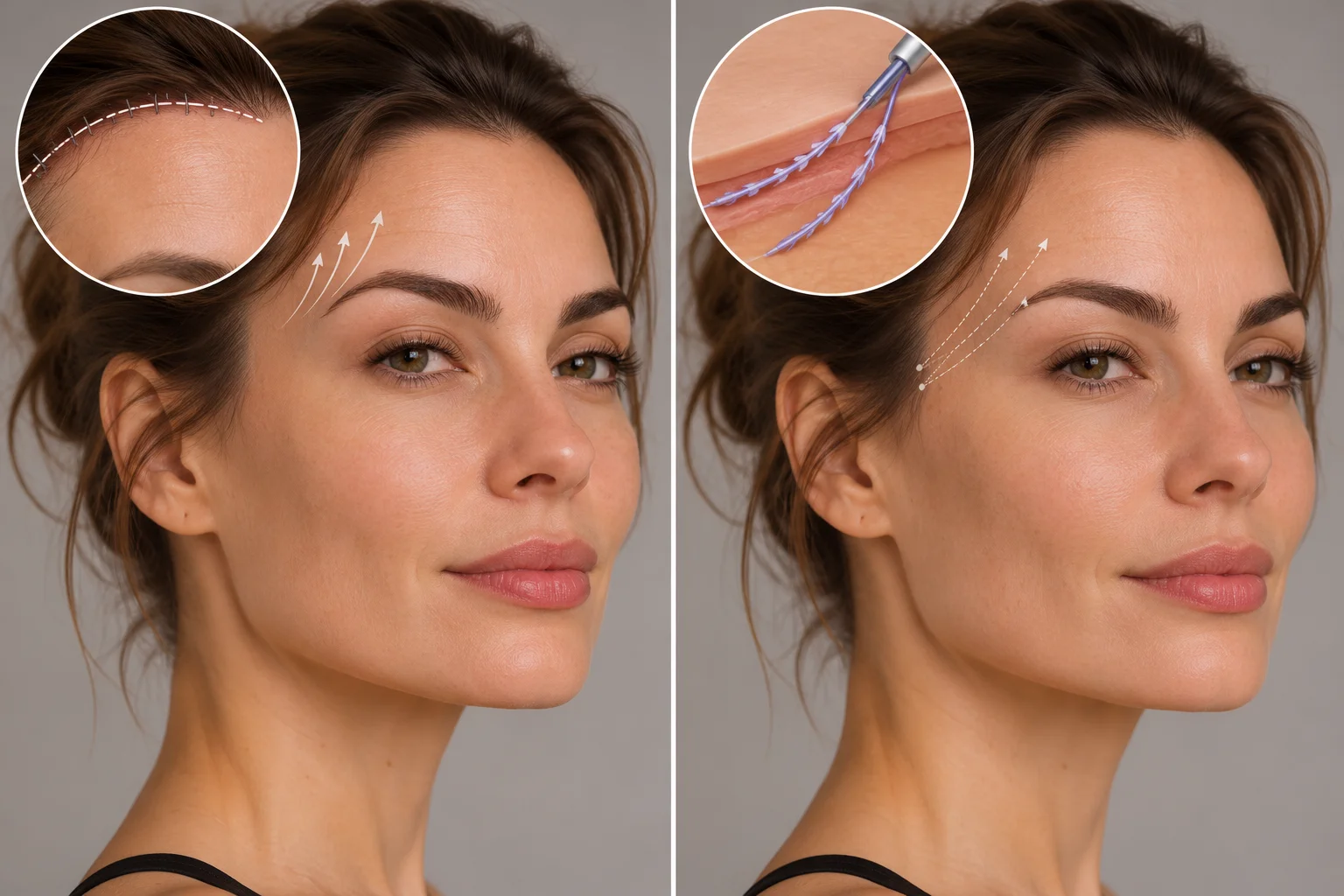
A surgical brow lift, also called a forehead lift or browplasty, involves releasing or repositioning tissues that contribute to a low eyebrow position. Depending on the technique, the surgeon may adjust underlying structures and skin through small scalp incisions or a longer incision along or behind the hairline.
A thread lift places medical-grade threads beneath the skin through small entry points. Certain barbed or suspension threads mechanically draw tissues upward, sometimes providing a modest lift to the outer eyebrow. Unlike surgery, the technique does not remove significant excess skin or provide the same access to deeper forehead structures.
The American Society of Plastic Surgeons (ASPS) describes brow lift surgery as a way to raise sagging brows and improve forehead lines. Its thread lift guidance explains that threads can provide a subtler lift for early facial looseness, including some sagging eyebrows.
Neither procedure is automatically best for everyone. A person with substantial true brow descent may need a different treatment from someone who wants a very small change in the outer brow’s angle.
How does a surgical brow lift work?
The goal of a surgical brow lift is to change the position and support of the eyebrows and, in some techniques, improve the appearance of forehead creases. Different surgical approaches are chosen according to eyebrow anatomy, forehead height, hairline position and the degree and pattern of descent.
Endoscopic brow lift
The surgeon makes several small incisions within the scalp and uses an endoscope—a narrow instrument with a camera—to view and adjust the underlying tissues. These incisions are usually concealed in the hair-bearing scalp, but they still create surgical scars.
The Aesthetic Society notes that endoscopic approaches are commonly considered for mild-to-moderate brow descent, although they are not suitable for every patient. The final result depends on tissue fixation, anatomy and technique, not simply the use of a camera.
Open or hairline brow lift
Open techniques may use a longer coronal incision within the scalp or a hairline incision. They allow direct tissue repositioning and, in selected cases, skin removal. A hairline approach can be relevant when forehead height is important, because moving the hairline upward is not desirable for every patient.
These techniques have different scar and hairline trade-offs. A procedure that is appropriate for a person with significant brow descent may be unnecessary for someone seeking only a minor lateral lift.
Temporal or lateral brow lift
A limited-incision temporal lift focuses primarily on the outer portion or tail of the eyebrows. It may be considered where the lateral brow is the main concern, while offering less correction to the central brow or forehead than a more extensive approach.
Our endoscopic brow lift guide provides more background on one surgical method. A qualified surgeon should explain why a particular incision and fixation technique would suit your individual features.
How does an eyebrow thread lift work?
In a thread brow lift, the clinician places specialised sutures beneath the skin, often in the brow or temporal region. Depending on the thread design and placement, the sutures can engage tissue to reposition it and may also produce a local healing response that stimulates collagen formation.
Cleveland Clinic describes eyebrow and “cat eye” thread lifting among the applications of the technique. The procedure commonly uses local anaesthesia and small insertion points rather than the incisions required for conventional brow lift surgery.
Thread materials and designs vary. Some are absorbable; others are not. Terms such as PDO, PLLA and PCL refer to different materials, but the material alone cannot guarantee a particular lifting effect or duration. The technique, fixation, tissue mobility and clinician’s anatomical knowledge all influence the result.
A 2025 anatomical review of eyebrow thread lifting emphasises the relationship of threads to muscles, blood vessels and nerves and the need to assess tissue mobility before choosing the placement strategy. Threads placed near the brow are not a simple beauty treatment without anatomical risks.
Surgical brow lift vs thread lift: side-by-side comparison
This table summarises the usual differences. It does not replace a consultation or guarantee the result of either treatment.
| Factor | Surgical brow lift | Thread brow lift |
|---|---|---|
| Primary method | Repositions brow and forehead tissues through incisions | Uses threads beneath the skin to suspend selected tissues |
| Extent of lift | Can address more pronounced or widespread brow descent | Generally offers modest adjustment, often laterally |
| Duration | Often longer-lasting, but ageing and changes continue | Temporary; durability is variable and long-term evidence is limited |
| Anaesthesia | Sedation or general anaesthesia depending on technique | Usually local anaesthesia |
| Scars | Surgical incisions, often near or within the hairline | Small thread entry sites; no conventional brow-lift incision |
| Initial recovery | Often around 10–14 days for initial wound healing | Often a few days of bruising or swelling; activity restrictions may continue |
| Possible problems | Scarring, numbness, nerve injury, hairline change, asymmetry | Dimpling, visible threads, migration, infection, asymmetry |
| Potential repeat treatment | Revision may occasionally be required | Maintenance or repeat lifting may be considered as effects diminish |
People sometimes choose a thread lift because they want to avoid surgery, but the shorter recovery should be weighed against the limitations of the result. Conversely, a surgical brow lift offers more extensive correction but entails incisions and a different risk profile.
Which treatment creates a more noticeable brow lift?
A surgical brow lift can generally reposition the brow more substantially and predictably where there is a genuine structural descent. This can be especially relevant when low-set eyebrows contribute to a heavy appearance above the upper eyelids.
A thread lift is generally better understood as a method for a small or moderate, carefully selected adjustment, not a substitute for every surgical correction. A patient hoping to raise markedly descended brows by several millimetres or alter the entire forehead may be disappointed by thread lifting alone.
The desired look also matters. Some people prefer slightly raised outer brow tails, while others need balanced lifting of the inner, central and outer portions. Over-lifting the lateral brow can produce an unnatural expression, and lifting the whole eyebrow can change facial character.
Photographs alone can mislead because eyebrow height changes with facial expression. A physical examination assesses the brows when the forehead muscles are relaxed, as well as skin laxity, asymmetry and the relationship with the upper eyelids.
How long do surgical brow lifts and thread lifts last?
Surgical brow lifting is intended to provide a longer-lasting repositioning of the tissues. However, it does not stop ageing, guarantee permanent symmetry or prevent all future brow descent. Outcomes depend on the method and patient.
A 2026 systematic review and meta-analysis of long-term surgical brow lift results included 22 studies representing 2,127 brows, with a weighted mean follow-up of about 21 months. The authors reported average persistent elevation of approximately 3.8 mm laterally, 3.0 mm centrally and 2.4 mm medially. These are pooled research findings, not the result any individual patient should expect.
Thread lifting is temporary. Cleveland Clinic describes results potentially lasting around one to three years for thread lifts generally, while published studies show substantial variation in techniques and follow-up. More conservative scientific assessments indicate that the visible mechanical lift may fade considerably sooner in some patients.
A 2025 systematic review of absorbable facial thread lifts found early improvement but emphasised that reliable long-term efficacy data are lacking. Most of the included research concerned the mid and lower face rather than eyebrow-specific lifting. It would therefore be misleading to promise that an eyebrow thread lift will last exactly two or three years.
Ask what is known about the particular technique offered to you, including how the clinician defines success and how they manage results that fade earlier than expected.
Does a thread lift leave scars?
Thread lifting uses small entry points instead of the longer incisions used for surgical brow lifting, so visible scarring is generally less prominent. Nonetheless, breaking the skin can leave marks, and infection or thread extrusion can cause more noticeable changes.
Surgical incisions are often planned within the hair-bearing scalp or at the hairline to make them less conspicuous. Their visibility depends on incision placement, hairstyle, hair density and individual scar healing. A hairline incision may be more apparent in some patients, while a coronal technique can affect hairline height.
The ASPS lists unfavourable scarring and loss of hair around incisions among recognised brow lift risks. A surgeon should explain precisely where your incision will be and whether the proposed technique could change your forehead or hairline appearance.
What is recovery like after each procedure?
After surgical brow lifting
Expect some swelling, bruising and forehead tightness or altered sensation. Dressings or other postoperative support may be used, and the surgeon will provide instructions on wound care, activity and follow-up.
The ASPS describes initial brow-lift wound healing of around 10–14 days, with swelling and incision changes continuing for weeks or months. This is not a promise of complete recovery in two weeks or permission to exercise vigorously without clearance.
After an eyebrow thread lift
Bruising, tenderness and swelling can occur after thread placement. Some people return to ordinary non-strenuous activities quickly, although the clinician may recommend avoiding vigorous exercise, heavy facial manipulation or certain movements for a period of time.
Cleveland Clinic notes that bruising and swelling can occur for several days after thread lifting and that more demanding activity may need to be delayed. The recovery plan depends on the threads used, their placement and individual healing.
Whichever approach you choose, increasing pain, fever, spreading redness, unusual drainage or other concerning changes require medical assessment rather than simply waiting for routine swelling to settle.
What are the risks of surgical brow lift vs thread lift?
Both treatments carry risks, but the complications differ because one involves surgical tissue dissection and the other involves inserted suspension threads.
Surgical brow lift risks
Possible complications include bleeding, infection, poor wound healing, scarring, sensory changes, asymmetry, temporary or lasting nerve injury, hair loss near an incision and a change in hairline position. As with other surgery, anaesthesia and certain systemic risks must also be considered.
The ASPS safety guidance lists these risks and stresses that they should be discussed before consent. The fact that a surgery is described as “endoscopic” or “minimally invasive” does not make all complications impossible.
Thread lift risks
Threads can cause bruising, pain, swelling, puckering or dimpling, asymmetry, palpable or visible threads, migration, extrusion, infection and inflammatory reactions. Some problems resolve with time, while others may require treatment or removal of a thread.
A 2021 meta-analysis of facial thread lifts included 26 studies and reported pooled rates of swelling around 35%, skin dimpling around 10%, and infection and thread extrusion around 2% each. These figures relate to facial thread lifting across different sites and techniques; they are not eyebrow-specific complication probabilities.
A newer 2026 meta-analysis also identified swelling, bruising, palpable threads and dimpling, but reported substantial differences between the studies. This means individual complication rates are uncertain and depend on procedure details, technique and patient selection.
The important practical point is that “non-surgical” does not mean risk-free. The eyebrow and temple regions contain vessels and nerves, so anatomical expertise is relevant to both treatments.
Who is a better candidate for a surgical brow lift?
Someone with substantial brow descent, deep tissue laxity or a clearly low brow position may benefit from a discussion about surgery when they want a more pronounced, longer-term adjustment and accept the scar and recovery trade-offs.
Surgery may also be considered when the forehead and brow position need coordinated correction or when a person has already tried a less-invasive treatment without achieving an adequate result.
However, not every brow concern requires lifting. The surgeon must examine forehead height, hairline, brow shape, skin elasticity, upper eyelid condition, vision-related symptoms and any existing asymmetry. Relevant medical conditions, previous procedures and smoking or medication use also influence suitability.
A person requesting only a subtle change may find the potential surgical effect greater than they actually want. Appropriate treatment planning should avoid altering the brow merely because a surgical technique is available.
Who might consider an eyebrow thread lift?
Thread lifting may be discussed with patients seeking a relatively subtle temporary change, often near the outer brow, who have limited skin laxity and realistic expectations about durability. It may be attractive to someone who prefers shorter initial downtime and wants to avoid a traditional surgical incision.
It is less likely to provide adequate correction where the eyebrows are substantially descended or the patient has extensive upper-face skin laxity. The clinician should assess how freely the tissues move and whether the proposed thread placement can plausibly achieve the desired shape.
Not everyone is a suitable candidate for threads. Previous facial surgery, skin conditions, active infection, certain medication or medical concerns and unusual tissue anatomy may affect the recommendation. Thread material and placement should be discussed before treatment.
Patients should understand that future maintenance may involve another procedure and further expense. The term “fox eye” is a description of a desired look, not a guarantee that thread placement can safely reproduce it on every face.
Is a brow lift the same as upper blepharoplasty?
No. Blepharoplasty addresses the eyelid itself, often by removing or repositioning excess eyelid skin or other tissue. A brow lift addresses the position of the eyebrows and forehead. The treatments can improve related features but are not substitutes in all situations.
If you have hooded upper eyelids, the cause may be a low brow, extra eyelid skin, true eyelid ptosis or a combination. The American Academy of Facial Plastic and Reconstructive Surgery explains that brow lifting and blepharoplasty target different anatomical problems and may sometimes be combined.
A thread lift that raises the outer eyebrow slightly may do little for substantial excess upper eyelid skin. Similarly, eyelid surgery alone may not correct a significantly descended eyebrow. Patients should be examined rather than selecting a treatment from photographs of “hooded eyes”.
Our existing guide on brow lift and blepharoplasty explores situations where a combined surgical plan is considered.
Could Botox be an alternative to surgery or threads?
Botulinum toxin injections may temporarily alter the balance of muscles that pull the eyebrows up and down, creating a small change in brow position for selected patients. The effect is not equivalent to surgically repositioning loose forehead tissues and cannot remove significant eyelid skin.
In some people, relaxing the wrong muscle or using an unsuitable injection pattern can worsen brow or eyelid drooping. The choice and placement of any injection should be assessed by an appropriately qualified clinician.
There is no reason to assume that a person with mild brow asymmetry needs either threads or surgery. Sometimes observation or a conservative, temporary option better matches the person’s goals, while structural descent may need a different approach.
What if you have already had a thread lift?
A previous thread lift does not automatically exclude later brow surgery. However, the surgeon needs to know what type of threads were used, when they were placed, where they were inserted and whether you had complications or attempts at removal.
Residual threads, local scar formation or unusual tissue changes may affect the evaluation and surgical planning. If possible, obtain treatment notes or details of the thread material. Do not attempt to pull or remove protruding threads yourself.
If you have persistent pain, a new lump, redness or a visible thread, arrange a clinical assessment. Cosmetic dissatisfaction should be distinguished from a complication that requires timely treatment.
How should you compare the costs?
A thread lift may have a lower upfront fee and require less initial time away from work, but the result may fade and repeat procedures can add to the total cost. Surgery generally involves a more extensive procedure and recovery, while potentially offering a longer-lasting change.
Ask for a written quotation that identifies the procedure, clinician, anaesthesia if applicable, facility charges, medicines, aftercare and what happens if complications or revision treatment are needed. When travelling for treatment, include accommodation and travel costs as well as the initial fee.
It would be misleading to provide a fixed Turkey price without knowing the exact technique, facility and individual treatment plan. The more meaningful comparison is the clinical suitability and likely long-term value of each approach, not the advertised number alone.
Questions to ask before choosing a brow lift or threads
- Is my main problem brow descent, excess eyelid skin, forehead wrinkles or a combination?
- How much elevation could the proposed technique realistically provide in my case?
- Would the procedure affect the inner, central or outer eyebrow—or all three?
- How stable is the expected result, and what evidence supports that estimate?
- Where would a surgical incision or thread entry point be placed?
- What are the risks of asymmetry, nerve problems, dimpling or visible scars?
- What is the realistic recovery plan, including exercise and time off work?
- Would blepharoplasty or another treatment better address my concern?
- If I am unhappy or a complication occurs, what are the options and likely additional costs?
Bring photographs showing your natural relaxed expression, not only images with your eyebrows deliberately raised. That will help the clinician understand the change you want without confusing facial muscle movement with the brow’s usual position.
CK Health Turkey: discussing brow lifting options
CK Health Turkey in Antalya supports international patients exploring plastic surgery and facial aesthetic treatments in Turkey. If you are considering eyebrow rejuvenation, share whether your main concern is a heavy brow, outer-brow drooping, forehead lines, hooded eyelids or asymmetry.
A qualified clinician should assess your anatomy, medical history and goals before explaining which treatment approaches are suitable. A patient coordinator can assist with the consultation and travel-planning process, but the clinical decision about surgery, threads or an alternative must be made through an individual assessment.
For more information about treatment planning and arranging a consultation, contact CK Health Turkey.
Ultimately, choosing a surgical brow lift vs thread lift means balancing the degree of elevation you need, your expectations for how long it should last and your willingness to accept incisions, downtime or possible thread-related complications. A careful examination can reveal whether a substantial repositioning procedure, a subtle temporary adjustment or no brow-lifting treatment at all best fits your concerns.