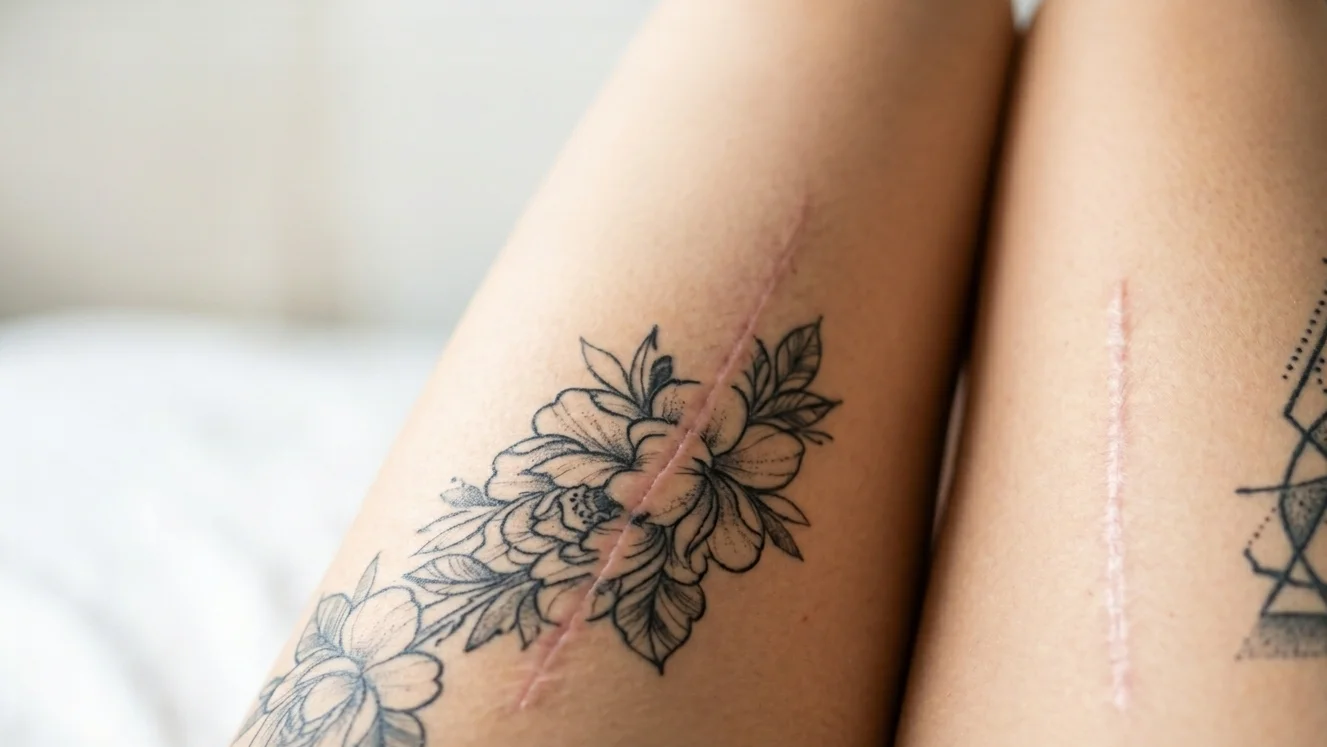
Achieving smoother, more contoured legs through thighplasty is a transformative milestone for individuals managing loose skin after major weight loss or aging. However, patients with pre-existing body art must carefully consider how the surgical process affects their skin’s appearance. Understanding the dynamics of Thigh Lift Scars and Tattoo Changes is essential for managing aesthetic expectations and planning future cover-up ink.
Table of Contents
Understanding Thigh Lift Surgery and Incision Types
Thigh lift surgery, or thighplasty, removes redundant skin and excess fat from the lower body to reshape the contours of the legs. The technique chosen by a plastic surgeon relies extensively on the patient’s anatomy, skin laxity, and the specific distribution of tissue. Because the procedure involves cutting and pulling the skin to achieve tightness, it leaves permanent scarring and alters any nearby dermal pigment.
The image above highlights how different incisions cater to varying degrees of skin laxity. When reviewing options, surgeons typically categorize the approach into three primary models.
Mini or Medial Thigh Lift
This conservative approach targets tissue laxity in the upper third of the inner thigh. The incision is placed directly within the groin crease, extending from the front of the femoral triangle toward the gluteal groove. Because the removal is limited to a crescent shape of skin, the scar remains relatively well-hidden within natural clothing lines.
Vertical Thigh Lift
Designed for patients with severe laxity extending down toward the knees, this technique addresses horizontal skin redundancy. The incision begins in the groin fold and runs vertically down the inner aspect of the leg. While this provides maximum tightening and reshaping, it leaves a long, highly visible scar on the medial surface of the thigh.
Complex or Combination Thigh Lift
Often required after massive bariatric weight loss, a complex approach combines both horizontal and vertical patterns. This method allows the surgeon to address multi-directional skin laxity, reshaping both the upper and lower portions of the upper leg. However, the resulting scars form a large inverted-T or L-shape across the thigh.
Thigh Lift Scars and Tattoo Changes: Impact on Leg Art
When a surgical blade crosses skin that hosts artwork, the integrity of that tattoo is permanently altered. The degree of disruption depends on the proximity of the ink to the incision lines and the direction in which the skin is tensioned. Understanding the relationship between Thigh Lift Scars and Tattoo Changes requires a clear grasp of skin mechanics and surgical placement.
Mechanical Distortion and Stretching
To close an incision smoothly, a plastic surgeon must pull adjacent skin taut under precise tension. This stretching changes the shape of the remaining skin cells and the ink particles trapped within the dermis. Circular designs can become oblong, straight geometric patterns can warp into curves, and intricate shading can appear stretched or faded.
Direct Excision of Tattoo Elements
If a tattoo sits directly within the zone of excess skin, portions of the artwork will be permanently excised. Surgeons prioritize anatomical tissue removal and symmetry over preserving a tattoo’s continuity. This means portraits, patterns, or scripts can be severed, leaving only fragmented elements on either side of the final scar line.
Misalignment of Pattern Edges
Even if a surgeon attempts to re-approximate the edges of a sliced tattoo, perfect alignment is rarely possible. The natural thickness and elasticity of the skin vary across the leg, causing the upper and lower margins of the cut to shift during the pulling phase. The resulting scar line creates a visible break or shift in the continuity of the design.
Scientific Research on Thigh Lift Incisions and Recovery
Medical research emphasizes the unique challenges associated with inner leg skin contouring. A landmark retrospective study published in Plastic and Reconstructive Surgery by Dr. Jeffrey Adam Gusenoff and his research team evaluated the surgical outcomes of 106 patients who underwent medial thighplasty. The clinical data revealed that while complications are frequent due to high mobility and friction in the groin basin, they are predominantly minor and resolve without secondary operations. The researchers identified an overall wound separation (dehiscence) rate of 51% and a fluid accumulation (seroma) rate of 25%, with the likelihood of complications rising alongside the length of the incision line. Specifically, horizontal thighplasties presented a 43% complication rate, short-scar techniques rose to 64%, and full-length vertical procedures carried a 74% incidence rate, demonstrating that greater skin excision increases tension on both the healing tissue and any embedded dermal ink.
Managing and Minimizing Scar Appearance
Maximizing the cosmetic outcome of both your leg contours and your remaining body art requires an aggressive, structured scar management routine. Once the incisions close fully and the surgical team grants clearance, tracking a methodical care plan prevents hypertrophic or widened scars.
- Apply medical-grade silicone sheets or gels daily for at least three to six months to lock in moisture and flatten the healing tissue.
- Protect the healing incision from ultraviolet radiation by wearing clothing with a certified UPF rating or applying broad-spectrum SPF 50 sunscreen consistently.
- Perform targeted scar tissue massage twice daily for five to ten minutes to break down rigid collagen fibers and improve local blood flow.
- Wear customized compression garments precisely as instructed by your surgical team to minimize localized fluid swelling and reduce skin shearing stress.
- Avoid nicotine products and smoke exposure entirely, as vasoconstriction severely limits the oxygen supply required for clean cellular repair.
Navigating Tattoo Adjustments: Pre- and Post-Surgery Options
If you have extensive leg art or plan to get tattooed after your body contouring procedure, managing the timeline carefully ensures safety and optimal aesthetics.
- Schedule a comprehensive pre-operative consultation with both your plastic surgeon and a professional tattoo artist to map existing ink against planned incision lines.
- Postpone any new tattooing or ink touch-ups on the lower body for a minimum of one year after your thighplasty to allow the skin matrix to stabilize.
- Collaborate with an expert tattoo artist to design custom cover-ups or camouflage patterns that run parallel to or integrate with the mature surgical scar.
- Evaluate laser tattoo removal prior to your operation if a specific segment of your ink will be partially distorted or cut in half by the planned incision line.
- Monitor the scar’s color and texture over twelve to eighteen months to guarantee it has fully softened and faded before introducing new needle pigments.
Comparing Thigh Lift Techniques, Scars, and Tattoo Risks
Choosing the right procedure involves weighing the benefits of tissue removal against the permanent marks left behind. The following table highlights how each major technique behaves regarding healing and tattoo impact.
| Incision Technique | Primary Scar Placement | Tattoo Distortion Risk | Ideal Patient Profile |
| Mini / Medial | Concealed purely within the inguinal crease | Low (limited to the uppermost inner thigh zone) | Patients with mild skin laxity isolated to the top third of the leg |
| Vertical | Runs down the inner midline from groin to knee | High (stretches and shifts patterns circumferentially) | Individuals with severe horizontal skin redundancy along the entire leg |
| Complex / Extended | Inverted T-shape or L-shape across the thigh | Very High (alters ink along horizontal and vertical axes) | Massive weight loss patients requiring extensive multi-directional contouring |
Choosing CK Health Turkey for Your Body Contouring Journey
For international patients seeking exceptional surgical precision and attentive care, navigating lower body contouring requires highly skilled medical specialists. The experienced plastic surgeons at CK Health Turkey understand how to balance complex body sculpting with the preservation of your skin’s aesthetic appearance. By prioritizing advanced suturing styles, deep fascial anchoring systems, and individualized recovery strategies, the clinical teams work diligently to minimize tissue tension and safeguard your pre-existing body art wherever possible.
From the initial virtual diagnostic planning sessions through to your dedicated post-operative recovery monitoring, our medical professionals provide a smooth, stress-free healthcare experience. If you are ready to reshape your legs and want a clear, professional assessment regarding how your surgical plan will interact with your skin, reach out to our team today to schedule an expert consultation via our website.
Embarking on a lower body contouring journey requires a balanced look at structural improvement and surface aesthetics. By consulting with an expert surgeon and an experienced tattoo artist, you can successfully navigate the realities of Thigh Lift Scars and Tattoo Changes to protect your body art while achieving your cosmetic goals.