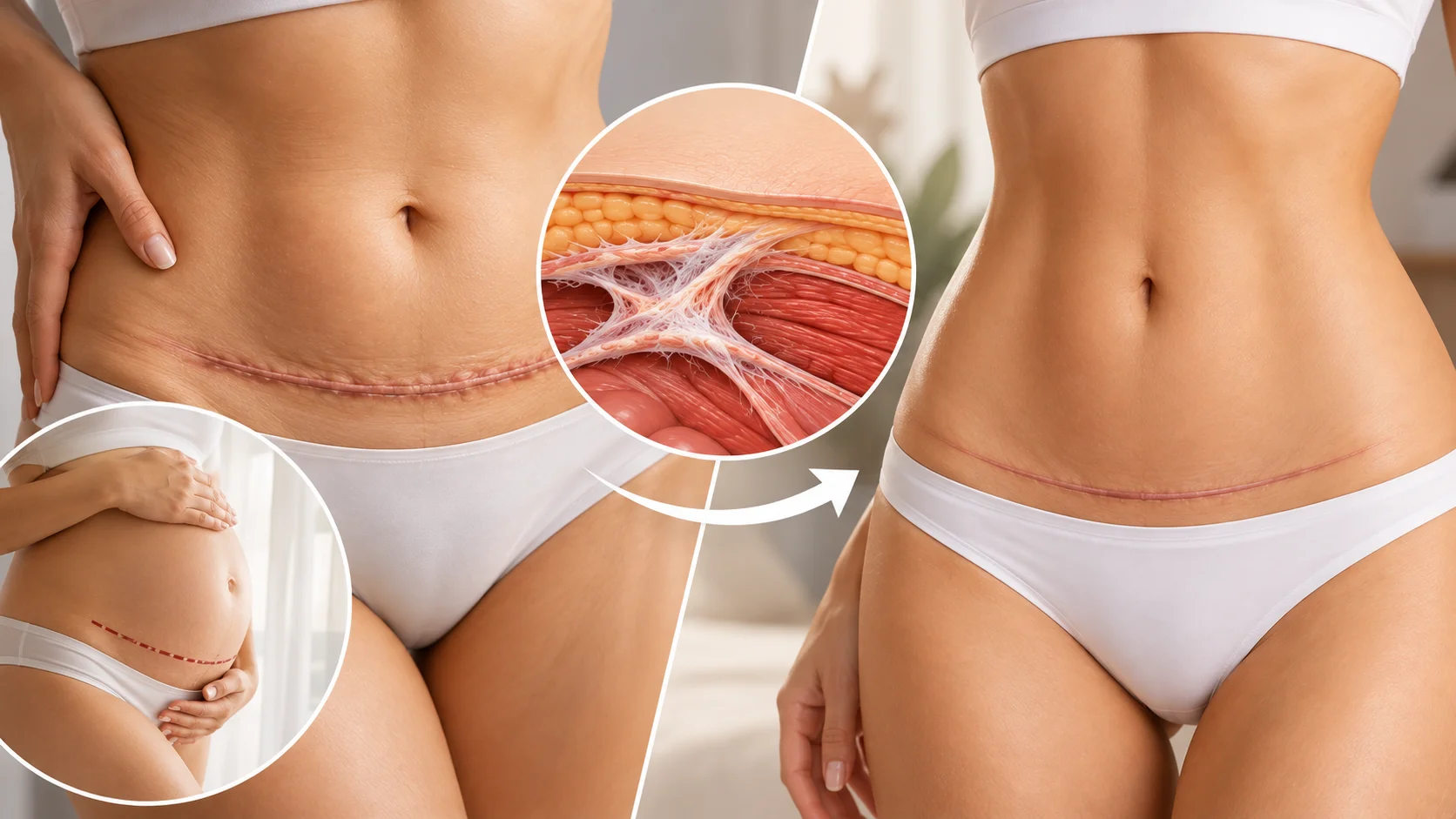
Considering a tummy tuck with previous C-section scar tissue? A past Caesarean delivery does not automatically prevent abdominoplasty, but your original incision and the way it healed can affect surgical planning. It is especially important to distinguish the visible skin scar from deeper internal adhesions before deciding what a tummy tuck can realistically improve.
Table of Contents
Can you have a tummy tuck with previous C-section scar tissue?
In many cases, yes. Surgeons regularly assess people who have previously delivered by Caesarean section and later want to address loose abdominal skin, a persistent lower-belly fold or abdominal wall laxity. A previous C-section is not, by itself, a reason to rule out a tummy tuck.
However, the surgeon needs to examine the position, texture and mobility of your scar, check for tenderness or a possible hernia, and understand whether you have had one or several abdominal operations. The amount of loose skin, your general health and the intended tummy tuck technique also matter.
The American Society of Plastic Surgeons (ASPS) notes that previous Caesarean scars may be incorporated into the new abdominoplasty scar. That is a possibility, not a promise that every pre-existing scar can be completely removed or hidden.
What does C-section scar tissue actually mean?
The phrase “scar tissue” can describe several different things. Understanding which one is causing a concern makes the consultation more useful and avoids assuming that an operation on the outer abdomen will treat a problem deeper inside.
Visible skin scar and thickened tissue
Most Caesarean deliveries leave a horizontal scar low on the abdomen, although some people have a vertical or differently positioned incision. The scar may be flat, widened, raised, darker or lighter than the surrounding skin. Some people notice an indentation that makes the skin immediately above the scar look like a shelf or pouch.
That indentation may partly reflect tethering: firm tissue connecting the skin and deeper layers, making the surface less mobile. A tummy tuck can sometimes improve this visible contour if the relevant tissue lies within the planned removal area or can be safely released during surgery. The new incision still creates a permanent scar.
Abdominal wall scarring
After a C-section, healing also affects the tissue layers beneath the skin. The extent and location of this scarring vary between patients. A surgeon may find areas of altered tissue mobility when lifting the abdominal skin during a tummy tuck, and the dissection plan may need to be modified accordingly.
Repeated operations, previous wound complications, infection or unusual scarring can make planning more complex. None of these details can be reliably assessed from a photograph of the outer scar alone.
Internal adhesions inside the abdomen
Internal adhesions are bands of scar tissue that can form between organs or inside the abdominal cavity after surgery. They are not the same as a tight external C-section scar or a lower-abdominal skin fold.
A standard cosmetic tummy tuck works mainly with the skin, fat and abdominal wall; it generally does not enter the abdominal cavity to remove adhesions around internal organs. The Aesthetic Society’s surgeon guidance makes this distinction explicit. If you have persistent deep pain, suspected adhesions or bowel symptoms, those concerns require separate medical assessment rather than an expectation that abdominoplasty will resolve them.
Can a tummy tuck remove an old C-section scar?
Sometimes the old scar can be removed as part of the excess lower-abdominal skin taken away during a full tummy tuck. The surgeon then closes the tissue to form a new, typically longer, lower-abdominal scar. In suitable patients, this may also reduce a tethered or indented appearance that was associated with the original incision.
The result depends on several factors: how high the existing scar sits, how much skin can be moved safely, your skin quality, the position of the belly button and the chosen operation. A scar positioned outside the skin-removal area may remain, and scar tissue cannot simply be “erased” without another healing process.
In some cases, the surgeon may design the new incision at, near or below the previous C-section scar. ASPS patient guidance explains why C-section scars and the overlying shelf of skin are common concerns at tummy tuck consultations. The final scar location, shape and visibility must still be discussed before surgery.
If your main concern is the appearance of a narrow scar rather than a substantial amount of excess skin, ask whether dedicated scar revision or another less extensive option is more appropriate. A full tummy tuck is major surgery and should not be chosen purely because a scar is present.
Will a tummy tuck improve a C-section shelf or overhang?
A lower-belly “shelf” can have several contributors, including loose skin, a localised fat deposit, scar tethering and changes to abdominal wall support. These can look similar in clothing but require different approaches.
If excess skin hangs over an indented scar, an abdominoplasty may remove some of that skin and improve the contour. If the main issue is a localised adherent scar without significant skin laxity, the surgeon may consider a more targeted approach. If the abdomen protrudes because of abdominal muscle separation, a full tummy tuck may include appropriate fascia repair.
Not every lower-abdominal bulge is cosmetic. A lump that changes with coughing, becomes painful or feels distinct from surrounding tissue may need assessment for a hernia or another condition. Our related article about hernia repair with a tummy tuck explains why suspected hernias should be identified before planning combined surgery.
Which type of tummy tuck is best after a Caesarean?
The fact that you have a C-section scar does not determine whether you need a mini, full or extended tummy tuck. The choice is based primarily on your anatomy, the area of loose skin, any abdominal wall separation and the surgeon’s judgement.
Mini tummy tuck
A mini tummy tuck treats selected concerns limited mainly to the lower abdomen. It may be discussed when there is a relatively small amount of excess skin below the belly button. It does not address all the changes that may be present after pregnancy, and whether an old C-section scar can be revised within the smaller procedure depends on its position.
Full tummy tuck
A full abdominoplasty typically addresses a wider area of abdominal laxity and usually involves a longer incision and belly-button repositioning. When clinically indicated, the abdominal fascia can be tightened to improve the contour associated with rectus diastasis. The operation may offer an opportunity to remove or incorporate a low Caesarean scar if skin movement and blood supply allow it.
Extended tummy tuck
Where loose skin continues towards the flanks, an extended approach may be considered. It creates a longer scar than a standard full abdominoplasty and is not necessary just because a patient has undergone multiple C-sections. For a separate comparison of incision patterns and suitability, see extended versus standard tummy tuck surgery.
Some patients may benefit from no surgery, a scar-focused intervention or a staged treatment plan. Your surgeon should explain why the recommended procedure addresses your actual concern.
Does previous C-section scar tissue increase tummy tuck risks?
A tummy tuck carries risks whether or not you have had a Caesarean. These include infection, bleeding, fluid accumulation (seroma), haematoma, delayed wound healing, wound separation, numbness, asymmetry, prominent scarring, anaesthetic complications and blood clots. Previous operations can also make certain tissue planes more difficult to assess.
The evidence about the effect of old scars is not completely uniform, so it would be misleading to say that every patient with a C-section scar has a high complication risk.
A 2024 retrospective study in Aesthetic Surgery Journal reviewed 746 abdominoplasty patients, including 308 with a history of Caesarean delivery. The researchers found an association between prior C-section and postoperative seroma, with an odds ratio of 1.65 (95% confidence interval 1.07–2.56). This is an increase in relative odds, not a prediction that 65% of patients will have a seroma. The study was observational and the authors called for further research.
An earlier retrospective study of 123 abdominoplasty patients did not find that previous abdominal scars independently increased complications after adjustment; smoking and diabetes were the independent predictors in that particular sample. These two studies examined different patient groups and research questions. Together they reinforce the importance of individual assessment rather than treating the appearance or presence of a scar as the only risk factor.
The surgeon may consider your medical history, smoking or nicotine use, weight stability, diabetes, medications, the pattern of old incisions and how previous wounds healed. A history of troublesome scarring, multiple surgeries or postoperative infection is worth reporting even if your skin looks normal now.
What if you have had two or three C-sections?
Having more than one C-section does not automatically rule out a tummy tuck. It does mean that the surgeon should review your complete operative history, including whether the same low incision was reused and whether any delivery involved infection, complex surgery or other complications.
Multiple procedures can produce variable scar tissue, but the number alone does not reveal the extent of internal adhesions or predict exactly how your external scar will behave. In the 2024 study noted above, the researchers did not establish a statistically significant relationship between the number of C-sections and seroma risk.
If you have pelvic pain, bowel symptoms, a known hernia, a previous major abdominal complication or surgery beyond Caesarean delivery, mention it early. You may need evaluation from another specialist before elective cosmetic treatment is planned.
When is it appropriate to consider a tummy tuck after a C-section?
There is no universal waiting period that is right for everyone. Your body needs to recover from childbirth and the Caesarean operation, and your weight and health should be sufficiently stable for elective surgery. The timing also depends on breastfeeding, nutrition, anaemia, other health conditions and the level of practical support available at home.
If you are considering further pregnancies, discuss that openly with the surgeon. Pregnancy after a tummy tuck is possible, but future abdominal stretching may alter the cosmetic result. For some patients it makes sense to complete planned pregnancies before elective contouring surgery; this is a planning consideration, not an absolute rule.
Do not confuse a routine postpartum check with clearance for an additional major operation. Your obstetric and surgical teams may recommend further recovery or tests depending on the circumstances. Our guide to mummy makeover timing discusses how breastfeeding and weight changes influence treatment planning.
What happens during recovery when you already have a C-section scar?
Recovery after a tummy tuck is not identical to recovery after Caesarean delivery. Although both can involve an incision on the lower abdomen, abdominoplasty often repositions a broad area of skin and may include abdominal wall repair. The treated area and movement restrictions can therefore be different.
Expect a period of swelling, discomfort and limited activity. Your clinical team may recommend a compression garment and may use drains depending on the operation. You will receive instructions about wound care, sleeping position, walking, lifting and follow-up appointments. As the NHS tummy tuck guidance explains, recovery commonly requires several weeks away from normal exercise and work; personal circumstances vary.
Parents with young children should plan practical help because lifting a baby or toddler may place strain on healing tissues. The surgeon should tell you when lifting and normal childcare tasks can resume. Read our dedicated guide to caring for children after a tummy tuck.
Seek urgent medical advice for fever with worsening redness or discharge, sudden heavy bleeding, significant one-sided leg swelling, new chest pain, shortness of breath or rapidly increasing pain. These symptoms should not be attributed automatically to “old scar tissue”.
Questions to ask your surgeon about an old Caesarean scar
- Is my concern caused by loose skin, scar tethering, muscle separation or something else?
- Can my existing C-section scar be included in the tissue removed, or will it remain visible?
- Where will the new tummy tuck incision sit, and how long is it likely to be?
- Does my history of previous surgery change the wound-healing or seroma risks?
- Will the operation stay outside the abdominal cavity, and do I need assessment for suspected internal adhesions or a hernia?
- Would a mini tummy tuck, full abdominoplasty or targeted scar treatment be more appropriate?
- What help will I need at home, and how will follow-up care work after travelling?
If possible, bring details of your previous C-sections and other operations. Explain any numbness, persistent pain, unusual swelling or previous wound problems. A meaningful consultation should distinguish changes that a tummy tuck may improve from symptoms that need another type of investigation.
CK Health Turkey: planning tummy tuck treatment after a C-section
CK Health Turkey in Antalya supports international patients exploring plastic surgery options in Turkey. If you have an old Caesarean scar, it is useful to explain how many C-sections you have had, when they took place and whether your main concern is a skin fold, a visible indentation or overall abdominal laxity.
The treating surgical team must assess your scar and abdominal anatomy before recommending a procedure. Patient coordination can help you understand the consultation process, travel planning and questions to ask about postoperative care. Any possible scar revision, abdominal wall repair or additional evaluation should be confirmed as part of an individual treatment plan, not assumed from a general blog article.
For information about a personalised assessment and tummy tuck options, contact CK Health Turkey and discuss your previous C-section history with the team.
A tummy tuck with previous C-section scar tissue can be an option for suitable patients, and an old low scar may sometimes be incorporated into the new incision. The key is to understand whether your concern involves visible skin changes, deeper abdominal wall tissue or internal adhesions, then choose a plan based on examination, realistic expectations and individual surgical risk.