
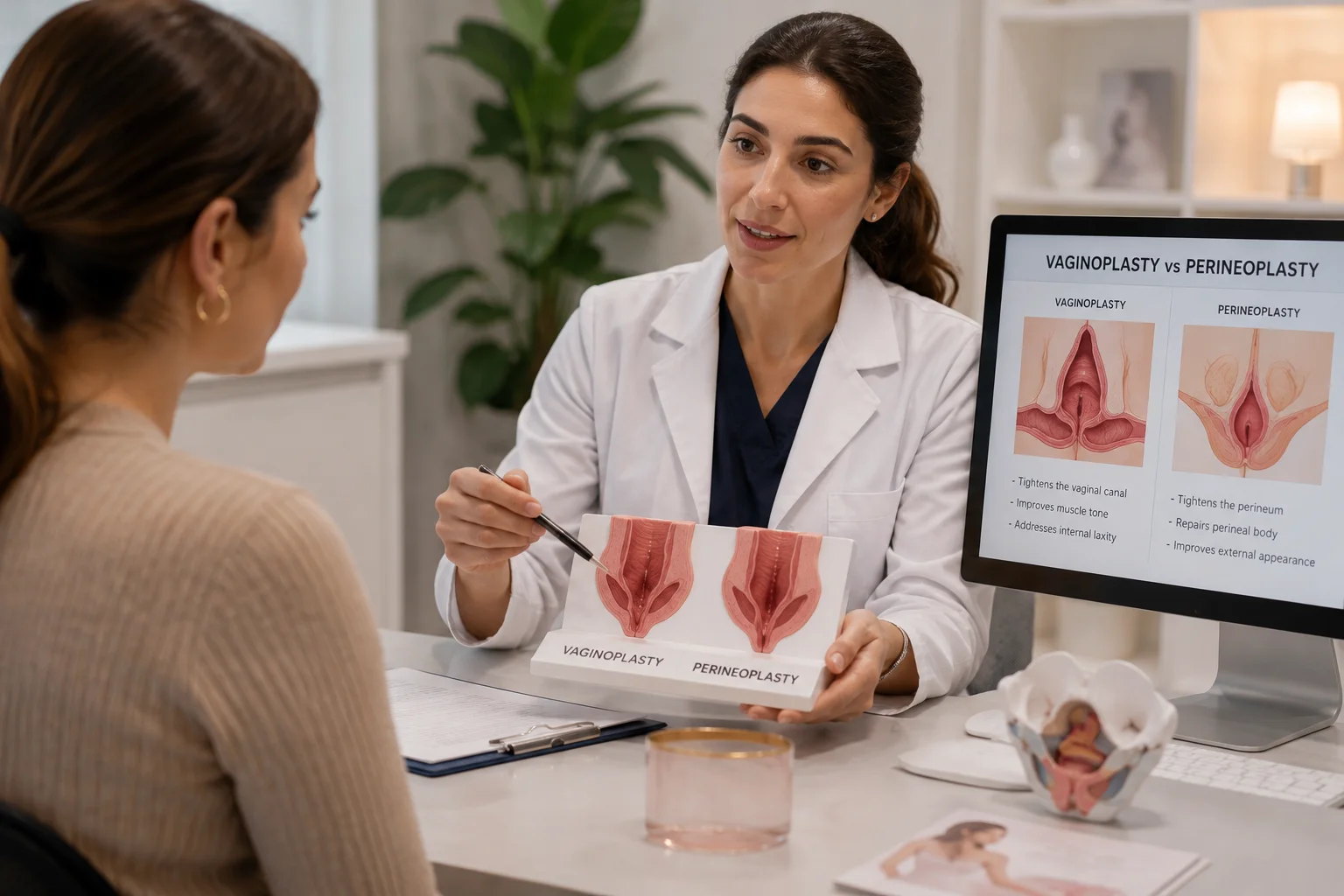
Navigating the decision to undergo intimate restorative surgery requires a clear understanding of your personal goals and pelvic anatomy. When evaluating vaginoplasty vs perineoplasty, many patients discover that these procedures target distinct parts of the female pelvic floor to solve different functional and aesthetic concerns. Choosing the correct surgical approach depends on whether laxitySkin laxityHow much the skin has lost its ability to retract. Determines whether liposuction alone is enough or skin excision is needed. originates deep inside the internal canal or at the external vaginal entrance.
Table of Contents
Vaginoplasty vs Perineoplasty: Understanding the Structural Differences
While both surgeries fall under the umbrella of functional and aesthetic female genital procedures, they address entirely different anatomical zones. Childbirth, natural aging, hormonal changes, and genetic connective tissue variations can alter the female pelvic architecture. For some women, the issue is internal weakness; for others, it is external tissue distortion or scarring.
Vaginoplasty focuses primarily on the internal vaginal canal, restoring muscle tone and tightening the passage along its full length. In contrast, perineoplasty focuses on the perineal body, which is the muscular and cutaneous area situated between the lower edge of the vaginal opening and the anus. Understanding where your physical discomfort or lack of sensation originates is the first step in identifying which procedure will yield the most satisfying clinical outcome.
What Is Vaginoplasty?
Vaginoplasty is a reconstructive surgical procedure designed to tighten and reshape the internal vaginal canal. During vaginal delivery, the levatorLevator muscleThe muscle lifting the upper eyelid. Weakness here causes true ptosis, which needs muscle repair rather than skin removal. ani muscles and fasciaFasciaThe tough connective tissue sheet wrapping muscles. In abdominoplasty it is the layer tightened to flatten the abdomen. that support the vaginal walls can stretch, separate, or tear. Over time, this anatomical separation causes the canal to lose its elasticity and structural resistance, leading to a condition known as vaginal laxity.
Indications for Vaginoplasty
Women who consider vaginoplasty often experience symptoms that affect their quality of life, physical confidence, and sexual satisfaction. Common clinical indicators include:
- Reduced friction and physical sensation during sexual intercourse for both partners.
- Difficulty keeping tampons securely in place.
- Involuntary air trapping inside the canal during movement or exercise.
- A persistent sensation of internal heaviness or loose internal tissues.
The Surgical Technique
During a vaginoplasty, a board-certified surgeon makes an incisionIncisionThe planned cut a surgeon makes to reach the treatment area. Its length and position determine where the scar will sit. along the posterior (back) wall of the vaginal canal. The underlying stretched or separated levator ani muscles are brought together and securely stitched using strong, absorbable suturesSutureSurgical thread used to close tissue. Absorbable sutures dissolve on their own; non-absorbable ones are removed at a check-up.. Excess mucosalMucosaThe moist lining of the mouth, nose and digestive tract. lining is then precisely removed, and the remaining tissues are reapproximated to narrow the internal diameter of the vagina along its entire length.
What Is Perineoplasty?
Perineoplasty, also known as perineorrhaphy, is a surgical procedure dedicated to reconstructing the perineum and repairing the perineal body. The perineal body acts as the central anchor for the pelvic floor muscles. When it is damaged—frequently due to childbirth tears, episiotomy incisions, or rapid stretching—the external vaginal opening can remain abnormally wide, asymmetric, or scarred.
Indications for Perineoplasty
A compromised perineal body can cause structural instability at the vaginal opening (introitus). Candidates for perineoplasty frequently report:
- A visibly wide, gaping, or loose vaginal entrance.
- Painful, thick, or unsightly scar tissue resulting from previous childbirth tears or an episiotomy.
- A feeling that the pelvic floor lacks external base support.
- Discomfort during physical activities, cycling, or sexual intimacy caused by abnormal scar tissue tension.
The Surgical Technique
During perineoplasty, the surgeon excises distorted skin, defective scar tissue, and weakened subcutaneousSubcutaneousThe layer just beneath the skin containing fat and connective tissue; the plane in which most liposuction is performed. mucosa around the posterior introitus. The underlying perineal muscles are reconstructed and brought together to build a strong, elevated perineal bridge. Finally, the skin edges are meticulously closed with fine sutures, creating a tighter, symmetric, and structurally sound vaginal opening.
Clinical Comparison: Vaginoplasty vs Perineoplasty
To highlight how these two interventions compare across key operational parameters, review the breakdown below:
| Feature / Attribute | Vaginoplasty | Perineoplasty | Combined (Colpoperineoplasty) |
| Anatomical Target | Internal vaginal canal & levator ani muscles | External perineal body & introitus | Internal canal + external perineal bridge |
| Primary Goal | Restore internal muscular tightness & friction | Repair external opening & episiotomy scars | Complete functional & aesthetic restoration |
| AnesthesiaAnaesthesiaMedication that prevents pain during a procedure. General anaesthesia puts you fully asleep; local and regional forms numb only part of the body. Type | General anesthesia or twilight sedationSedationMedication that makes you drowsy and relaxed while remaining able to breathe on your own. Often combined with local anaesthesia. | Local with sedation or general anesthesia | General anesthesia |
| Procedure Duration | 1.5 to 2.5 hours | 45 minutes to 1.5 hours | 2.5 to 3.5 hours |
| Initial Recovery | 1 to 2 weeks off work | 5 to 7 days off work | 2 weeks off work |
| Abstinence Period | 6 to 8 weeks | 4 to 6 weeks | 6 to 8 weeks |
| Average Cost (UK) | £4,000 – £7,000 | £3,000 – £5,000 | £6,000 – £9,000 |
| Average Cost (US) | $6,000 – $12,000 | $4,500 – $8,000 | $9,000 – $15,000 |
| Average Cost (Turkey) | €2,000 – €3,500 | €1,500 – €2,500 | €2,800 – €4,200 |
Scientific Evidence and Surgical Outcomes
Modern pelvic floor and gynecological literature demonstrates strong clinical support for surgical tightening procedures when conservative treatments like pelvic floor muscle training (Kegel exercises) fail to restore adequate tissue integrity.
A peer-reviewed clinical trialClinical trialA planned study testing safety and effectiveness in patients; the basis of evidence-based treatment choices. published in PubMed evaluated female sexual function and partner satisfaction following vaginal reconstructive procedures. The research recorded statistically significant post-operativePostoperativeThe recovery period after surgery, covering wound care, medication, activity limits and follow-up. improvements across all parameters of the Female Sexual Function Index (FSFI), with total average scores increasing from 19.2 before surgery to 29.7 post-treatment. Furthermore, patients reported a substantial decline in both state and trait anxiety levels following their physical recovery. Studies focused on perineoplasty specifically noted an overall success rate exceeding 87% in resolving wide-vagina sensations, alongside a partner satisfaction rate of over 92% and low incidence rates of chronic postoperative dyspareunia (painful intercourse).
When to Consider Combining Both Procedures
In clinical practice, vaginal laxity and perineal body damage frequently occur together. Childbirth places intense strain on both the internal vaginal fascia and the muscular structures surrounding the external outlet.
When a surgeon performs a vaginoplasty alone without addressing a damaged perineum, the internal canal may become tight, but a gaping vaginal entrance remains. Conversely, performing only a perineoplasty narrows the external threshold while leaving the internal canal loose and unsupportive.
Combining both operations into a single surgical session—often called a colpoperineoplasty—offers several clinical and practical benefits:
- Comprehensive structural repair: Restores both the internal muscular framework and the external structural support in one session.
- Single recovery timeline: Consolidates post-operative downtimeDowntimeThe period during which visible swelling or bruising means you may prefer to stay out of social or work settings., allowing you to heal completely during one 6-to-8-week recovery period.
- Cost efficiency: Avoids paying separate facility, anesthesia, and surgeon fees across two independent hospital stays.
Recovery Timeline and Post-Operative Guidelines
Proper post-operative care is vital to protect delicate muscle sutures, prevent infection, and ensure optimal aesthetic and functional results.
- Days 1 to 3 (Immediate Post-Op): Mild swelling, bruising, and moderate discomfort are expected. Pain is well managed with prescribed analgesics. Ice packs wrapped in clean towels can be applied to the external perineal region to minimize swelling.
- Week 1 to 2 (Early Healing): You will be advised to rest at home and avoid prolonged sitting directly on the perineum. Using a donut-shaped cushion provides comfort. Walking short distances helps prevent blood clots.
- Weeks 3 to 4 (Resuming Daily Routine): Swelling diminishes significantly, and surface sutures begin to dissolve. Most patients return to light desk jobs and normal non-strenuous daily routines.
- Weeks 6 to 8 (Full Functional Recovery): Internal fascial and muscular healing reaches structural stability. Following your surgeon’s formal post-operative clearance, you may safely resume strenuous physical exercise, heavy lifting, swimming, and sexual intercourse.
Financial Investment and Global Cost Comparison
The total cost of intimate surgery depends heavily on geographical location, facility accreditation, surgical expertise, and whether additional procedures (such as labiaplasty) are included.
In countries like the United States and the United Kingdom, private cosmetic gynecological procedures incur substantial administrative overheads, clinical staffing costs, and facility rental fees. As a result, standalone vaginoplasty or perineoplasty costs frequently range between $6,000 and $12,000 in the US and £4,000 to £7,000 in the UK.
By contrast, healthcare destinations like Turkey offer world-class medical standards at considerably lower operational costs. Patients traveling to accredited Turkish clinics benefit from all-inclusive packages that cover expert surgical fees, hospital overnight stays, luxury hotel accommodation, personal translations, and private VIP transfers at approximately 50% to 70% less than Western rates.
CK Health Turkey: World-Class Intimate Health Care
For international patients seeking exceptional surgical care, CK Health Turkey in Antalya stands out as a leading center for gynecological and plastic aesthetic procedures. Combining specialized medical expertise with warm Turkish hospitality, the center provides a comfortable, private, and high-quality surgical experience.
- Expert Medical Team: Surgeries are performed by experienced, board-certified surgeons specializing in reconstructive pelvic floor and aesthetic gynecology.
- JCI-Accredited Hospitals: All procedures are conducted in internationally accredited, modern hospital facilities equipped with advanced surgical technology and intensive care units.
- All-Inclusive VIP Experience: International patients receive seamless support, including private airport and clinic transportation, luxury accommodation, multilingual patient coordinators, and comprehensive post-operative follow-up care.
- Discreet and Personalized Care: Every treatment plan is tailored specifically to your physical anatomy and clinical expectations within a supportive, confidential setting.
If you are considering intimate restorative surgery and wish to explore personalized treatment options, visit the CK Health Turkey website to book a private, confidential consultation with a senior medical consultant.
Careful consultation with a specialized surgeon is essential when evaluating vaginoplasty vs perineoplasty to ensure your chosen procedure targets the precise anatomical cause of your symptoms and restores your physical comfort.