Highlights
- Stubborn fat is a normal energy reserve that remains soft and painless, eventually responding to a sustained calorie deficit despite being slower to shrink.
- Lipoedema is a chronic medical condition characterized by symmetrical, painful, and nodular fat accumulation that typically spares the hands and feet.
- Unlike standard subcutaneous fat, lipoedema tissue is resistant to diet, exercise, and bariatric surgery due to structural changes like inflammation and fibrosis.
Losing weight requires dedication, yet many individuals find that specific body regions like the knees, calves, hips, and lower abdomen refuse to change. When overall body mass decreases while these areas remain unchanged, identifying the underlying cause is crucial. Determining whether you are experiencing lipoedema or stubborn fat after weight loss? how to tell the difference requires analyzing physical symptoms, tissue texture, and structural characteristics under the skin.
Table of Contents
Why Certain Body Fat Resists Weight Loss
When you maintain a calorie deficit, your body mobilizes stored triglycerides from fat cells throughout your frame to convert them into usable energy. However, fat loss rarely occurs uniformly across every body part due to variations in receptor density, blood circulation, and tissue structure.
The Nature of Stubborn Subcutaneous Fat
Standard subcutaneous fat is stored directly beneath the skin and serves as an energy reserve, insulation, and protective padding. Areas such as the lower abdomen, outer thighs, and love handles often contain a higher ratio of alpha-2 adrenergic receptors compared to beta-2 receptors. Alpha-2 receptors slow down lipolysis (the breakdown of fat), making these pockets slower to shrink during weight loss.
Despite this slower response rate, normal stubborn fat will eventually decrease in volume if a calorie deficit or systematic weight loss program is maintained long enough. The tissue remains soft, pliable, painless, and metabolically responsive to physical exercise and nutritional changes.
The Pathological Reality of Lipoedema
Lipoedema is a chronic, progressive adipose tissue disorder that almost exclusively affects women. Unlike normal fat storage, lipoedema involves an abnormal, symmetrical accumulation of diseased subcutaneous adipose tissue, most frequently in the legs, thighs, buttocks, and upper arms.
Lipoedema fat is structurally altered by inflammation, fluid retention, and fibrotic tissue changes. Because lipoedema tissue is pathologically modified, it does not respond to standard energy expenditure mechanisms in the same way normal fat does. Consequently, even after severe weight loss or bariatric surgery, lipoedema-affected limbs maintain their enlarged size, creating an increasingly noticeable disproportion with the rest of the body.
Lipoedema or Stubborn Fat After Weight Loss? How to Tell the Difference
Understanding whether persistent fat deposits are physiological or medical is essential for choosing the correct management strategy. Paying attention to specific symptoms helps differentiate standard stubborn fat from lipoedema.
Distribution and Sparing Patterns
One of the most noticeable features of lipoedema is its specific structural distribution. Lipoedema typically causes a stark disproportion between the upper body and lower body.
- Hand and Foot Sparing: Lipoedema fat accumulates symmetrically down the legs or arms but stops abruptly at the ankles and wrists. This creates a distinct cuffing effect tissue fold, leaving the feet and hands completely unaffected.
- Stubborn Fat Distribution: Normal fat accumulation may favor certain areas due to genetics or body type (such as pear or apple shapes), but fat tapers naturally toward the ankles or wrists without creating an abrupt ring or cuffing boundary.
Pain, Sensitivity, and Easy Bruising
Standard subcutaneous fat is painless. You can press, pinch, or massage stubborn fat on the abdomen or thighs without discomfort. Lipoedema tissue, on the other hand, is characterized by distinct clinical pain markers:
- Tenderness to Pressure: Even light pressure, such as a child sitting on your lap or a pet walking across your legs, can provoke sharp or aching pain.
- Heavy and Aching Sensation: Affected limbs frequently feel heavy, tight, and fatigued, especially toward the end of the day or after prolonged standing.
- Capillary Fragility: Individuals with lipoedema bruise extremely easily, often noticing large or frequent bruises without remembering any direct trauma.
Tissue Texture and Nodular Structure
Palpating the affected area provides vital clues regarding tissue structure:
- Normal Stubborn Fat: Feels smooth, soft, and continuous beneath the skin.
- Early-Stage Lipoedema: Feels granular under the skin, often described as feeling like small rice-like nodules or frozen peas embedded within the fat.
- Advanced Lipoedema: As the condition progresses, these small nodules combine into larger fibrotic masses and lobules, causing the skin surface to develop a pronounced mattress-like or nodular dimpling pattern.
Response to Caloric Deficit and Bariatric Surgery
The ultimate test often occurs after significant weight loss. If you lose 20 to 50 pounds, your chest, face, neck, and waistline may slim down significantly.
- If the fat around your knees, lower calves, or hips decreases proportionally alongside the rest of your body, it is stubborn subcutaneous fat.
- If your torso grows visibly thin while your lower legs, knees, or thighs remain entirely untouched in size, accompanied by persistent pain and heaviness, it indicates lipoedema fat.
Scientific Insights into Lipoedema Adipose Tissue
Medical literature demonstrates that lipoedema is not a lifestyle-driven issue or a failure of willpower, but a distinct medical condition. Peer-reviewed studies published in journals such as Frontiers in Cell and Developmental Biology and the Journal of Clinical Endocrinology & Metabolism reveal that lipoedema adipose tissue exhibits specific cellular anomalies, including stage-dependent adipocyte hypertrophy, microvascular fluid leakiness, elevated tissue sodium levels, and an immune response dominated by M2 macrophages rather than standard inflammatory pathways. Clinical evaluations confirm that while diet-induced weight loss or metabolic bariatric surgery successfully reduces visceral fat and overall body weight, the fibrotic nodular structure and vascular fragility of lipoedema tissue remain largely resistant. This explains why dietary restriction alone fails to resolve the physical discomfort, swelling, and disproportionate volume associated with lipoedema.
Diagnostic Steps: How to Tell the Difference Self-Check
Evaluating your body through a structured diagnostic process can help you prepare for a medical consultation. Follow these steps to assess your symptoms systematically:
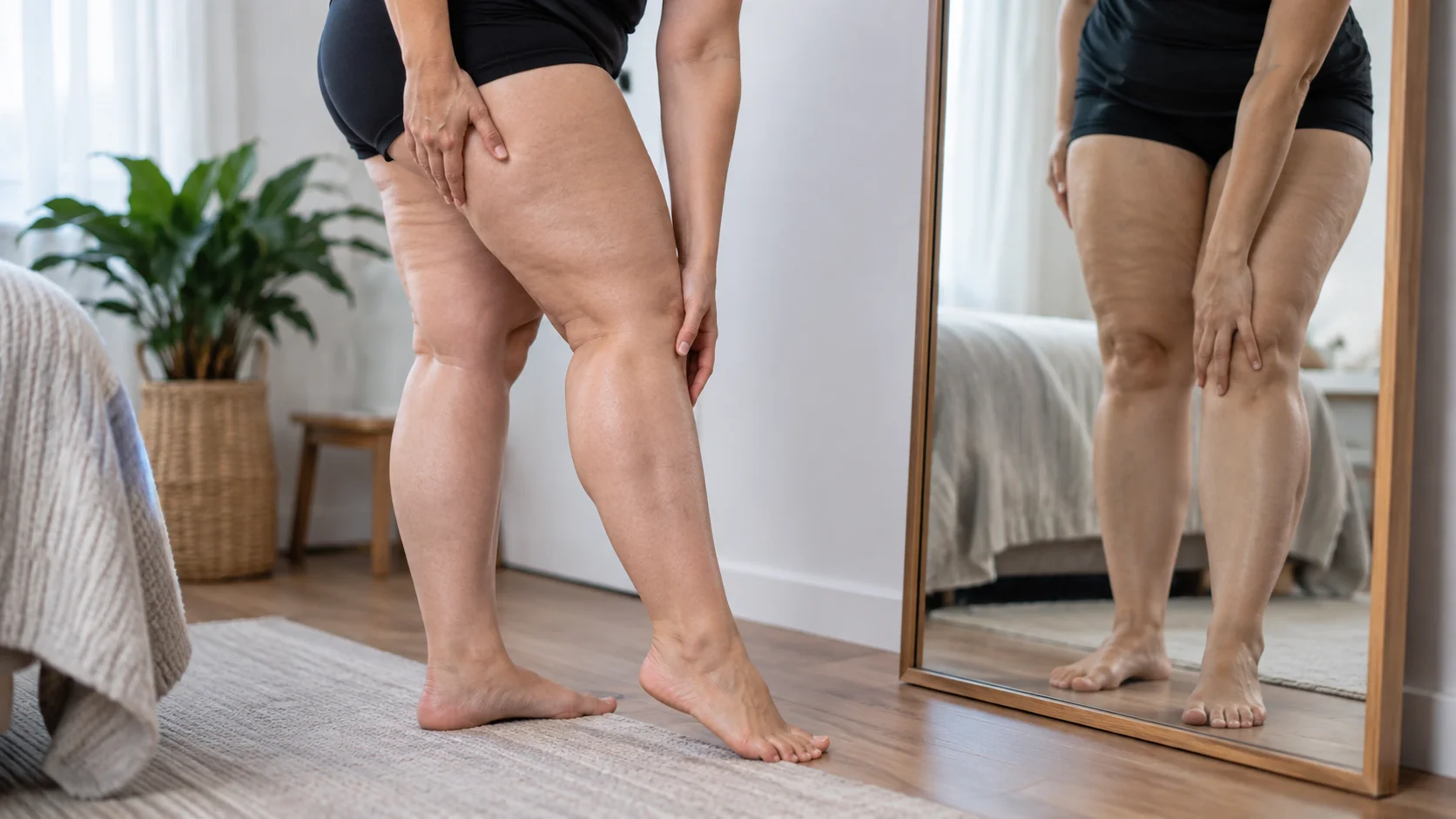
- Examine your body symmetry in a full-length mirror to check if fat accumulation on both legs or both arms is identical in shape and volume.
- Check your hands and feet to see if swelling or fat buildup stops abruptly at the wrist or ankle joint.
- Gently pinch the skin and underlying fat on your upper calf or inner knee and note whether light pressure triggers discomfort, tenderness, or pain.
- Palpate the tissue beneath the skin surface with your fingertips to feel for fine, bead-like nodules or firm, lumpy structures.
- Review your photo history following periods of weight loss to evaluate whether the affected areas changed in proportion to your upper body.
- Consult a qualified vascular specialist, plastic surgeon, or lymphologist experienced in lymphatic and adipose disorders for an accurate clinical diagnosis.
Lipoedema vs. Stubborn Fat: Direct Comparison
| Feature | Lipoedema Fat | Stubborn Subcutaneous Fat |
| Symmetry | Bilateral and strictly symmetrical | Can be asymmetrical or localized |
| Hand & Foot Involvement | Feet and hands are spared (cuffing effect) | Fat tapers naturally into ankles/wrists |
| Physical Pain / Tenderness | Present; sensitive to light pressure or touch | Absent; tissue is painless to press |
| Tissue Texture | Nodular, granular, or lumpy (“rice-like”) | Smooth, soft, and uniform |
| Bruising Tendency | High; frequent bruising from minor impacts | Normal capillary resistance |
| Response to Diet & Exercise | Highly resistant; tissue volume persists | Responsive; gradually reduces in volume |
| Primary Affected Areas | Legs, thighs, knees, calves, upper arms | Lower abdomen, flanks, outer thighs |
Treatment Strategies for Lipoedema and Persistent Fat
Once you identify whether you are dealing with lipoedema or stubborn fat, you can choose a targeted treatment strategy to restore body contour and comfort.
Managing Stubborn Subcutaneous Fat
For normal fat deposits that resist diet and exercise, non-invasive and surgical body contouring procedures offer predictable, localized results:
- Standard Liposuction: Procedures such as traditional or high-definition liposuction remove stubborn fat cells permanently, recontouring problem areas like the lower abdomen, flanks, or inner thighs.
- Targeted Ultrasound / Energy Devices: Technologies like VASER (Vibration Amplification of Sound Energy at Resonance) liquefy localized fat pockets cleanly before extraction, making removal smoother and reducing recovery times.
Specialized Treatment for Lipoedema
Because lipoedema tissue involves vascular fragility and altered lymphatic structures, standard aggressive liposuction techniques must be adapted. Treatment focuses on symptom relief, restoring mobility, and preventing disease progression:
- Conservative Therapy: Manual lymphatic drainage (MLD), custom gradient compression garments, and low-inflammation nutritional plans help manage fluid retention and tissue swelling.
- Specialized Lipoedema Liposuction: Surgical removal using water-assisted liposuction (WAL) or tumescent VASER liposuction is designed to extract diseased fat while protecting delicate lymphatic vessels. Surgeons use specialized, blunted cannulas and micro-cannular techniques to systematically clear fibrotic fat nodules while preserving vascular integrity.
Specialized Lipoedema and Body Contouring at CK Health Turkey
Navigating lipoedema diagnosis and surgical management requires dedicated medical expertise and specialized surgical technique. For international patients seeking world-class medical care, CK Health Turkey stands out as a premier destination in Antalya, Turkey.
CK Health Turkey offers comprehensive, patient-centered care for individuals dealing with both lipoedema and post-weight-loss body contouring needs. Their multidisciplinary team of experienced plastic surgeons understands the complex anatomical differences between metabolic fat and diseased lipoedema tissue. Utilizing advanced surgical modalities—including specialized tumescent and VASER-assisted liposuction—surgeons at CK Health Turkey meticulously extract stubborn or lipoedematous fat while prioritizing lymphatic safety and aesthetic harmony.
Beyond surgical precision, CK Health Turkey provides international patients with an all-inclusive healthcare journey. From initial virtual consultations and detailed diagnostic assessments to personalized postoperative care, VIP transfers, and English-speaking patient coordinators, every aspect of your treatment is managed with high medical standards. Choosing CK Health Turkey allows patients to receive advanced, compassionate surgical solutions in a state-of-the-art clinical environment at highly competitive global rates.
If you are ready to address painful lipoedema symptoms or eliminate stubborn fat deposits that persist after weight loss, reach out to the medical team at CK Health Turkey to book your private consultation and explore your personalized treatment plan.
Achieving your health and aesthetic goals should feel empowering, even when specific body areas resist rigorous diet and exercise routines. Learning to distinguish between lipoedema or stubborn fat after weight loss? how to tell the difference allows you to move past frustration and take control of your well-being through targeted, medically backed solutions.