Highlights
- The Loop Duodenal Switch combines a sleeve gastrectomy with an intestinal bypass to restrict food intake and significantly reduce calorie absorption.
- Patients can expect to lose 60% to 80% of their excess weight within two years, making it highly effective for treating morbid obesity and diabetes.
- The procedure preserves the stomach valve to prevent Dumping Syndrome and allows for easier endoscopic monitoring compared to traditional bypass surgeries.
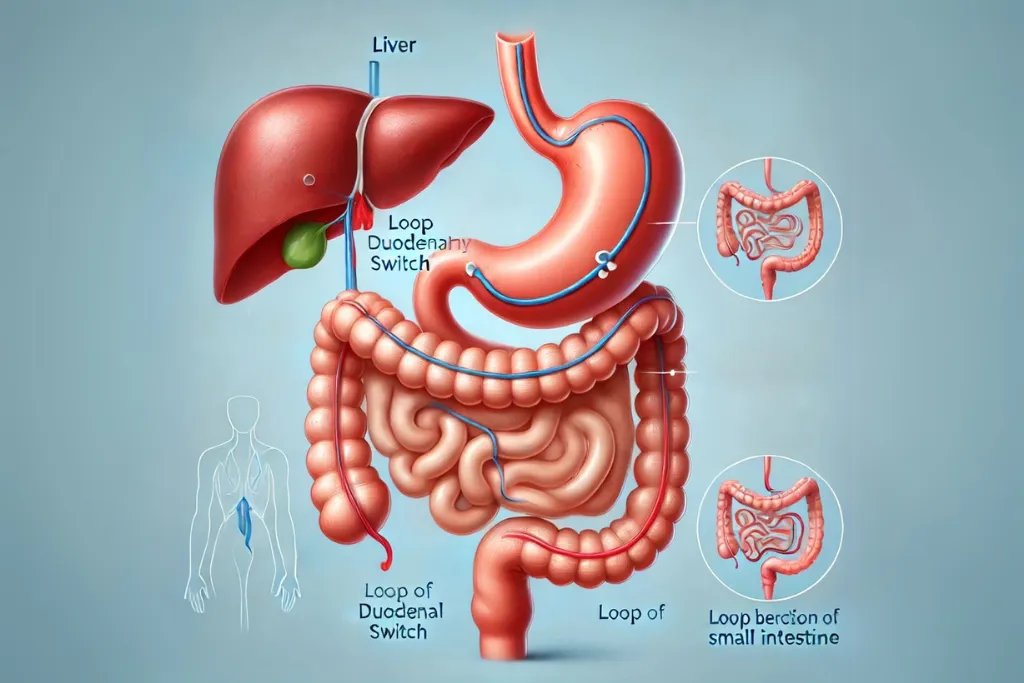
Loop Duodenal Switch is a complex procedure that causes weight loss with pancreatic diversion, sleeve gastrectomy and intestinal bypass with duodenal switch (also called duodenal switch). This approach causes reduced absorption of food as mentioned.
With this surgery, it is ensured that the stomach takes the form of a tube by removing about 60-70% of the stomach (sleeve gastrectomy). Then the lower intestine is bypassed by two-thirds or more. So that only a few cm of intestines remain, where food and digestive enzymes meet. This is the intestinal bypass part of the operation. The name Duodenal is due to the fact that in this operation the intestinal bypass begins in the duodenum.
The first part of the intestine, the duodenum, is separated and re-attached to the lower part of the intestine. Since this process causes a condition in which absorption decreases. Patients will most likely experience more frequent and looser bowel movements. Thus, patient will need to be monitored very closely for mineral and protein levels. Most patients can approximately lose between 60 to 80% of their excess weight in 2 years of period of time.
This method, which is usually applied in diabetic patients with high body mass index. Also, can be performed in a single surgery, but it is also possible to apply it gradually. At the first stage, a different surgery can be performed for bypass 6-18 months after sleeve gastrectomy is performed.
How is Loop Duodenal Switch performed?
85% of the stomach is removed and the stomach is made into a tube shape as in the stomach. This part facilitates weight loss by creating the effect that restricts food intake. Afterwards, twelve fingers are separated from the forward part to the layer at the exit of the stomach. Also, surgeon places it further back where bile-pancreas fluids are poured.
The gastric outlet is combined with the intestine at a distance of 250 cm from the small large intestinal bile. Thanks to this process, the absorption of fat and calories from foods is further reduced compared to bypass surgery. By in vitrifying the stomach, both food intake is restricted and absorption decreases as the last 250 cm of the small intestines. Thus, more effective weight loss is achieved. The valve at the exit of the stomach is not disturbed. Thus, there is no bile escape to the stomach and the stomach ulcers due to it. Since this valve is preserved, Dumping Syndrome is not seen. Along with symptoms such as low blood pressure, vomiting and fainting.
A dysfunctional piece of stomach that cannot be reached with endoscopy is not left in the body. It is very difficult to diagnose situations. Such as ulcers and cancers that may occur in the blind stomach section left in bypass surgeries. It is one of the most effective methods of treating morbidity and controlled diabetes. The transition to this surgery is crucially simple in those who gain weight in the long term after gastric surgeries.